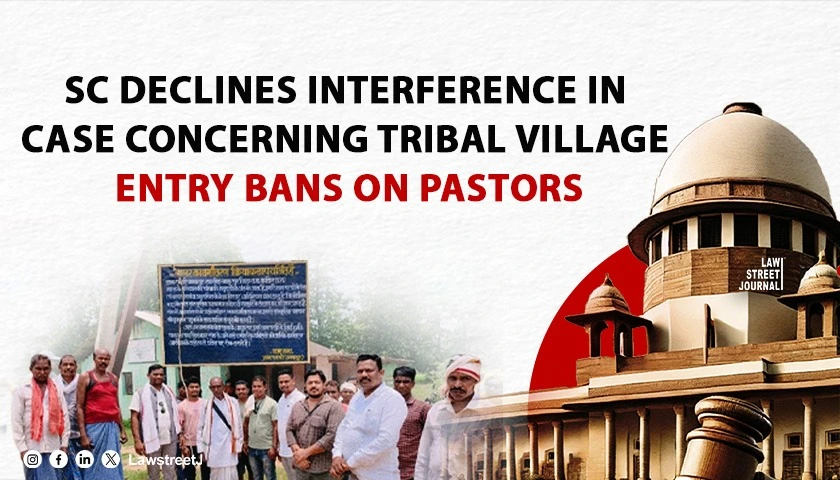
New Delhi: The Supreme Court dismissed a petition challenging an order that upheld the authority of tribal Gram Sabhas to install hoardings barring Christian pastors and converts from entering their villages.
A Bench of Justices Vikram Nath and Sandeep Mehta refused to interfere in the matter, observing that the petitioner should first exhaust the statutory remedies available under the Panchayats (Extension to Scheduled Areas) Act before seeking constitutional intervention.
The dispute originated in the Bastar region of Chhattisgarh, a Scheduled Area where several Gram Sabhas erected signboards prohibiting the entry of Christian pastors and priests. These village bodies justified the move as a measure to protect tribal customs and prevent alleged coercive religious conversions. Relying on the Panchayats (Extension to Scheduled Areas) Act, 1996, they asserted their authority to safeguard tribal traditions and social order.
In its earlier ruling, the Chhattisgarh High Court did not directly declare the bans unconstitutional but instead directed the petitioners to approach the “competent authority” under the statutory framework. The High Court noted the constitutional right to propagate religion but also expressed concern about conversions allegedly affecting social harmony in tribal areas. During the Supreme Court hearing, Justice Vikram Nath emphasized that statutory authorities are better equipped to examine factual disputes through affidavits and evidence before judicial review is invoked.
Senior Advocate Colin Gonsalves, appearing for the petitioner, argued that the High Court failed to address whether such entry bans violate fundamental rights, including freedom of movement and religion. He contended that the observations regarding inducement were unsupported by evidence and referred to reported incidents affecting Christian minorities in the region.
Solicitor General Tushar Mehta, representing the State of Chhattisgarh, maintained that new factual claims had been introduced at the Supreme Court stage and that procedural discipline required the petitioners to first approach the appropriate authority. The apex court’s refusal to intervene leaves the High Court’s directive intact.
Case Title: Digbal Tandi v. State of Chhattisgarh & Ors., Diary No. 64814 of 2025







.jpeg)