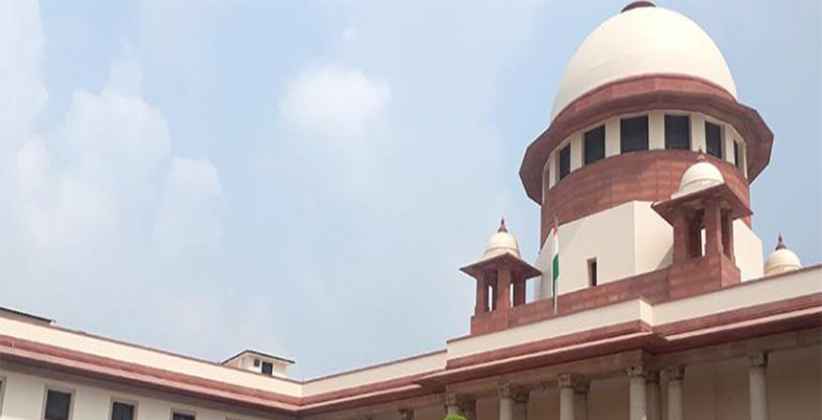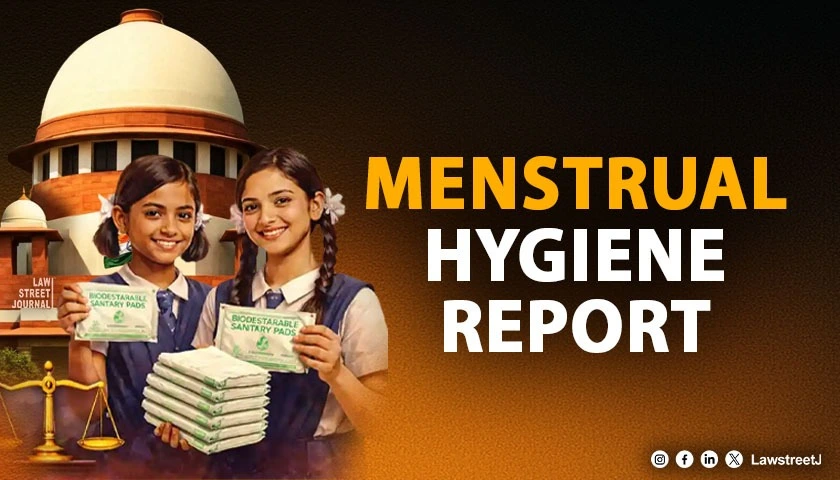
New Delhi: The Supreme Court on May 25, 2026 directed the Union government to periodically file fresh status reports every three months on compliance with its landmark January 30 judgment mandating free sanitary napkins and gender-segregated toilet facilities with adequate menstrual hygiene facilities in schools across the country, in the matter of Dr. Jaya Thakur v. Government of India. A Bench of Justices J.B. Pardiwala and R. Mahadevan urged the Centre to ensure that the benefits of the judgment reach as many girl students as possible, observing that lack of access to menstrual hygiene has a direct impact on girls’ education.
In its judgment dated January 30, 2026, the Supreme Court had held that access to menstrual hygiene measures is inseparable from the right to live with dignity under Article 21 of the Constitution. The Court had observed that the absence of menstrual hygiene facilities leads to stigma, stereotyping, and humiliation for menstruating girl students, and that girl students have a legitimate expectation to manage menstruation with privacy and dignity. The Court had accordingly directed the Union government, all States, and Union Territories to provide free sanitary pads to girl students and to ensure gender-segregated toilets with adequate menstrual hygiene facilities in schools.
The matter came up before the Bench on May 25, 2026, for the first compliance review following that judgment. Additional Solicitor General (ASG) Archana Pathak Dave appeared on behalf of the Union government and placed a summary of the compliance report on record, detailing the steps taken by the Centre and various States in the wake of the ruling.
The Bench emphasised the importance of implementation in strong terms, urging the Centre to make the most of the judgment in the interest of girl students across the country. The Court observed:
“Make the most of it. This is for the good of the women of our country, young girls, and young students. Because this will have a direct impact on education. Girls should not have to give up their education and sit at home and do some domestic work for this reason.”
The Court stated that it would continue to monitor compliance with the January 30 judgment on a three-monthly basis and directed the Centre to periodically collect the necessary data and information regarding due compliance from all States and Union Territories. The Court further directed: “The Union shall proceed further to ensure that all our directions are complied with in letter and spirit. The Union shall continue to guide all States in this regard.”
ASG Archana Pathak Dave submitted that following the pronouncement of the judgment, there has been a galvanisation of efforts by all States and Union Territories towards implementation. She informed the Bench that various inter-ministerial meetings had been held with States, Union Territories, and the Ministry of Health and Family Welfare to coordinate compliance efforts.
Justice Pardiwala enquired whether the Union was guiding States on the specific manner in which they should implement the Court’s directions. The ASG responded affirmatively and added that meaningful progress would require at least six months to assess, given the scale of implementation involved.
Another counsel appearing for an NGO raised an interlocutory application before the Court, contending that the use of the term “oxo-biodegradable sanitary napkins” in the January 30 judgment may be environmentally counterproductive. The Court took note of the submission and observed that the issue could be brought to the notice of the ASG for consideration.
The matter is next scheduled to be heard in September 2026, when the Court will take up the next compliance review. The direction to file a fresh status report every three months underscores the Court’s intent to actively supervise the nationwide implementation of its menstrual hygiene mandate, one of the first instances of the Supreme Court affirmatively holding that the right to menstrual health falls within the constitutional guarantee of the right to life under Article 21.
Case Details
Dr. Jaya Thakur v. Government of India, Supreme Court of India. Before Justices J.B. Pardiwala and R. Mahadevan. Heard on May 25, 2026. Additional Solicitor General Archana Pathak Dave appeared for the Union of India. Next date of hearing: September 2026.