

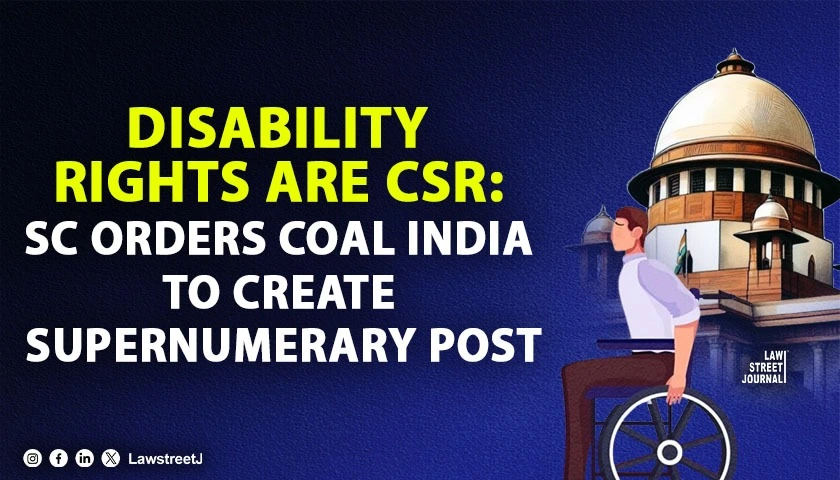
New Delhi: The Supreme Court has directed Coal India Limited to create a supernumerary post for a visually disabled candidate who was wrongly denied employment in 2019, holding that disability rights must be viewed through the prism of Corporate Social Responsibility and emphasizing the principle of reasonable accommodation as a gateway right for persons with disabilities.
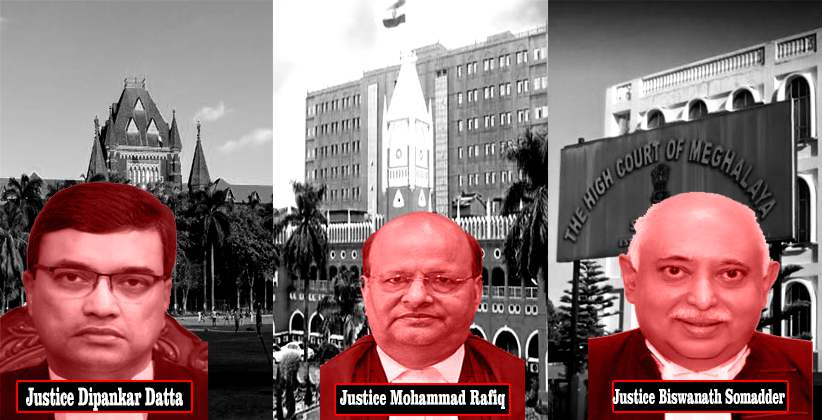
Justice J.B. Pardiwala and Justice K.V. Viswanathan delivered the judgment on January 13, 2026, setting aside the Division Bench order of the Calcutta High Court and directing that the appellant be appointed as a Management Trainee.
The Court addressed the case of Sujata Bora, who applied for the post of Management Trainee under the Visually Handicapped category pursuant to a 2019 advertisement issued by Coal India Limited. She was selected for interview but was declared unfit during the Initial Medical Examination conducted in September 2021 on the ground that she was not only suffering from visual disability but also from residuary partial hemiparesis.
A Single Judge of the Calcutta High Court quashed the IME result and permitted the appellant to participate in the ensuing recruitment process. However, the Division Bench set aside the judgment on the ground that the writ petition had been filed after the expiry of the panel.
The Supreme Court thereafter directed the All India Institute of Medical Sciences to constitute a Board of experts, including Dr. Satendra Singh, who has been working extensively on disability rights. The medical examination report dated January 1, 2026, found that the appellant suffered from 57% disability, which is above the benchmark disability of 40%.
The Bench further observed:
“We had an opportunity to interact with the appellant, and we have found her to be a lady of grit and determination. She wants to excel in her field and work hard.”
The Court extensively discussed the concept of reasonable accommodation as enshrined in the Rights of Persons with Disabilities Act, 2016. Citing Omkar Ramchandra Gond v. Union of India, the Court observed that reasonable accommodation means necessary and appropriate modifications and adjustments to ensure that persons with disabilities enjoy rights equally with others.
The Bench emphasized that reasonable accommodation should not be narrowly construed to mean only the provision of assistive devices. It observed:
“If the mandate of the law is to ensure full and effective participation of persons with disabilities in society, a broad interpretation of reasonable accommodation that furthers the objective of the RPwD Act and Article 41 of the Directive Principles of State Policy is mandated.”
Citing Om Rathod v. Director General of Health Services, the Court held that reasonable accommodation is a gateway right, observing:
“Without the gateway right of reasonable accommodation, a person with disability is forced to navigate a world that excludes them by design.”
The Bench held that reasonable accommodation is a fundamental right rooted in Part III of the Constitution and a facet of substantive equality, the denial of which amounts to discrimination.
Invoking the constitutional framework linking Fundamental Rights with the Directive Principles of State Policy, the Bench cited Minerva Mills Ltd. v. Union of India and quoted Chief Justice Y.V. Chandrachud’s observation that Parts III and IV of the Constitution are like two wheels of a chariot.
The Court also referred to Article 41 of the Constitution, which mandates effective provision for the right to work, education, and public assistance in cases of disablement.
Addressing the intersection of disability and gender justice, the Court observed:
“Here is a case of a single woman before us who has the urge to succeed notwithstanding the disability she encounters. Technicalities like the expiry of the panel cannot come in the way of doing complete justice, especially when the denial of employment in 2019 was through no fault of hers.”
Citing Jane Kaushik v. Union of India, the Bench reiterated that disability and gender often operate as compounded axes of discrimination and that addressing only one dimension may fail to achieve substantive equality.
Highlighting corporate responsibility, the Court referred to the UN Guiding Principles on Business and Human Rights and observed that business enterprises have an obligation to respect the rights of persons with disabilities.
The Bench also relied on a working paper of the ILO Global Business and Disability Network, noting that disability rights are human rights and must be respected by enterprises.
The Court held:
“Rights of persons with disabilities must be viewed through the prism of Corporate Social Responsibility. True workplace equality can be achieved only when disability rights are treated as an integral facet of CSR.”
The Court further observed that disability inclusion forms a crucial part of the “Social” component of the Environmental, Social and Governance (ESG) framework, referring to the ILO’s 2024 guide advocating disability inclusion as a strategic advantage.
Accordingly, the Supreme Court directed Coal India Limited to create a supernumerary post for the appellant and observed:
“We are sure that the Chairman of Coal India will provide a suitable position commensurate with the appellant’s abilities, including a suitable desk job with a separate computer and keyboard, in accordance with universal design under Section 2(ze) of the RPwD Act, 2016.”
The Bench requested that the appellant be posted at North Eastern Coalfields, Coal India Limited, at its office in Margherita, Tinsukia district, Assam.
The Court clarified that the directions were issued in the peculiar facts of the case, keeping in mind Articles 14, 21, and 41 of the Constitution, and in exercise of powers under Article 142.
The Court placed on record its appreciation for Mr. Vivek Narayan Sharma, counsel for Coal India Limited, for facilitating an amicable conclusion to the litigation, and expressed gratitude to the doctors and the Director of AIIMS, New Delhi.
Mr. Prashant Srikant Kinjale appeared for the appellant, while Mr. Vivek Narayan Sharma represented Coal India Limited.
Case Title: Sujata Bora v. Coal India Limited & Ors.