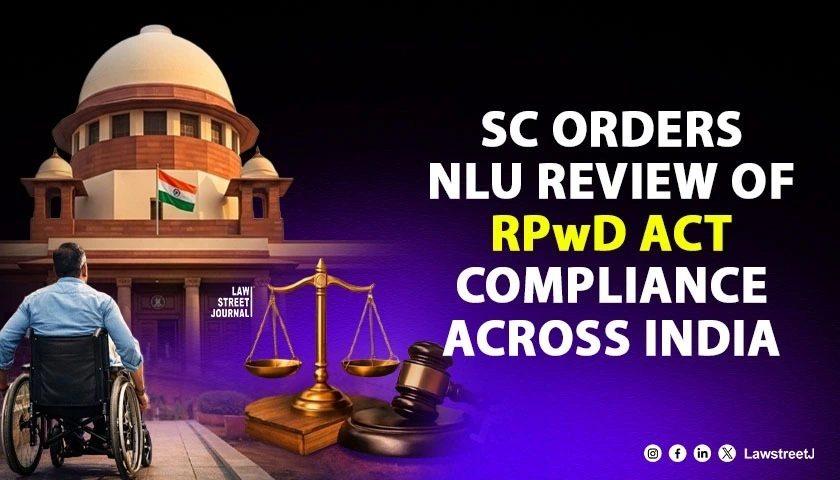
New Delhi: The Supreme Court of India has directed the National Law Universities entrusted with the exercise under Project Ability Empowerment to undertake a detailed and structured assessment of the implementation of the Rights of Persons with Disabilities Act, 2016 across all States and Union Territories, observing that nearly eight years after the coming into force of the Act, full and effective compliance remains elusive.
A Bench comprising Justice Vikram Nath and Justice Sandeep Mehta passed the order on 28.04.2026, while also granting a final opportunity to the Union Territories of Lakshadweep and Ladakh to appoint Nodal Officers on or before 15.05.2026, and endorsing the Union of India’s policy framework on the upward movement of meritorious persons with benchmark disabilities against unreserved vacancies.
The proceedings arise from Writ Petition (Civil) No. 116 of 1998 filed by the Justice Sunanda Bhandare Foundation and connected matters. By judgment and order dated 12.09.2025, the Court had issued detailed directions, including the appointment of Nodal Officers by all States and Union Territories. By order dated 15.04.2026, the Court had recorded that eleven States and seven Union Territories had failed to appoint Nodal Officers even after a lapse of seven months from the date of the judgment, expressed serious displeasure at such inaction, and granted a final opportunity to the defaulting States and Union Territories to comply before the next date of hearing, failing which the Chief Secretaries and concerned departmental Secretaries were directed to remain personally present with affidavits explaining the delay.
When the matter was taken up on 28.04.2026, Senior Counsel Mr. Colin Gonsalves, appearing for the appellant in Civil Appeal No. 11938 of 2016, submitted that the States of Chhattisgarh, Meghalaya, Manipur, Sikkim, Tripura, Mizoram, and Uttarakhand, as well as the Union Territory of Delhi, had since appointed Nodal Officers. However, the States of Kerala, Jharkhand, Odisha, Arunachal Pradesh, Madhya Pradesh, and Telangana, as well as the Union Territories of Puducherry, Lakshadweep, Ladakh, Chandigarh, and Andaman and Nicobar Islands, had still not complied.
Counsel appearing for the States of Kerala, Jharkhand, Odisha, Arunachal Pradesh, Madhya Pradesh, and Telangana, and the Union Territories of Puducherry, Chandigarh, and Andaman and Nicobar Islands, subsequently submitted that Nodal Officers had been appointed on different dates in April 2026. Consequently, only the Union Territories of Lakshadweep and Ladakh remained non-compliant. Additional Solicitor General Mr. K.M. Nataraj submitted that Advocate-on-Record Mr. Vatsal Joshi would take the necessary steps in the matter.
The Court granted a final opportunity to the Union Territories of Lakshadweep and Ladakh to appoint Nodal Officers on or before 15.05.2026, and directed the Registry to transmit a copy of the order to Mr. Vatsal Joshi for ensuring compliance.
Counsel for the Union of India submitted that a compliance affidavit in terms of paragraph 53 of the judgment dated 12.09.2025 had, in fact, been filed on 02.01.2026, and that owing to the inadvertent absence of counsel on the previous date, it had not been brought to the Court’s notice earlier.
The affidavit, filed through the Department of Personnel and Training, placed on record comprehensive instructions governing the upward movement of persons with benchmark disabilities against unreserved vacancies, with reference to Office Memoranda dated 15.01.2018, 17.05.2022, and 27.09.2022. The policy provides that a PwBD candidate selected on the basis of their own merit, without availing relaxed standards, is to be adjusted against unreserved vacancies and not against the quota reserved for PwBD candidates. Candidates who avail themselves of relaxed standards are to be adjusted against reserved vacancies.
The policy clarifies that facilitative measures such as the provision of a scribe or compensatory time do not constitute relaxation of standards, while relaxations in cut-off marks, age, number of attempts, or other eligibility criteria would amount to relaxed standards. The disability itself is not to be treated as a relaxed standard in the medical fitness test for determining own merit. The policy applies to both direct recruitment and promotions.
The Court expressed satisfaction that the Union of India had adequately addressed the query and endorsed the position, urging the Union of India as well as all States and Union Territories to scrupulously adhere to and implement the policy of upward movement in its true letter and spirit, so as to advance the constitutional mandate of equality, dignity, and inclusion for persons with disabilities.
Counsel for the petitioner in Writ Petition (Civil) No. 116 of 1998 submitted a status report indicating that despite several orders passed by the Court directing States and Union Territories to implement the RPwD Act, 2016, compliance had remained minimal. The status report traced the history of the proceedings, noting that compliance had remained inadequate even under the earlier regime of the Persons with Disabilities Act, 1995.
It recorded persistent gaps despite multiple orders fixing timelines, seeking compliance affidavits, and directing senior officials to ensure implementation. Specific deficiencies noted included the failure to establish mandatory institutional mechanisms such as State Funds for Persons with Disabilities, and inadequate implementation across key areas of the Act. The interim reports under Project Ability Empowerment were also noted as not having adequately addressed implementation.
The status report underscored that nearly eight years after the coming into force of the RPwD Act, 2016, full and effective compliance by all States and Union Territories remained elusive.
The Court observed that with almost all States and Union Territories having now appointed Nodal Officers, the implementation of the RPwD Act, 2016 could be more effectively examined by the National Law Universities under Project Ability Empowerment. It directed the NLUs to undertake a detailed and structured assessment of implementation across all States and Union Territories, involving substantive evaluation of compliance with statutory mandates, including the creation of requisite institutional mechanisms, enforcement of rights, and accessibility measures.
It further directed that Nodal Officers shall extend full cooperation to the NLUs to enable an effective and time-bound assessment.
The Court specifically directed National Law University, Delhi to undertake the exercise of mapping the extent of compliance with the RPwD Act, 2016 by the Union of India, and directed the Secretary, Department of Social Justice and Empowerment to depute an officer not below the rank of Joint Secretary to participate in meetings convened by NLU Delhi for this purpose.
A copy of the order was directed to be transmitted to the Registrar of each of the eight National Law Universities mentioned in paragraph 36 of the judgment dated 12.09.2025, as well as to the Secretary, Department of Social Justice and Empowerment and the Chief Secretaries of all States and Union Territories.
The matter was listed for receiving updated status reports from the NLUs on 22.09.2026.
Case Details
- Case Title: Justice Sunanda Bhandare Foundation v. Union of India and Others
- Case Numbers: Writ Petition (Civil) No. 116 of 1998; Civil Appeal No. 11938 of 2016; Diary No. 29329 of 2021; Diary No. 26974 of 2024
- Citation: 2026 INSC 441
- Court: Supreme Court of India
- Bench: Justice Vikram Nath and Justice Sandeep Mehta
- Date of Order: 28.04.2026
- Next Date: 22.09.2026
Appearances
- For the Appellant in Civil Appeal No. 11938 of 2016: Senior Counsel Mr. Colin Gonsalves
- For the Union of India: Additional Solicitor General Mr. K.M. Nataraj