

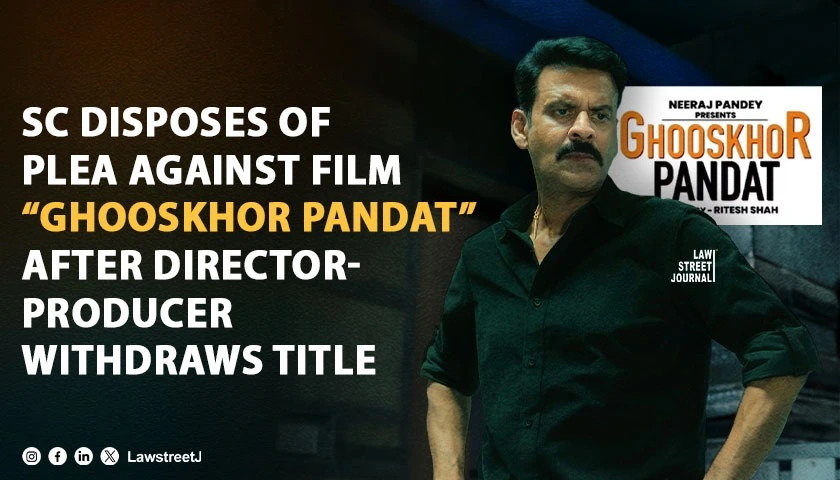
New Delhi: The Supreme Court of India has disposed of a writ petition challenging the upcoming film titled “Ghooskhor Pandat” after the director-producer of the film filed an affidavit unequivocally withdrawing the title and undertaking that any new title adopted shall not be similar to or evocative of the earlier one.
A Bench comprising Justice B.V. Nagarathna and Justice Ujjal Bhuyan disposed of the petition vide order dated February 19, 2026, while also observing that a quietus ought to be given to the controversy in all respects, whether in the form of civil or criminal proceedings or in any other form. Justice Ujjal Bhuyan additionally authored a separate concurring opinion addressing the larger constitutional questions of fraternity and freedom of speech and expression.
The writ petition was filed by Atul Mishra, claiming to be the National Organisation Secretary of Brahman Samaj of India, as a public interest litigation under Article 32 of the Constitution. The petitioner was aggrieved by the film’s title, contending that equating “Pandat”, a caste within Hindu society, with “Ghooskhor”, meaning bribe-taker, created offensive stereotyping against an identifiable community and violated their right to dignity under Article 21.
The petitioner sought restraint on the release, screening or broadcasting of the film, a direction to the Central Board of Film Certification to re-examine the content of the film in accordance with constitutional principles and statutory guidelines, and a stay on the film’s public exhibition.
During the preliminary hearing on February 12, 2026, the Bench had expressed serious concern over the attempt to portray any particular community in a negative manner, observing that the constitutional objective of fraternity is paramount and that freedom of speech and expression is not absolute and is subject to reasonable restrictions. It was also brought to the Court’s notice that a similar writ petition had been filed before the Delhi High Court, where the respondent had stated that the producer had taken a conscious decision to change the title, on the basis of which the High Court disposed of the petition on February 10, 2026.
In response to the Supreme Court’s notice, the director-producer filed an affidavit stating that neither he nor his production house had any deliberate or malicious intention of outraging the religious feelings of any class of citizens; that the film was a fictional police drama revolving around a criminal investigation and did not portray any caste, religion or community as corrupt; and that the promotional materials had been withdrawn on February 6, 2026, in view of concerns received from members of the public.
Paragraph 5 of the affidavit, which the Court took on record, contained an unequivocal withdrawal of the title “Ghooskhor Pandat” and an undertaking that any new title adopted shall not be similar to or evocative of the earlier title and shall accurately reflect the narrative and intent of the film without giving rise to unintended interpretations. The Court, finding that the respondent had positively addressed the grievances ventilated by the petitioner and that the cause no longer survived, disposed of the writ petition accordingly.
Justice Ujjal Bhuyan, in his separate opinion, addressed what he described as two fundamental questions involved in the case: fraternity and free speech. On the question of fraternity, the Judge referred extensively to the constitutional Preamble and Article 51A(e), which casts a duty on every citizen to promote harmony and the spirit of common brotherhood transcending religious, linguistic, regional or sectional diversities.
He also referred to the views of Dr. B.R. Ambedkar, who had bracketed fraternity with liberty and equality as the bedrock of democracy. Referring to the recent Constitution Bench decision in In Re: Citizenship Act, 1955, Section 6A, Justice Bhuyan noted that the Court had held that fraternity, as articulated in the Preamble, embodies a sense of collective brotherhood among all Indians and serves as a critical element for national unity and social cohesion. He further noted that Dr. Ambedkar’s introduction of the term fraternity into the constitutional Preamble reflected his persistent efforts towards eradicating caste discrimination and advocating unity and brotherhood.
On the basis of these principles, Justice Bhuyan stated:
“It is therefore constitutionally impermissible for anybody, be it the State or non-State actors, through any medium, such as speeches, memes, cartoons, visual arts, etc., to vilify and denigrate any community. It would be violative of the Constitution to target any particular community on the basis of religion, language, caste or region, by whosoever he or she may be. This is particularly true for public figures occupying high constitutional office who have taken the solemn oath to uphold the Constitution.”
On the question of freedom of speech and expression, he traced the settled legal position through a line of Supreme Court decisions. He referred to S. Rangarajan v. P. Jagjivan Ram, where a three-Judge Bench declared that freedom of expression which is legitimate and constitutionally protected cannot be held to ransom by an intolerant group of people; that restrictions must be justified on the anvil of necessity and not the quicksand of convenience or expediency; and that freedom of expression cannot be suppressed on account of threats of demonstration and violence.
Justice Bhuyan also quoted with approval the standard laid down by the Nagpur High Court in Bhagwati Charan Shukla v. Provincial Government and affirmed by the Supreme Court in the Tamas case:
“The effect of the words must be judged from the standards of reasonable, strong-minded, firm and courageous men, and not those of weak and vacillating minds, nor of those who scent danger in every hostile point of view.”
Justice Bhuyan further referred extensively to Indibily Creative Pvt. Ltd. v. Government of West Bengal, where the Court expressed concern over growing intolerance in recent times and observed:
“Contemporary events reveal that there is a growing intolerance… If the right of the playwright, artist, musician or actor were to be subjected to popular notions of what is or is not acceptable, the right itself and its guarantee under the Constitution would be rendered illusory. The true purpose of art, as manifest in its myriad forms, is to question and provoke.”
He also quoted from the recent decision in Imran Pratapgadhi v. State of Gujarat, of which he was himself a member, where the Court declared:
“Free expression of thoughts and views… is an integral part of a healthy, civilised society… Even if a large number of persons dislike the views expressed by another, the right of the person to express those views must be respected and protected.”
Justice Bhuyan reiterated the constitutional duty of courts to protect free speech, stating:
“Courts, particularly the Constitutional Courts, must be at the forefront to zealously protect the fundamental rights of the citizens… The Courts must not be seen to regulate or stifle the freedom of speech and expression.”
Concluding his separate opinion, Justice Bhuyan observed that these principles would equally apply to the title of a movie and stated that he felt it necessary to restate these first principles “lest there remain any lingering misconception.”
Case Title: Atul Mishra v. Union of India & Others