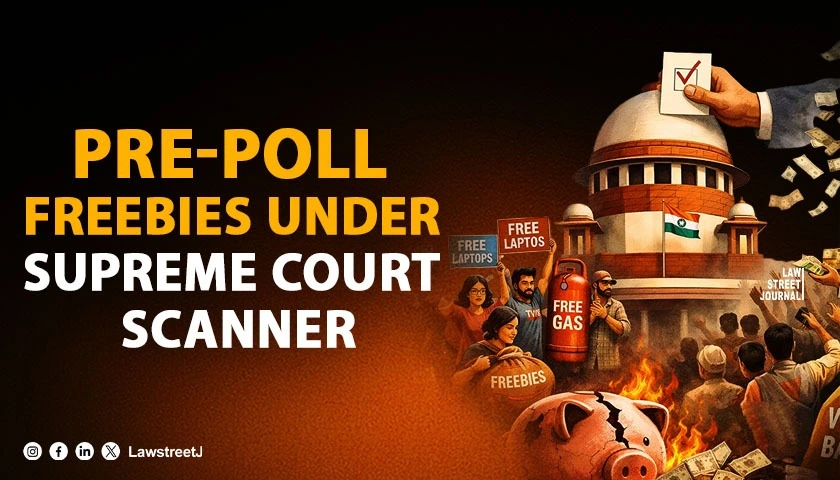
New Delhi: The Supreme Court of India has issued a comprehensive and stern critique of the growing trend among political parties to announce populist “freebies” and cash transfer schemes immediately preceding elections.
During a significant hearing on February 19, 2026, a three-judge Bench led by Chief Justice of India (CJI) Surya Kant, and comprising Justices Joymalya Bagchi and Vipul M. Pancholi, observed that such practices are not only fiscally unsustainable but are also actively hampering the long-term economic development and nation-building of the country.
The Court characterised the indiscriminate distribution of state largesse as a policy of “appeasement” rather than genuine public welfare, particularly when no distinction is made between the affluent and the marginalised.
The Court was hearing a writ petition filed by the Tamil Nadu Power Distribution Company Ltd, which challenged Rule 23 of the Electricity Amendment Rules, 2024. This specific rule mandates that electricity tariffs must be “cost-reflective,” ensuring that there is no revenue gap between the approved annual requirement and the estimated revenue, except in cases of natural calamities. The Tamil Nadu entity argued that implementing such a rule would result in an “exponential tariff shock” for consumers and place an unsustainable burden on the State’s public exchequer.
However, the Bench also made observations on the broader pan-India implications of pre-election subsidies, questioning whether it is in the public interest for states to absorb massive costs regardless of a consumer’s ability to pay.
A central concern expressed by the Bench was the failure of many state governments to differentiate between those who genuinely need assistance and those who are financially stable. CJI Kant emphasised that while it is a fundamental duty of the State to provide relief to the marginalised—such as children who cannot afford basic education or medical training—providing free services to the affluent amounts to a misuse of taxpayer funds.
The Court questioned why freebies should be distributed to “all and sundry” and remarked that it is “high time” for states to revisit these policy frameworks to ensure that limited resources are not diverted from essential infrastructure to those who can afford to pay for their utilities.
The Court further scrutinised the fiscal health of various states, noting that most are currently running revenue deficits while continuing to offer significant pre-election handouts. The Bench expressed deep “disturbance” over the fact that states often find themselves without “a single penny left for development” because their collected tax revenue is exhausted by salaries and election-eve distributions.
CJI Kant questioned the source of these funds, reminding state governments that they are spending money collected from other taxpayers who expect their contributions to be used for public infrastructure such as roads, hospitals, schools, and medical colleges. The Bench suggested that states should ideally dedicate at least 25 per cent of their revenue strictly towards development purposes rather than non-planned populist expenditure.
Beyond fiscal concerns, the Supreme Court raised alarms regarding the long-term impact of direct cash transfer schemes and universal subsidies on the nation’s work ethic and dignity. The Court also questioned whether providing free food, gas, electricity, and cash transfers “on a platter” would eventually discourage citizens from seeking employment and contributing to the economy.
CJI Kant pointedly asked, “From where are they going to learn to work when they know everything will be given to them from one platform? Is this the nation-building we are doing?” This sentiment follows earlier observations from 2025, where the Court had warned against the potential creation of a “class of parasites” who might become unwilling to work due to the lure of free rations and cash handouts.
Justice Joymalya Bagchi further highlighted the need to distinguish between planned and unplanned expenditure in state budgets. He noted that if a state considers a subsidy part of its welfare policy or constitutional commitment, it should be included in the budgetary proposals with a clear justification for the outlay.
Additionally, the Court remarked that “sudden” or “last-minute” announcements of largesse near elections create arbitrariness in fiscal administration and disrupt the regulatory processes of statutory bodies such as electricity commissions. The Court also observed that individuals capable of paying for a service should do so as a general principle, allowing the State to recover costs and channel resources towards sustainable development.
In its concluding remarks, the Court called upon “political stalwarts, leaders, parties, and social engineers” to revisit existing policy strategies to strike a balance between welfare measures and long-term national growth.
The Bench reiterated that while the design and implementation of welfare schemes fall within the domain of political wisdom, the current trend of indiscriminate largesse threatens the overall development of the nation.
The Supreme Court has issued notice to the Union Government and agreed to further examine the petition challenging the Electricity Amendment Rules.
Case Title: Tamil Nadu Power Distribution Corporation Limited v. Union of India | W.P.(C) No. 158/2026