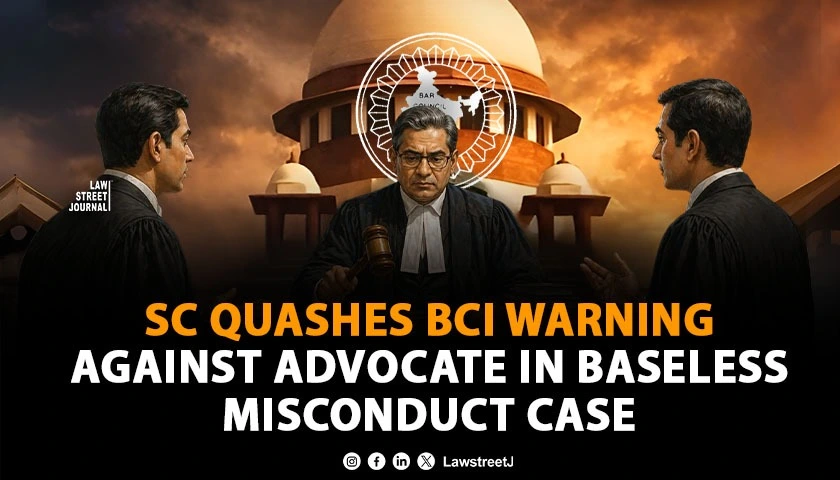
New Delhi: The Supreme Court on May 5, 2026 allowed an appeal filed by an advocate against whom the Bar Council of India’s disciplinary committee had issued a warning despite concurrently finding no merit in the misconduct complaint filed against him, holding that issuing such a warning without any justification was wholly unwarranted.
A bench comprising Justice Vikram Nath, Justice Sandeep Mehta, and Justice Vijay Bishnoi quashed and struck off the warning observations recorded by the Bar Council of India’s disciplinary committee against the appellant-advocate, Prem Pal Singh, who is enrolled with the Bar Council of Uttar Pradesh and practices at the Moradabad courts.
The complaint had been filed under Section 35 of the Advocates Act, 1961 before the State Bar Council of Uttar Pradesh by the complainant, who was the brother-in-law of the appellant-advocate. The complainant, serving as an Inspector in the GST Department, was embroiled in matrimonial disputes with his wife, who is the sister of the appellant-advocate. Multiple litigations arising out of the matrimonial discord were pending before various courts.
The crux of the complaint was that the appellant-advocate had abused and threatened to kill the complainant during an incident alleged to have taken place on March 18, 2021.
After adjudicating the complaint, the State Bar Council found it to be false and motivated, filed with mala fide intent to harass the appellant-advocate for oblique purposes. Consequently, the complaint was rejected, and costs of Rs. 25,000 were imposed on the complainant.
Aggrieved by the decision, the complainant preferred an appeal before the disciplinary committee of the Bar Council of India. By its order dated March 13, 2024, the committee affirmed the finding of the State Bar Council that there was no cogent evidence to proceed against the appellant-advocate under Section 35 of the Advocates Act.
However, while waiving the costs of Rs. 25,000 imposed by the State Bar Council, the disciplinary committee of the Bar Council of India additionally proceeded to issue a warning to the appellant-advocate, directing him not to indulge in any unwarranted conduct involving threats or intimidation toward the complainant whenever he appeared before courts in connection with the pending litigations.
The appellant-advocate thereafter approached the Supreme Court under Section 38 of the Advocates Act, 1961 challenging both the warning observations and the waiver of costs.
The Supreme Court held that despite both the State Bar Council and the Bar Council of India finding no merit in the complaint and affirming that it had been filed for oblique motives and to wreak vengeance against the appellant-advocate, the disciplinary committee of the Bar Council of India had “without any justification whatsoever proceeded to issue a warning.”
The Court further noted that the complainant had accepted the concurrent findings that the complaint was frivolous and motivated, having not challenged those findings before any competent forum.
The Court also held that the Bar Council of India had set aside the costs of Rs. 25,000 imposed by the State Bar Council without assigning any justifiable reasons. Finding merit in the appeal, the Court quashed and struck off the warning observations recorded against the appellant-advocate.
Case Details: Prem Pal Singh v. Disciplinary Committee of the Bar Council of India and Others, Civil Appeal No. 12368 of 2025, Supreme Court of India. Before Justice Vikram Nath, Justice Sandeep Mehta, and Justice Vijay Bishnoi. Order dated May 5, 2026.