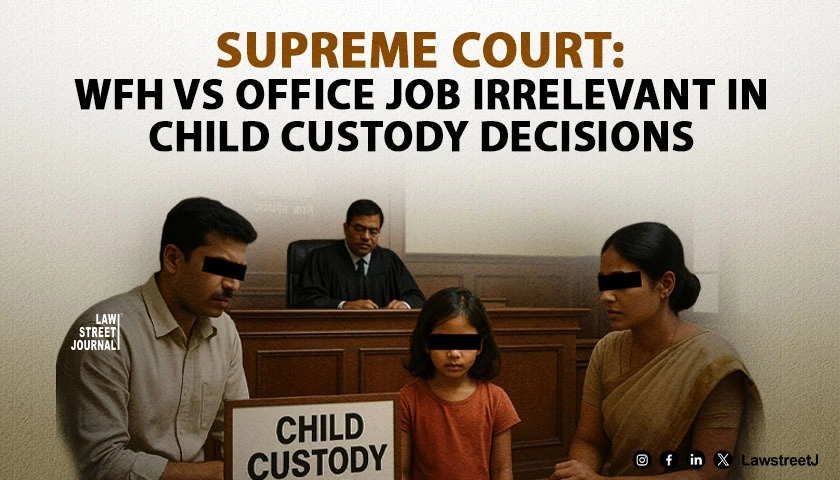
New Delhi: The Supreme Court has held that a parent working from home versus one working from an office cannot be a determining factor in deciding child custody. The Court ruled that both working parents face similar challenges in balancing careers and childcare, and that employment arrangements should not create presumptions about superior caregiving capacity.
A Division Bench comprising Justice Manoj Misra and Justice Ujjal Bhuyan, in an order dated November 25, 2025, dismissed the mother’s appeal challenging a Punjab and Haryana High Court order dated July 1, 2024, which had granted custody of the couple’s minor son to his father.
The case arose from Criminal Revision No. 2069/2022, where the High Court had set aside trial court orders dated July 30, 2022, and September 23, 2022, which had granted custody of the minor son to his mother, while leaving it open for the parties to pursue custody proceedings under relevant statutes before the Family Court.
Advocate Preeti Singh, representing the appellant mother, challenged specific observations in the High Court’s judgment—particularly paragraph 38(i), which recorded that the father, employed with Oracle, was working from home while the mother, serving as Associate Manager at Virtusa Gurugram, had long working hours requiring office attendance. Counsel argued that this created an erroneous impression that the parent working from home could provide better care.
The appellant also contested the High Court’s reliance on the distance between Heritage School at Vasant Kunj and the respective residences, arguing that the distances were nearly equal. She further emphasized the counsellor’s report, which recorded the minor son’s strong desire to remain with his sister, who lived with the mother—suggesting that siblings should ideally be kept together.
The appellant additionally challenged the High Court’s criticism of her travelling abroad during the peak COVID-19 period, arguing that she was fully vaccinated and that the travel was job-related, not indicative of irresponsible conduct warranting an adverse inference in custody determination.
Advocate Tina Garg, representing the respondent father, supported the High Court’s view and sought discharge of visitation rights granted through the Supreme Court’s earlier order dated May 3, 2024, which allowed the mother custody from Saturday 12 noon to Sunday 6 PM. She argued that shifting the child between homes disturbed his psyche and hindered his overall development.
The Supreme Court had earlier passed a detailed order on August 21, 2025, after interacting with both children, noting that they “desperately wanted to be in the company of each other though they did not want to separate from their respective parents.” The Court stayed all inter se proceedings for three months to allow reconciliation efforts, directing the parents to meet their children more often and to plan holidays, dinners, or outings together.q4
However, when the matter was taken up again on November 25, 2025, the Court was informed that reconciliation had failed, with the mother proposing divorce by mutual consent—an option rejected by the father.
On the work-from-home issue, the Supreme Court categorically held:
“It is not in dispute that both parents are working parents and, therefore, it is expected that they cannot always be physically with their children. But this cannot be a ground to place the custody of the child with the one who may be temporarily working from home.”
The bench further observed the economic realities of modern families:
“It is a matter of common knowledge that to meet individual as well as family aspirations, married couples have to work to build a proper home and, most importantly, to secure better education for their ward, which is getting costlier day by day.”
The Court concluded:
“We, therefore, do not subscribe to the view that if one parent is working from home and the other is not, the child’s interest would be better served by placing him with the parent who does not go to office for work.”
Similarly, addressing the distance-from-school argument, the Court held:
“Distance from home to school is not a relevant consideration, particularly when both sides reside in the National Capital Region and the child is required to travel some distance for better education. Moreover, it hardly matters whether travel time is a few minutes less or more.”
On the COVID-19 travel criticism, the bench remarked:
“The view taken by the High Court that the mother exhibited irresponsible conduct by travelling abroad during the COVID-19 period may not be a relevant consideration, particularly when, according to her claim, she was duly vaccinated and such travel was required for her job.”
The Court added that vacations play an important role in maintaining a healthy state of mind, and therefore no adverse inference could have been drawn.
Despite agreeing with the mother’s objections on these considerations, the Supreme Court declined to interfere with the custody arrangement based on overriding factors. The bench noted that the child, now above five years of age, was not willing to separate from his father, continued studying in the same school without disruption, and lived with elder family members—including his grandfather—who provided companionship.
The Court stated:
“Though we may find that the aforesaid aspects ought not to have weighed with the High Court while determining the custody issue, we should not be oblivious of the fact that [the child] is a male child aged above five years.”
It further noted:
“From our interactions with [the child] we noticed that he was not willing to part company with his father.”
Accordingly, the Supreme Court upheld the father’s custody while preserving the mother’s visitation rights as earlier granted. The Court clarified that the High Court had not closed the custody issue but had left it open for the appellant to seek custody before the appropriate forum under relevant statutes.
The father’s application seeking discharge of visitation rights was also rejected, ensuring the mother’s continued access to her son from Saturday noon to Sunday evening.
Case Title: PW (Appellant) vs. AW & Ors. (Respondents)