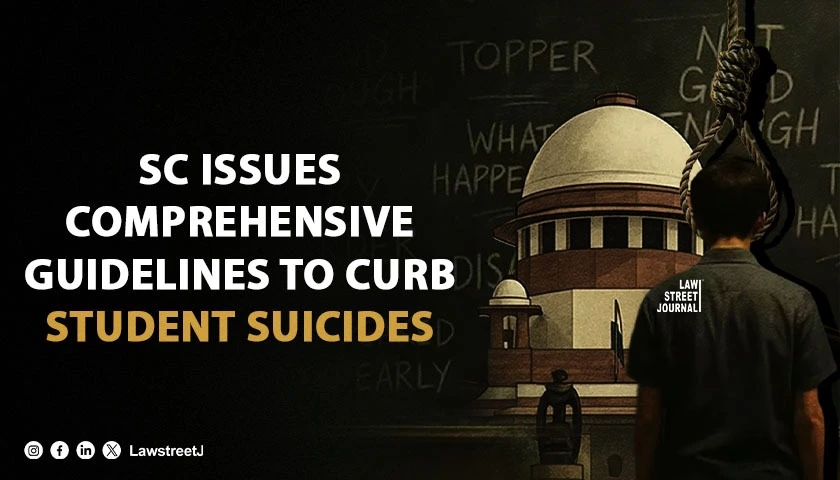
New Delhi: The Supreme Court has issued extensive directions by invoking its powers under Article 142 to address the alarming rise in student suicides across higher educational institutions, holding that structural inequalities, academic pressure, inadequate mental health support, and financial stress collectively create an “iceberg of student distress” requiring urgent systemic reforms.
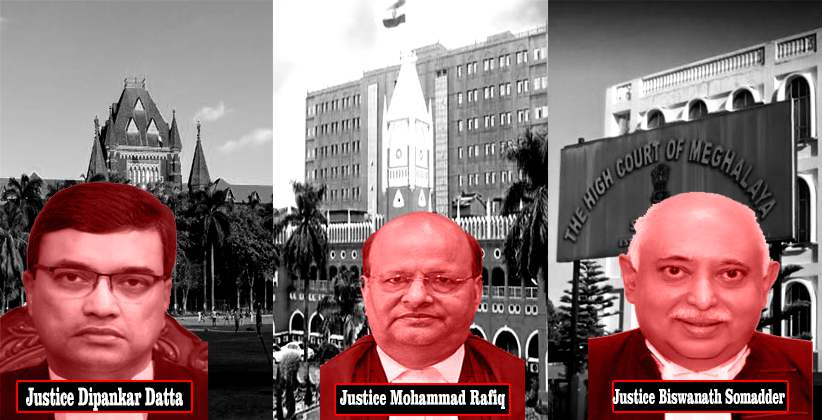
Justice J.B. Pardiwala and Justice R. Mahadevan were considering a criminal appeal in which the Court had earlier constituted a National Task Force (NTF) to examine the underlying causes contributing to student distress and to formulate comprehensive strategies for ensuring mental well-being in Higher Educational Institutions (HEIs).
At the outset, the Court acknowledged the gravity of the crisis, stating, “Before giving a broad overview of the interim report prepared by the NTF, we are deeply saddened to acknowledge that we have come across several more incidents of student suicides which have been reported to have occurred in educational institutions across the country.”
The Court highlighted alarming statistics from NCRB data, noting, “According to NCRB data for the year 2022, the total number of student suicides stood at an alarming 13,000 cases.” The Bench observed that “the youth of this country are increasingly becoming more vulnerable to suicides than the overall population.”
Analysing Sample Registration System data, the Court found that “in the 15–29 age group, suicides are either the second highest cause of death in the case of men or the highest cause of death in the case of women, with medical reasons falling far behind.” The Court emphasised that “the suicide rate in India is far ahead of global rates pertaining to this age group.”
The National Task Force conducted comprehensive research, including tailored surveys from five stakeholder groups—students, faculty, parents, mental health service providers, and HEIs—along with 30 meetings at 19 institutional sites spanning different States, institutions, and disciplines.
Identifying systemic problems, the Court observed, “The ‘massification’ and ‘privatisation’ of the higher education system in India has brought in unprecedented levels of student enrolment.” However, the Court cautioned, “This growth has brought with it substantial challenges and unprecedented pressure on academic standards. The purely quantitative expansion, without any adequate institutional support framework, has left students vulnerable.”
On structural inequalities, the Court held that affirmative action cannot stop at merely ensuring entry into higher education. It must also reflect in the creation of adequate support systems that ameliorate, rather than exacerbate, existing inequities.
The Court found that Equal Opportunity Cells and Internal Complaints Committees “either only exist on paper or not at all; even when they exist in actuality, they are merely tokenistic.” More disturbingly, the Court noted, “Though these bodies may exist in several institutions, they lack independence and often work to favour the perpetrators or aggressors rather than the students for whom they were created.”
On ragging, the Court observed, “The menace of ragging still seems to persist within several HEIs, with the same being normalised and touted as a ‘bonding exercise’ or a ‘friendly ice-breaking effort.’”
On mental health services, the Court found that “around 65% of the institutes surveyed currently do not provide access to any Mental Health Service Providers (MHSPs)” and that “the lack of presence of any full-time MHSPs was indicated in 73% of the surveyed HEIs.”
The Court identified a critical implementation gap, stating, “Policies and measures to ensure student well-being in India do exist to a very large extent, but they are scattered across several individual documents, and therefore, their implementation and accountability for non-compliance slip through the cracks.”
Exercising its powers under Article 142, the Court issued nine specific directions, including:
First, mandating central maintenance of Sample Registration System data on suicides in the 15–29 age group for accurate estimates.
Second, directing the NCRB to distinguish between school-going students and higher education students in its categorisation of student suicides.
Third, requiring that “all HEIs must report any incident of suicide or unnatural death of a student, regardless of the location of its occurrence (i.e., on campus, hostels, PG accommodations, or otherwise outside the institutional premises), to the police authorities no sooner than they come to know about the incident.”
Fourth, mandating annual reporting to the UGC and relevant regulatory bodies, including AICTE, NMC, DCI, and BCI, of student suicides or unnatural deaths.
Fifth, requiring every residential HEI to have “access to qualified medical help round the clock—if not on campus, then within a one-kilometre radius.”
Sixth, directing that “all vacant faculty positions (both teaching and non-teaching) be filled within a period of four months, with priority given to posts reserved for candidates from marginalised and underrepresented communities.”
Seventh, requiring the appointment of Vice-Chancellors, Registrars, and key administrative positions within four months, with future vacancies to be filled within one month.
Eighth, mandating that “the backlog of any and all pending scholarship disbursements must be cleared within a period of four months.” The Court strictly directed, “No student should be prevented from appearing in an examination, removed from hostels, barred from attending classes, or have their marksheets and degrees withheld because of delays in the disbursal of scholarships.”
Ninth, putting all HEIs “on strict notice to remain fully compliant with all regulations that have a binding effect on them,” including regulations on ragging, equity promotion, sexual harassment, and student grievances.
The Court also directed the NTF to create model Standard Operating Procedures for periodic “well-being audits,” faculty sensitisation and training, and campus mental health services. These SOPs are to address the composition of audit bodies, evaluation parameters, compliance mechanisms, scoring systems, and NAAC grading integration.
The Court further requested the NTF to develop a comprehensive “Universal Design Framework” or “Suicide Prevention and Postvention Protocol” consolidating all measures into a single cohesive guiding document.
Expressing disappointment, the Court observed, “We are deeply disappointed with the apathetic attitude of most HEIs, which serves as a reminder of the deep-rooted complexities and formidable barriers that hinder the implementation of any national-level initiative aimed at strengthening student mental health support systems.”
The Court directed the Union and State Governments to ensure that its directions are communicated to all HEIs immediately and that appropriate action is taken.
Expressing gratitude, the Court stated, “We wish to record and express our deepest gratitude towards the Chairperson and all the members of the NTF for the resolute devotion with which they have been working to address the issue of student suicides in HEIs.”
Case Title: Amit Kumar & Ors. v. Union of India & Ors.