


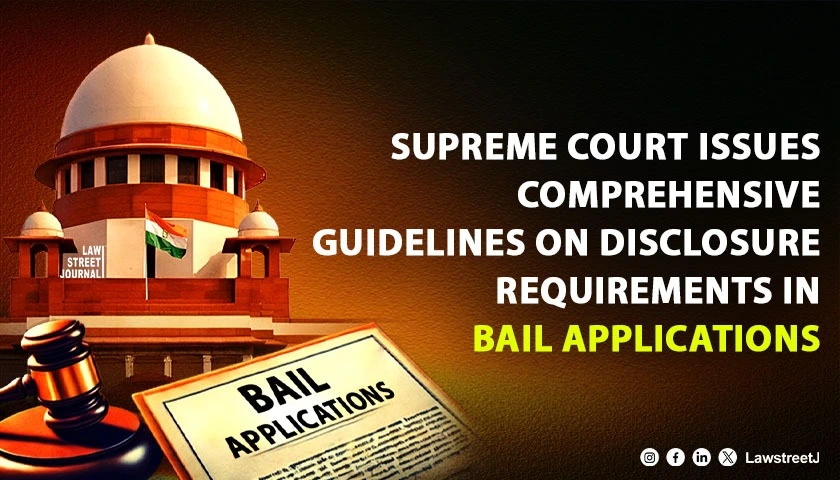
New Delhi: The Supreme Court has set aside a bail order granted by the Allahabad High Court while issuing detailed guidelines mandating full disclosure of material facts in bail applications across all courts in the country. The judgment addresses the growing concern of accused persons securing bail by suppressing criminal antecedents and other relevant information.
A Division Bench comprising Justice Ahsanuddin Amanullah and Justice R. Mahadevan delivered the judgment on February 11, 2026, in a case involving allegations of operating a large-scale racket for fabricating and circulating forged law degrees. The Court observed that the bail order was manifestly perverse and vitiated by non-application of mind, as the High Court had relied on documents whose genuineness formed the very subject matter of criminal prosecution.
The case arose from FIR No. 314 of 2024 registered on August 23, 2024, alleging an organised scam involving the fabrication of forged legal qualifications and academic certificates. The accused allegedly procured a forged LL.B. degree purportedly issued by Sarvodaya Group of Institutions, claimed to be affiliated with Veer Bahadur Singh Purvanchal University, Jaunpur. He allegedly used these credentials to falsely project himself as an advocate and appear before courts.
Verification by the University confirmed that Sarvodaya Group of Institutions was not affiliated with it and that the marksheet was never issued by the University. Sarvodaya Vidyapeeth Mahavidyalaya also clarified that it does not offer any law course. Despite this, the accused obtained bail from the High Court on July 30, 2025.
The Supreme Court noted that the accused deliberately concealed the existence of nine FIRs registered against him involving serious offences including forgery, cheating, sexual harassment, criminal intimidation, theft, and trespass. After registration of the present FIR, four additional FIRs were lodged against him by different universities across Maharashtra and Karnataka for similar offences relating to forged academic degrees.
Significantly, the State Bar Council of Maharashtra and Goa removed the accused’s enrolment and debarred him from practice after notice was issued by the Supreme Court. The Bombay High Court also made scathing observations against the accused, noting his deliberate non-compliance with judicial orders and describing him as a person of criminal turpitude with no respect for the rule of law.
The Court extensively discussed legal principles governing the annulment of bail orders. Citing precedents including State of Karnataka v. Sri Darshan, Salil Mahajan v. Avinash Kumar, and Manik Madhukar Sarve v. Vitthal Damuji Meher, the Bench emphasised that while personal liberty is a cherished constitutional value, bail orders are liable to interference when they are perverse, illegal, founded on irrelevant considerations, or ignore material factors.
The Court distinguished between appeals against the grant of bail and applications for cancellation based on post-bail conduct. In appeals against bail, the superior court examines the legality and correctness of the bail order itself at the time it was passed, without reference to subsequent conduct. Where bail orders suffer from non-application of mind, reliance on disputed material, suppression of facts, or disregard of legal principles, annulment is warranted.
Referring to Ash Mohammad v. Shiv Raj Singh and Neeru Yadav v. State of Uttar Pradesh, the Court held that criminal antecedents constitute a significant factor in bail decisions and cannot be ignored, particularly where allegations have grave societal impact. The Court noted that suppression of criminal history materially influenced the High Court’s decision, vitiating the bail order.
The Court declined the prayer for transfer of investigation to a special agency, noting that the investigation had been completed and the chargesheet filed. Citing Disha v. State of Gujarat and K.V. Rajendran v. Superintendent of Police, the Bench held that transfer of investigation after the filing of a chargesheet can be directed only in exceptional circumstances demonstrating bias, mala fides, or abuse of power, which were not established in this case.
Addressing the larger issue of disclosure in bail applications, the Court observed that suppression of material facts amounts to fraud on the court and abuse of process. Referring extensively to Kusha Duruka v. State of Odisha, the Bench noted that bail applications are examined at multiple stages on incomplete records, and non-disclosure of material aspects may result in the unwarranted grant or denial of bail.
The Court held that every petitioner or applicant seeking bail, at any stage of proceedings, is under an obligation to disclose all material particulars, including criminal antecedents and the existence of any coercive processes such as the issuance of non-bailable warrants, declaration as a proclaimed offender, or similar proceedings, duly supported by an affidavit, so as to promote uniformity, transparency, and integrity in bail adjudication.
In the interest of justice, the Court provided an illustrative disclosure framework, which is purely recommendatory in nature. The framework includes:
- Case Details – FIR Number & Date, Police Station, District and State, Sections invoked, maximum punishment prescribed;
- Custody & Procedural Compliance – Date of arrest, total period of custody undergone;
- Status of Trial – Stage of proceedings (Investigation/Chargesheet/Cognizance/Framing of charges/Trial), total number of witnesses cited in the chargesheet, number of prosecution witnesses examined;
- Criminal Antecedents – FIR No. & Police Station, Sections, Status (Pending/Acquitted/Convicted);
- Previous Bail Applications – Court, Case No., outcome of case;
- Coercive Processes – Whether any non-bailable warrant was issued, whether declared a proclaimed offender.
The Registrar (Judicial) of the Supreme Court was directed to circulate the judgment to all High Courts for examination of the feasibility of issuing appropriate administrative directions or incorporating suitable provisions in their respective Rules. The judgment shall also be circulated to the District Judiciary for guidance.
Setting aside the High Court’s order, the Supreme Court cancelled the bail and directed the accused to surrender within two weeks, failing which the trial court shall take steps to secure custody. The trial court was directed to proceed expeditiously with the trial.
Case Title: Zeba Khan v. State of U.P. & Others, Criminal Appeal No. 825 of 2026





Shreevardhan Dhoot Feb 12, 2026
Hi Can you please include the names of the advocates who appeared: 1. Mr. Shreevardhan Dhoot 2. Mr. Alabhya Dhamija 3. Mr. Amrit Rathi 4. Mr. Arjun Aggarwal Please check the order dated 11.02.2026 passed in SLP (Crl) No. 12669 of 2025 titled “Zeba Lhan v. state of UP