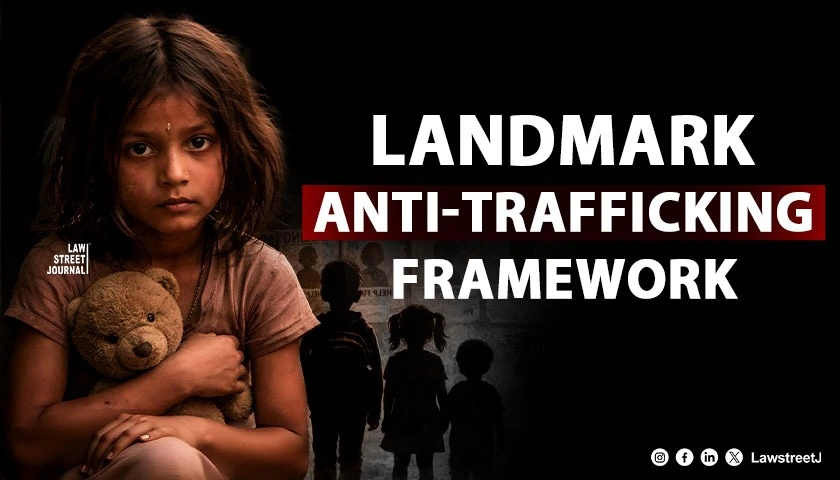
In a landmark judgment delivered on May 29, 2026, the Supreme Court laid down an exhaustive legal framework to combat human trafficking for commercial sexual exploitation and ensure the dignified rehabilitation of survivors across India [Prajwala v. Union of India, MA 530/2022 in W.P.(C) No. 56/2004].
Invoking its powers under Articles 32 and 142 of the Constitution, a Bench of Justice J.B. Pardiwala and Justice R. Mahadevan issued a detailed set of binding directions constituting a nationwide “Victim Protection Plan” covering rescue operations, victim identification, rehabilitation, prosecution mechanisms and institutional coordination.
“It took a pretty long time to prepare this judgment, but we are sure you won’t have to refer to any books henceforth on the subject. This will remain very close to our hearts because it will go a long way in protecting vulnerable young girls and women,” Justice Pardiwala observed at the time of pronouncement.
Background
The proceedings originated from a public interest litigation filed in 2004 concerning the alarming rise of human trafficking and commercial sexual exploitation of women and children across India. Over the years, the matter evolved into a continuing mandamus before the Supreme Court, with the Court monitoring rescue protocols, rehabilitation measures, institutional conditions and gaps in anti-trafficking enforcement across multiple states.
During the pendency of the case, the Court received extensive assistance from amicus curiae, women’s rights organisations, child protection bodies, legal services authorities and government agencies. Several reports highlighted systemic failures in victim identification, poor conditions in shelter homes, re-trafficking of rescued victims, lack of coordination among authorities and the absence of a uniform national rehabilitation framework.
The litigation also exposed persistent concerns regarding the manner in which police authorities often treated trafficked persons and adult sex workers interchangeably, resulting in arbitrary detention, wrongful institutionalisation and inadequate focus on organised trafficking networks.
Over the course of 22 years, the Court examined the functioning of Anti-Human Trafficking Units, Child Welfare Committees, shelter homes, One Stop Centres, legal aid systems and existing statutory mechanisms under the Immoral Traffic (Prevention) Act, 1956, the Juvenile Justice Act and the POCSO Act. The Bench ultimately decided to formulate a comprehensive pan-India framework to address the vacuum in rehabilitation policy, victim protection standards, inter-agency coordination and trafficking prosecutions.
Trafficking Versus Voluntary Sex Work: Consent as the Central Differentiator
The Court held that consent remains the central legal differentiator in determining whether a case involves trafficking or voluntary adult sex work. To prevent misuse of anti-trafficking machinery, the Court directed police and rescue authorities to conduct an immediate threshold inquiry before initiating coercive measures.
Rescue operations under Sections 15 and 16 of the Immoral Traffic (Prevention) Act, 1956 must focus on identifying exploitation, coercion, trafficking, abuse or force, and must not indiscriminately criminalise vulnerable individuals involved in sex work on the basis of their consent.
Relying extensively on the Palermo Protocol, the Court reiterated that trafficking comprises three essential elements: the action element, the means element and the exploitation element. The Court held that consent becomes legally irrelevant where trafficking is established through force, coercion, deception or exploitation. The judgment rooted anti-trafficking protections within Article 23 of the Constitution, calling trafficking a “direct assault on constitutional dignity.”
Child Protection and Rehabilitation
The Court integrated the Juvenile Justice Act and the POCSO Act into the anti-trafficking regime, directing closer coordination between Child Welfare Committees, Anti-Human Trafficking Units, One Stop Centres, legal aid authorities and state protection homes.
The Court held that the right to rehabilitation flows directly from Article 21 of the Constitution and forms part of the right to live with dignity. The Victim Protection Plan mandates minimum standards for shelter homes, mental health support, vocational training, compensation, legal aid, witness protection and reintegration measures.
No Separate Investigative Agency Directed
The Court declined to direct the establishment of a separate Organised Crime Investigative Agency, stating: “We believe whatever statutory framework is there today should suffice.”
Monitoring and Compliance
The matter will be relisted after three months for monitoring compliance by the Union Government and all States and Union Territories.
The Court specifically acknowledged the efforts of Legal Researchers Madhumita, Shambhavi Srivastava, Sakshi Mohan Dubey, Shankhan Reddy, Varun Hinge and Sri Japa for their research assistance in the matter.
Case Details
- Case Title: Prajwala v. Union of India
- Citation: MA 530/2022 in W.P.(C) No. 56/2004 PIL-W
- Court: Supreme Court of India
- Bench: Justice J.B. Pardiwala and Justice R. Mahadevan
- Date of Judgment: May 29, 2026
Appearances:
- For Petitioner: Senior Advocate Aparna Bhat; AOR Rajkumari Banju; Advocate Karishma Maria
- For Respondents: Additional Solicitor General Aishwarya Bhati; Advocates Shagun Thakur, Shivika Mehra, S.A. Haseeb, Ruchi Kohli, Akshay Amritanshu, Raman Yadav, N. Visakamurthy, T.V. Ratnam, Vani Vyas, Prakhar Singh, Sanjay Jain, Amit Kumar Singh, Chubalemla Chang, Prang Newmai, Ruby Singh Ahuja, Mythili S, Shiv Kumar, Vaishnavi, Gopal Prasad, G. Indira; AORs Sunil Fernandes, Naresh K. Sharma, T.V. George, Kamini Jaiswal, P.V. Yogeswaran, Hemantika Wahi, Sumita Hazarika, Anil Katiyar, Jatinder Kumar Bhatia, Arun K. Sinha, Rajesh Srivastava, A. Subhashini, M/s. Corporate Law Group, Purushottam Sharma Tripathi, Amit, K. Enatoli Sema, Limayinla Jamir, V.N. Raghupathy, Vishwanath P. Allannavar, B. Sunita Rao, Anil Shrivastav, Jogy Scaria, Mukesh K. Giri, Mandaar Mukesh Giri, D. Bharathi Reddy, Ranjan Mukherjee, R. Ayyam Perumal, M/s. Arputham Aruna and Co., Sabarish Subramanian