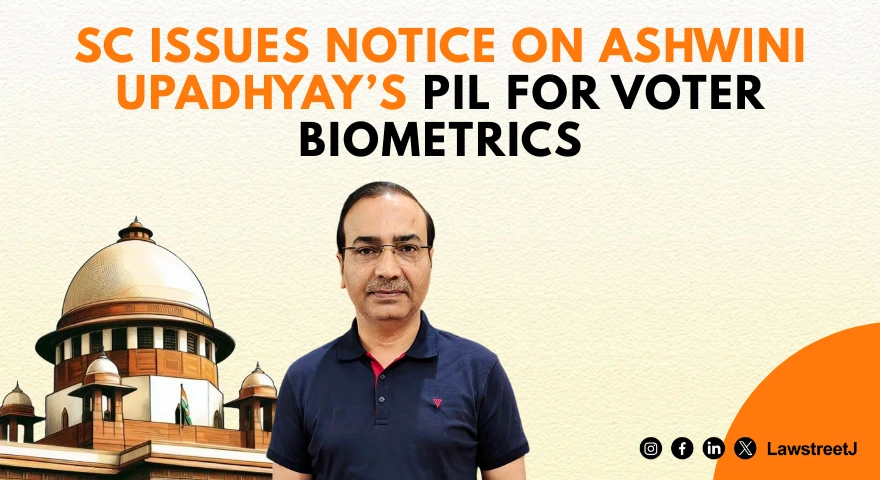
New Delhi: The Supreme Court has issued notice to the Central Government and the Election Commission of India on a public interest litigation filed by BJP leader and lawyer Ashwini Kumar Upadhyay, seeking the implementation of biometric and facial recognition of voters before votes are cast.
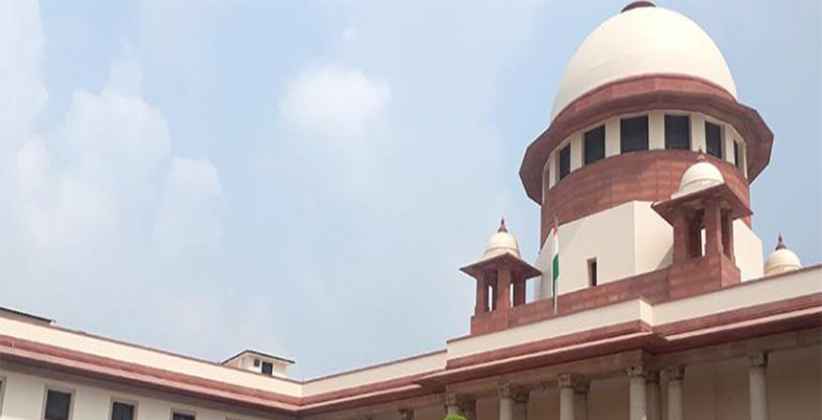
A Bench comprising Chief Justice of India Surya Kant and Justice Joymalya Bagchi sought responses from the poll body and the government, while observing that such an exercise would require changes in existing rules and involve a significant financial burden on the exchequer.
Appearing in person, Upadhyay submitted that the relief sought could be implemented only with the cooperation of the States. The plea seeks directions to curb electoral malpractices such as bribery, undue influence, personation, duplicate voting, ghost voting, and other irregularities that allegedly affect the purity and integrity of the electoral process.
The Bench was initially not inclined to issue notice and asked the petitioner to first approach the Election Commission of India. The Court observed that the ECI must examine the issue and respond, and if the States do not cooperate or the Finance Ministry does not allocate the necessary funds, the petitioner may then approach the Court. It remarked that issuing notice at this stage may not be necessary.
However, Upadhyay clarified that he was not seeking implementation of the proposed measures for the ongoing five State elections. Taking note of this submission, the Bench agreed to examine the matter. The Court observed that while such measures cannot be considered for the imminent elections, the question of whether they should be adopted for future parliamentary or State elections requires examination. Accordingly, notice was issued.
The petitioner submitted that the harm caused to citizens is substantial, as electoral malpractices such as bribery, undue influence, personation, duplicate voting, and ghost voting continue to undermine the integrity of the electoral process. The plea states that, to uphold the constitutional mandate of free and fair elections, the Election Commission of India may consider implementing fingerprint and iris-based biometric authentication at polling booths in upcoming Assembly elections.
It further suggests that such a system may be implemented on the lines of Aadhaar-based identification, which has been recognised as valid proof of identity under Section 23(4) of the Representation of the People Act, 1950. The petitioner contends that the ECI possesses plenary powers to introduce such biometric authentication measures.
The petition further states that the adoption of fingerprint and iris-based verification at polling booths would ensure that only genuine and duly registered electors are permitted to cast their votes, thereby effectively preventing electoral malpractices. It argues that the ECI, by exercising its powers under Article 324 of the Constitution, can implement such measures to strengthen voter identification mechanisms.
The plea emphasises that biometric identifiers are unique and incapable of fabrication, thereby reinforcing the principle of “One Citizen, One Vote.” It contends that a transparent electoral process is essential for maintaining public trust in democratic institutions, and that biometric verification would provide an objective and tamper-proof mechanism, enhancing confidence in the fairness of elections.
The petition also highlights that biometric authentication systems can create secure and verifiable digital records of voter authentication at the time of voting. Such records, while preserving voter secrecy, may serve as an audit trail to ensure that due process is followed at each polling station. This, it is argued, would enhance institutional accountability and enable the Election Commission of India to conduct post-election audits more efficiently. The existence of verifiable data would also act as a deterrent against malpractice.
The petitioner further submitted that the introduction of such mechanisms would strengthen transparency and reassure stakeholders that the electoral system is robust and accountable. The plea underscores that strengthening the integrity of the electoral process is crucial, as free and fair elections form part of the basic structure of the Constitution. Any gap in identity verification, it argues, directly impacts the legitimacy of electoral outcomes.
The Supreme Court’s decision to issue notice indicates that the matter will now be examined in detail after responses are filed by the Election Commission of India and the Central Government. The Court has clarified that any potential implementation of such a system would not apply to the ongoing State elections but may be considered for future parliamentary or State polls, subject to necessary rule changes and financial considerations.
Case Details:
Petitioner: Ashwini Kumar Upadhyay
Respondents: Election Commission of India & Central Government
Court: Supreme Court of India
Bench: CJI Surya Kant & Justice Joymalya Bagchi
Date of Hearing: April 13, 2026
Appearance: Petitioner appeared in person