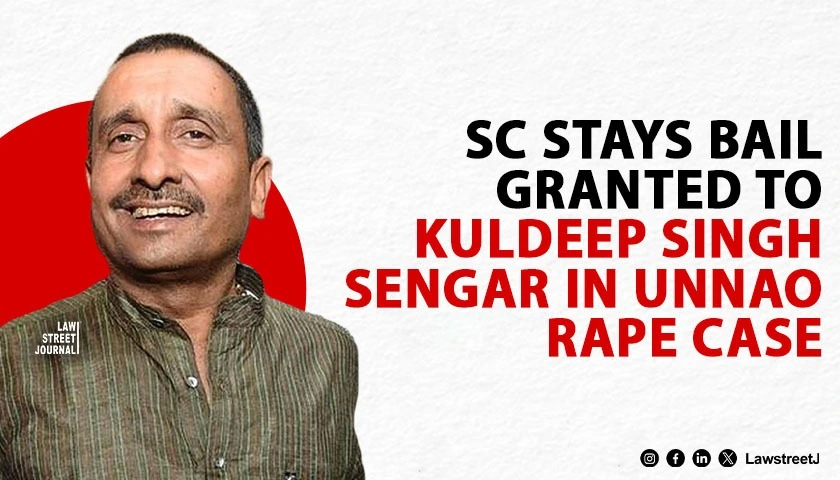
New Delhi: In a significant judicial intervention, the Supreme Court of India, on December 29, 2025, stayed the operation of a Delhi High Court order that had granted bail and suspended the life sentence of former Uttar Pradesh MLA Kuldeep Singh Sengar in the 2017 Unnao rape case. A vacation Bench comprising Chief Justice of India Surya Kant and Justices J.K. Maheshwari and Augustine George Masih issued notice to Sengar, directing him to file his response within four weeks.
The stay order was passed while hearing a Special Leave Petition filed by the Central Bureau of Investigation (CBI), which challenged the Delhi High Court’s December 23 decision allowing suspension of Sengar’s sentence during the pendency of his appeal.
At the core of the controversy is the interpretation of Section 5(c) of the Protection of Children from Sexual Offences Act, which defines aggravated penetrative sexual assault to include offences committed by a public servant. The Delhi High Court had held that Sengar could not be treated as a public servant for the purposes of this provision, relying on the definition under the Indian Penal Code and the Supreme Court’s earlier ruling in A.R. Antulay v. R.S. Nayak (1988), where it was held that an MLA is not a public servant for certain IPC offences.
Based on this interpretation, the High Court had prima facie concluded that the offence did not fall within the aggravated category under the POCSO Act and that Sengar had already undergone the maximum sentence of seven years applicable to a lesser offence.
Appearing for the CBI, Solicitor General Tushar Mehta argued that the High Court’s reasoning was legally flawed. He submitted that a sitting MLA occupies a constitutional position of authority and trust and must be viewed as a public servant within the contextual framework of the POCSO Act. The Supreme Court expressed similar concerns, observing that a narrow and literal interpretation could lead to an anomalous situation where lower-ranking officials are treated as public servants under the Act, while elected legislators are excluded. The Bench also noted the broader implications such an interpretation could have on legislative accountability.
“The legal issue requires consideration, and the judges of the High Court who passed this order are among the finest judges. But we are all prone to committing errors. Please see the definition of public servant under the POCSO Act. We are concerned that a constable would be treated as a public servant under the Act, while a Member of the Legislative Assembly would be excluded,” the Court observed.
The CBI further contended that Sengar continues to wield considerable influence and that his release would pose a serious threat to the safety of the survivor and her family, apart from undermining public confidence in the criminal justice system.
The Supreme Court clarified that the stay on the bail order does not presently infringe upon Sengar’s personal liberty, as he is already serving a separate 10-year sentence in connection with the murder of the rape survivor’s father. While the trial court had sentenced him to life imprisonment for the gang rape of a minor in December 2019, he was subsequently convicted in March 2020 for culpable homicide and criminal conspiracy relating to the death of the victim’s father.
As a result, Sengar will remain in judicial custody pending further consideration of the substantial questions of law regarding the definition of “public servant” under the POCSO Act and the scope of legislative accountability.
The Supreme Court’s interim order effectively halts Sengar’s release until the legal issues raised in the matter are conclusively adjudicated.