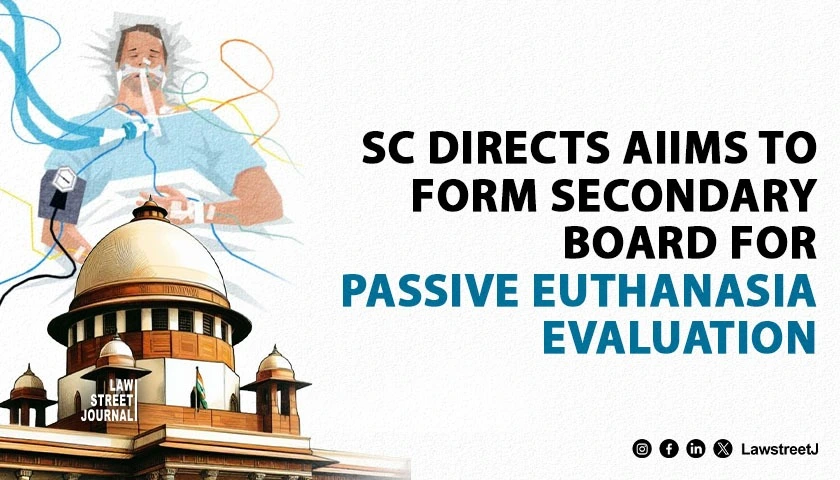
New Delhi: The Supreme Court has directed the All India Institute of Medical Sciences (AIIMS), New Delhi, to constitute a Secondary Medical Board to examine a 32-year-old man who has been in a persistent vegetative state for 13 years following injuries sustained in a fall, to determine whether life-sustaining treatment, including artificial nutrition and hydration, can be withdrawn.
A Division Bench comprising Justice J.B. Pardiwala and Justice K.V. Viswanathan, by an order dated December 11, 2025, passed directions in Miscellaneous Application No. 2238/2025 in SLP (C) No. 18225/2024, filed by Harish Rana through his father, Ashok Rana.
The matter originated from a petition before the Delhi High Court seeking the constitution of a Medical Board to examine Harish Rana’s medical condition and facilitate the process of passive euthanasia. The petitioner suffers from 100% disability with quadriplegia.
The Supreme Court had earlier disposed of the main SLP on November 8, 2024, after Additional Solicitor General Aishwarya Bhati explored alternative solutions for adequate care. The Union Ministry of Health and Family Welfare proposed viable options, including home care with government assistance, shifting the patient to District Hospital, Sector-39, Noida, or support through an NGO, all of which were accepted by the parents.
However, Advocate Rashmi Nandakumar, appearing along with Advocates Dhvani Mehta, Yashmita Pandey, Ritumbhara Garg, Manish Jain, and Vikash Kumar, moved a fresh miscellaneous application seeking:
- a declaration that clinically assisted nutrition and hydration constitute life-sustaining treatment;
- determination in terms of the Common Cause judgment;
- directions for the constitution of Primary and Secondary Medical Boards;
- directions to States for implementing nomination processes; and
- directions to High Courts regarding intimation procedures.
The applicant informed the Court that Harish Rana’s condition had deteriorated from “bad to worse,” that he was in a pathetic condition, not responding to any treatment, being kept artificially alive, and had shown no improvement over the past year.
On November 26, 2025, the Supreme Court directed District Hospital, Sector-39, Noida, to constitute a Primary Medical Board in terms of the landmark judgment in Common Cause (A Registered Society) v. Union of India (2018) 5 SCC 1, as modified by the order dated January 24, 2023, in Miscellaneous Application No. 1699/2019.
The Court referred to the modified Paragraph 199.1, which provides that in cases where a patient is terminally ill with an incurable ailment or has no hope of recovery, the hospital shall constitute a Primary Medical Board to consult with the family physician and the patient’s next of kin or guardian, explain the pros and cons of withdrawal or refusal of treatment, and, upon written consent, certify the proposed course of action within 48 hours.
The Supreme Court directed the Primary Board to submit a report, “whether the life-sustaining treatment can be withheld or, in other words, withdrawn,” within two weeks in a sealed cover.
Pursuant to this order, the Chief Medical Officer, Ghaziabad, along with four medical experts—Dr. Sachin Garg (Neurologist), Dr. Amit Srivastava (Plastic Surgeon), Dr. Ankit Kumar (Anaesthesiologist), and Dr. Akhil Prakash (Neurosurgeon)—visited Harish Rana’s residence at AM-1314, Raj Empire, Rajnagar Extension, Ghaziabad.
The medical experts concluded unequivocally:
“The chances of his recovery from this state are negligible.”
Photographs attached to the report revealed that Harish had developed severe bedsores, further indicating the deterioration of his condition over the past 13 years.
Justice Pardiwala observed:
“A bare reading of the letter would indicate that Harish is in a pathetic condition. He was found lying on a bed with a tracheostomy tube for respiration and a gastrostomy tube for feeding… The team of doctors is of the opinion that the chances of his recovery from the present state are negligible. Harish appears to have been in this vegetative condition for the past 13 years.”
Recognising the gravity of the situation, the Bench stated:
“In the circumstances referred to above, we should now proceed to the next stage in the process.”
The Court invoked the framework laid down in Common Cause (A Registered Society) v. Union of India (2018) 5 SCC 1, as modified by the judgment reported in (2023) 14 SCC 131, and directed the constitution of a Secondary Medical Board as the next step in the passive euthanasia evaluation process.
The Supreme Court directed:
“We request the Director, All India Institute of Medical Sciences, New Delhi, to constitute a Secondary Medical Board, as referred to above, and submit a report by next Wednesday, i.e., 17-12-2025.”
The Court further directed that the Primary Board’s letter along with all supporting documents be forwarded to the Director, AIIMS, at the earliest. The Registry was instructed to inform AIIMS of the order on the same day.
The matter has been listed for hearing on Thursday, December 18, 2025, as the second item at the top of the Board, marked Part-Heard.
Case Title: Harish Rana v. Union of India & Ors.