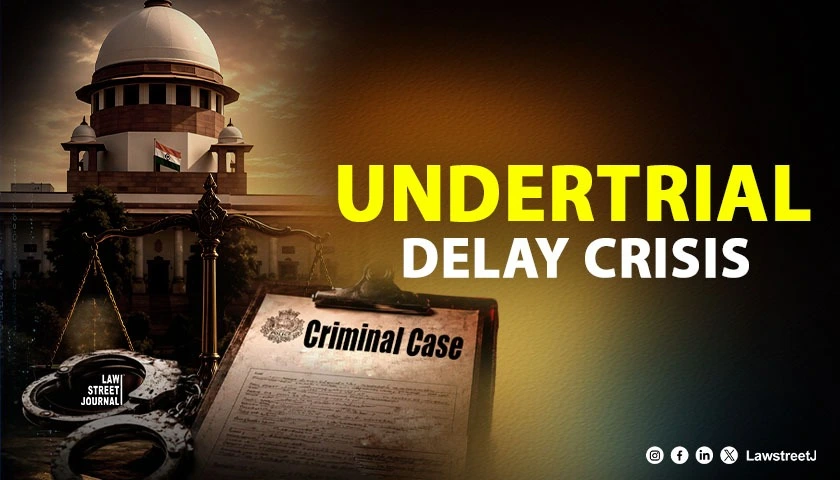
New Delhi: In a significant ruling that simultaneously grants individual relief and seeks to address systemic delay in criminal justice, the Supreme Court of India on April 29, 2026, quashed a criminal case that had been pending against a police constable for over 35 years, holding that the prolonged delay amounted to a violation of his fundamental right to a speedy trial under Article 21 of the Constitution.
The appellant, Kailash Chandra Kapri, a police constable, was one of five accused named in an FIR dated February 19, 1989, registered at GRP Rambagh Police Station, Allahabad, for offences under Sections 147, 323 and 504 of the Indian Penal Code and Section 120 of the Railways Act. The FIR, lodged by a fellow constable, alleged that the accused persons had surrounded and assaulted him in the police mess over a trivial dispute. A chargesheet was filed and the matter culminated in Criminal Case No. 545 of 1991 before the Additional Chief Judicial Magistrate (Railway), Allahabad.
Co-Accused Acquitted; Appellant Left in Legal Limbo
Of the five accused, two died during the pendency of proceedings. The remaining two co-accused were put to trial and acquitted by the ACJM (Railway), Allahabad vide judgment dated February 1, 2023, as the prosecution failed to examine even a single witness despite being given ample opportunity over more than three decades. The trial court noted that the case had been pending since 1991, that all witnesses were police personnel, and that even after summons were sent via Radiogram to the Director General of Police, no witness was produced. The prosecution evidence was eventually closed on May 25, 2022.
Kapri’s case stood on a different footing: following the bifurcation of Uttar Pradesh, he was transferred to the newly formed State of Uttarakhand. The trial court was unable to serve summons on him, and no proceedings took place against him until 2021. When he eventually approached the Allahabad High Court under Section 482 of the Code of Criminal Procedure seeking quashing of the proceedings in Application No. 20610 of 2024, the High Court declined, observing that disputed questions of fact could not be adjudicated at that stage and granting him liberty to move a discharge application before the trial court. Aggrieved, Kapri approached the Supreme Court.
Supreme Court: 35 Years for Simple Hurt is ‘Too Long a Time’
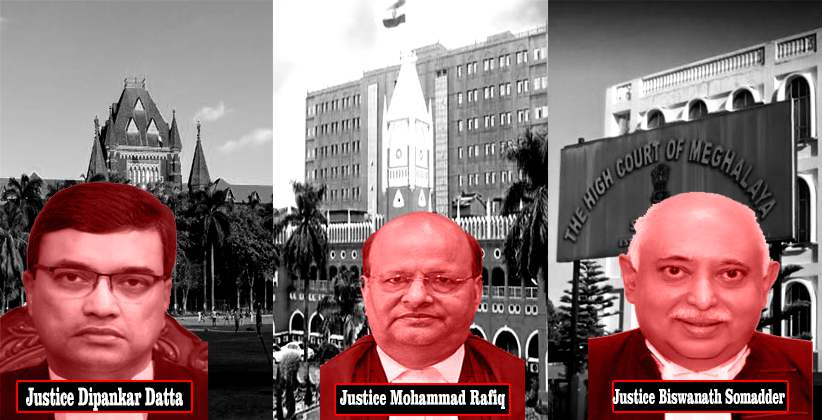
A bench of Justices J.B. Pardiwala and Ujjal Bhuyan granted special leave and allowed the appeal. Taking note of the nature of the offences — simple hurt and criminal intimidation — and the extraordinary duration of the proceedings, the Court held that continuing the prosecution would be unjust and inequitable. The bench observed that keeping a public servant “in suspended animation for 35 years” without any cause violated the spirit of the procedure established by law under Article 21.
The Court drew upon an extensive body of constitutional jurisprudence concerning the right to a speedy trial, tracing the doctrine from the US Supreme Court decisions in Dickey v. Florida (1970), Barker v. Wingo (1972) and Smith v. Hooey (1969), to the Indian Supreme Court’s foundational ruling in Hussainara Khatoon v. State of Bihar (AIR 1979 SC 1360), which held that a speedy trial is implicit in the “reasonable, fair and just” procedure guaranteed by Article 21. The bench also relied on the Constitution Bench ruling in A.R. Antulay v. R.S. Nayak (1992) and the seven-judge bench judgment in P. Ramachandra Rao v. State of Karnataka (2002).
Noting that Article 21 has been a cornerstone of Indian democracy for 76 years and that the right to speedy trial “should not remain as an abstract or illusory safeguard,” the Court directed that the prosecution of the appellant shall proceed no further.
Court Goes Further: Seeks Data on UP’s Criminal Justice Backlog
The bench did not stop at granting relief to the appellant. Expressing concern that guidelines on speedy trial “just remain on paper” because “no court bothers to follow” them due to a lack of accountability, the Court issued a comprehensive set of directions to the Registrar General of the Allahabad High Court, requiring detailed information to be submitted on oath by way of affidavit on or before July 13, 2026.
The information sought includes: the total number of criminal cases pending before Judicial Magistrates First Class, Chief Judicial Magistrates and Sessions Courts in Uttar Pradesh; the age-wise breakup of such pendency; the number of undertrial prisoners and the duration of their custody; the number of sanctioned judicial posts and vacancies at each level; and whether any proposals for filling vacancies are pending with the State Government.
The Court also directed the High Court to furnish specific data on bail applications, including: whether the period of custody of undertrial prisoners is recorded in bail applications filed before the High Court; the number of bail applications pending as of April 30, 2026, categorised by year of filing; and a detailed breakdown of pending bail applications by the duration of custody undergone by the applicant, covering brackets ranging from 0 to 1 year all the way to over 10 years.
The Court further sought information on whether any measures currently exist to expedite bail applications where the applicant has remained in custody for more than five years, and if not, whether such measures could be introduced.
The matter has been listed for further hearing after the status report is received and has been treated as part-heard.
Broader Significance
The judgment is notable for its dual character: it resolves a longstanding injustice to an individual while simultaneously initiating a data-driven judicial inquiry into the structural causes of delay in one of India’s most populous and case-burdened states. The bench drew attention to the NCRB Prison Statistics (2019), which showed that 69.5% of prisoners in Indian jails are undertrial prisoners, a figure the Court described as a “chronic malady” in the administration of criminal justice.
The order also cited the Bombay High Court’s ruling in NIA v. Areeb Ejaz Majeed (2021) and the Supreme Court’s own decision in Union of India v. K.A. Najeeb (2021) to underscore that even in cases under stringent special laws, the right to speedy trial under Article 21 can override statutory restrictions on bail when the delay is inordinate and the likelihood of early completion of trial is remote.
CASE DETAILS:
Case Title: Kailash Chandra Kapri v. State of Uttar Pradesh & Ors.
Citation: 2026 INSC 473
Court: Supreme Court of India, Criminal Appellate Jurisdiction
SLP No.: Special Leave Petition (Crl.) No. 6564 of 2026
Bench: Justice J.B. Pardiwala and Justice Ujjal Bhuyan
Date of Order: April 29, 2026
Originating FIR: Case Crime No. 115 of 1989, GRP Rambagh Police Station
Trial Court Case: Criminal Case No. 545 of 1991, ACJM (Railway), Allahabad
High Court Application: Section 482 Application No. 20610 of 2024, Allahabad High Court (order dated 23.02.2026)
Deadline for HC Compliance: July 13, 2026