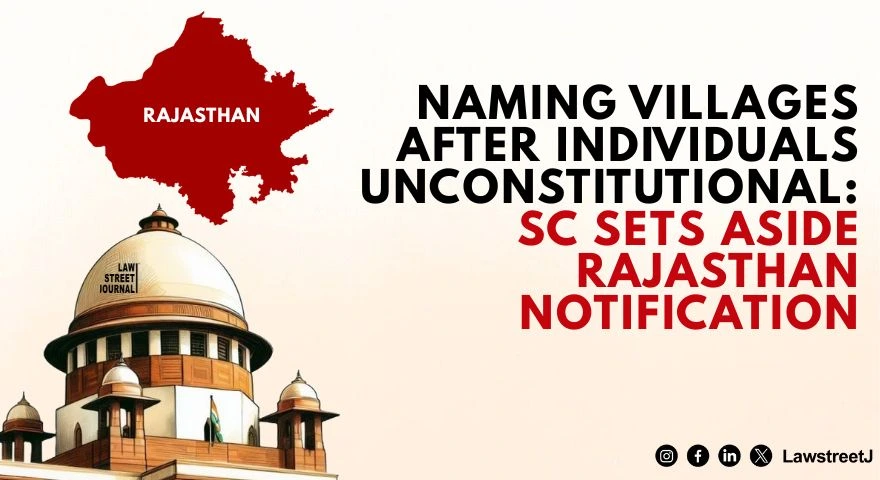
New Delhi: The Supreme Court has delivered a significant judgment holding that the Rajasthan Government’s notification creating two revenue villages named after individuals violated its own 2009 policy circular and was therefore arbitrary and unconstitutional under Article 14 of the Constitution.
Justice Alok Aradhe, writing for a Bench comprising Justice Sanjay Kumar, addressed a civil appeal challenging a Division Bench order of the Rajasthan High Court, which had set aside a Single Judge’s decision quashing the creation of revenue villages named “Amargarh” and “Sagatsar” in Barmer district.
The factual background revealed that, pursuant to a proposal from Gram Panchayat Sohda for the creation of new revenue villages, the Tehsildar, Gida, issued certificates on December 24, 2020, stating that he had “personally and thoroughly verified all the relevant aspects” concerning the formation of four new revenue villages carved out of Meghwalon Ki Dhani. The certificate recorded that the proposed villages “were not associated with any individual, religion, caste or community and that there existed no dispute regarding their creation.”
On the same day, affidavits were executed by Amarram and Badli Kunwar (wife of Sagat Singh), agreeing to donate land for the proposed revenue villages named Amargarh and Sagatsar. Subsequently, the State Government issued a notification dated December 31, 2020, under Section 16 of the Rajasthan Land Revenue Act, 1956, creating several new revenue villages, including Amargarh and Sagatsar.
However, on April 21, 2025, villagers of Meghwalo Ki Dhani filed objections asserting that the names of the new revenue villages, namely “Amargarh” and “Sagatsar,” were derived from the names of individuals.
The appellants approached the High Court challenging the notification. The Single Judge, by order dated July 11, 2025, held that “the names of the revenue villages were derived from the names of individuals, namely Amarram and Sagat Singh, who had also agreed to donate the land.” Relying on earlier Single Bench decisions in Moola Ram v. State of Rajasthan and Joga Ram v. State of Rajasthan, the Single Judge quashed the notification while granting liberty to rename the villages.
However, the Division Bench, on appeal by respondents 6 to 9, held that “the benefit of the decisions in Moola Ram and Joga Ram (supra) could not be extended to cases where the process was not pending at the relevant time,” and accordingly set aside the Single Judge’s order.
Before the Supreme Court, counsel for the appellants contended that the Division Bench erred in overlooking the fact that the names of the revenue villages in question were clearly based on the names of individuals, in direct violation of the circular dated August 20, 2009.
The State Government argued that the statutory procedure prescribed for the creation of revenue villages had been followed and that the circular dated August 20, 2009, was merely directory, urging that settled issues ought not to be reopened retrospectively.
Respondents 6 to 9 contended that the appellants lacked locus standi and that the notification did not cause any legal injury to them.
The Supreme Court examined Section 16 of the Rajasthan Land Revenue Act, which empowers the State Government to “create new or abolish existing divisions, districts, sub-districts, sub-divisions, tehsils and sub-tehsils, villages” and to “alter the limits of any of them.”
More critically, the Court analysed the Revenue Department’s comprehensive circular dated August 20, 2009, which laid down criteria for declaring new revenue villages. Clause 4 of the circular mandated: “While deciding the name, it shall be ensured that it is not based on any person, religion, caste, or sub-caste. As far as possible, the name of the village shall be proposed with general consensus.”
In a significant observation on the binding nature of policy decisions, the Court stated: “Thus, Clause 4 of the Circular mandates that the name of a Revenue Village shall not be based on any person, religion, caste or sub-caste, and the same shall be proposed with general consensus.”
Addressing the constitutional implications, the Court held: “The aforesaid circular is in the nature of a policy decision. Clause 4 of the circular has been incorporated with an object to maintain communal harmony.”
Articulating a settled principle of administrative law, the Court observed: “It is well settled in law that a policy decision, though executive in nature, binds the Government, and the Government cannot act contrary thereto unless the policy is lawfully amended or withdrawn.”
The Court emphasised: “Any action taken in derogation of such a policy, without amendment or valid justification, is arbitrary and violative of Article 14 of the Constitution of India,” citing Mahabir Auto Stores v. Indian Oil Corporation, Home Secretary v. Darshjit Singh Grewal, and State of Punjab v. Ram Lubhaya Bagga.
Applying these principles to the facts, the Court observed: “Admittedly, the names of the Revenue Villages, namely Amargarh and Sagatsar, are derived from the names of individuals, namely Amarram and Sagat Singh.”
The Court conclusively held: “The notification dated December 31, 2020, is therefore in contravention of Clause 4 of the Circular dated August 20, 2009. The State Government cannot be permitted to act in contravention of the policy framed by it, which binds it.”
Consequently, the Court stated: “No legal sanctity can be attached to the impugned notification dated December 31, 2020, insofar as it pertains to the revenue villages, namely Amargarh and Sagatsar.”
Criticising the Division Bench’s approach, the Court observed: “The Division Bench failed to consider this material aspect and erred in limiting its consideration only to the applicability of earlier decisions in Moola Ram and Joga Ram (supra).”
The Court added: “In any case, a lis pending before a court is required to be adjudicated on merits.”
In the final order, the Supreme Court quashed and set aside the Division Bench’s judgment dated August 5, 2025, and restored the Single Judge’s order dated July 11, 2025. The appeal was allowed without costs.
Case Title: Bhika Ram & Anr. v. State of Rajasthan & Ors.