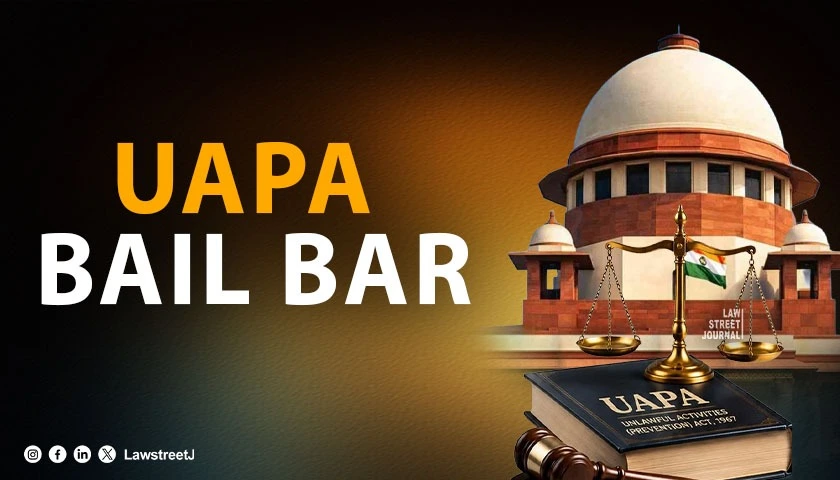
New Delhi: The Supreme Court on May 22 referred the question of how Article 21 of the Constitution is to be applied against the statutory bar on bail under Section 43D(5) of the Unlawful Activities (Prevention) Act, 1967, to a larger Bench, while simultaneously granting six months of interim bail to two accused in the Delhi riots conspiracy case.
A Bench of Justice Aravind Kumar and Justice P.B. Varale passed the order after Additional Solicitor General S.V. Raju submitted that there was a perceived divergence in the manner in which the Supreme Court’s three-judge Bench decision in Union of India v. K.A. Najeeb (2021) was being read and applied by coordinate Benches, and sought a reference to settle the law.
The Conflict Between Coordinate Benches
The reference arose in the context of a direct conflict between two coordinate Benches of the Supreme Court on the interpretation of K.A. Najeeb. That judgment had held that prolonged incarceration without trial warrants constitutional intervention, and that statutory conditions for bail would yield where there is no likelihood of trial being completed within a reasonable time and the period of incarceration already undergone has exceeded a substantial part of the prescribed sentence.
In January 2026, a coordinate Bench of Justice Aravind Kumar and Justice N.V. Anjaria, in Gulfisha Fatima v. State (Govt. of NCT of Delhi), denied bail to Umar Khalid and Sharjeel Imam and held that Article 21 cannot operate as a trump card for seeking bail in UAPA cases.
Shortly thereafter, a coordinate Bench of Justice B.V. Nagarathna and Justice Ujjal Bhuyan, in Syed Iftikhar Andrabi v. National Investigation Agency, Jammu, expressed serious reservations about Gulfisha Fatima and also doubted an earlier judgment in Gurwinder Singh v. State of Punjab (2024). The Bench in Andrabi held that Gulfisha Fatima and Gurwinder Singh had hollowed out K.A. Najeeb by recasting it as a narrow factual exception and had shrunk K.A. Najeeb by answering a proposition it never advanced — that the mere lapse of time automatically yields bail.
The Bench in Andrabi granted bail to a Kashmiri appellant after nearly six years of custody. It cited National Crime Records Bureau figures placed before Parliament to record conviction rates under UAPA in the low single digits, with the rate in Jammu and Kashmir hovering below one percent, and reasoned that pre-trial custody cannot operate as a sentence served without conviction.
The Referring Bench’s Reasoning
The Bench of Justices Kumar and Varale, in their order making the reference, recorded that K.A. Najeeb recognised the legislative policy underlying special statutes while preserving the force of Article 21. They held that K.A. Najeeb is “neither a charter for indefinite incarceration under the cover of Section 43D(5), nor a mathematical command that the mere passage of time, divorced from all surrounding circumstances, must automatically result in bail.”
The Bench addressed the conflict between Gulfisha Fatima and Andrabi with restraint, declining to enter into any adjudication on their correctness. “Judgments of this Court are not to be answered by counter-observations from another Bench of equal strength. The discipline of precedent demands a higher institutional method,” the order recorded.
The Bench held that a coordinate Bench cannot, by strong observations, effectively unsettle the ratio of an earlier coordinate Bench while continuing to sit in equal strength. “A doubt expressed in emphatic terms,” the order added, “still remains a doubt and does not amount to a declaration of law.”
The Bench framed the question for reference broadly. It held that the true question is not whether Article 21 survives Section 43D(5) — “It undoubtedly does” — but how Article 21 is to be applied in a statutory field where Parliament has consciously restricted bail in respect of offences alleged to affect the security of the State.
An unqualified reading that lapse of time must by itself compel bail could leave courts without room to weigh factors such as the centrality of the accused’s role, protected witnesses, risk of intimidation, reactivation of networks, and whether delay is attributable to the accused. An equally unqualified insistence on the statutory bar without regard to prolonged incarceration would, the Bench held, imperil Article 21.
The papers have been directed to be placed before the Chief Justice on the administrative side. The reference is confined to the legal questions identified and expresses no opinion on the merits of the prosecution or on the guilt or innocence of the appellants.
Interim Bail To Delhi Riots Accused
Tasleem Ahmed and Khalid Saifi, who have remained in custody since 2020 in connection with the alleged larger conspiracy behind the February 2020 riots in north-east Delhi, were granted interim bail for six months. Their bail pleas had been rejected by separate Benches of the Delhi High Court on September 2, 2025.
The Bench recorded that they had undergone substantial incarceration, that the trial was not likely to conclude immediately, and that the appellants themselves had invoked Gulfisha Fatima in their bail pleas.
The interim bail is subject to eleven conditions, including execution of a personal bond of Rs. 2,00,000 with two sureties, surrender of passports, a bar on leaving Delhi without permission of the trial court, fortnightly reporting to the investigating officer, and a prohibition on making public statements touching upon the merits of the case.
Case Details
- Court: Supreme Court of India
- Bench (Referring Order): Justice Aravind Kumar and Justice P.B. Varale
- Date of Order: May 22, 2026
- Appearing for State/Union: Additional Solicitor General S.V. Raju
- Statutory Provision: Section 43D(5) of the Unlawful Activities (Prevention) Act, 1967