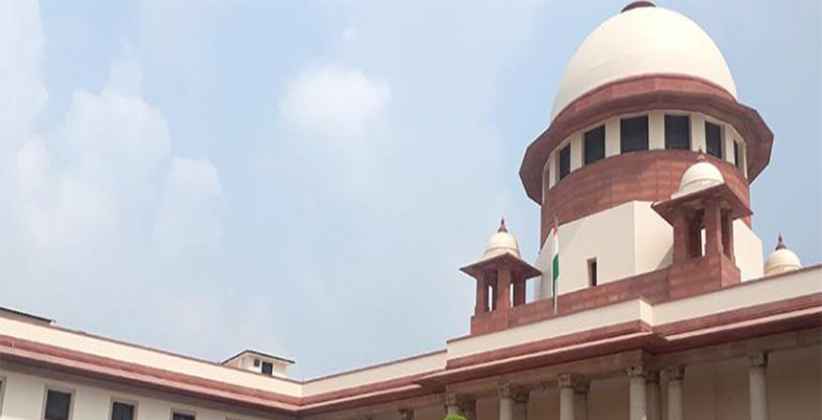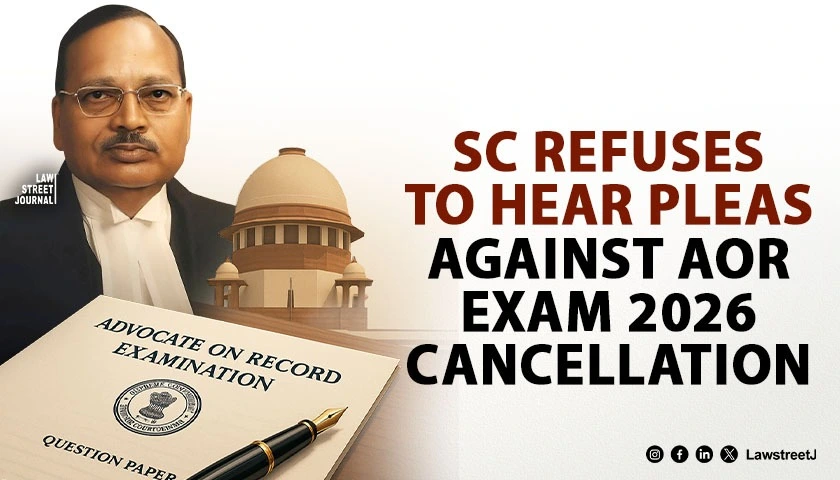
New Delhi: The Supreme Court on May 11, 2026, refused to entertain writ petitions challenging the decision of the Supreme Court Board of Examination not to hold the Advocates-on-Record (AOR) Examination in 2026, holding that the matter could not be considered on the judicial side, and directed the petitioners to submit a comprehensive representation to the Chief Justice of India on the administrative side within 10 days.
A bench comprising Justice Aravind Kumar and Justice PB Varale, while disposing of the petitions, observed that “the ends of justice would be met by permitting the petitioners to submit a comprehensive representation to the Chief Justice of India, and once made, we do not have any reason to think the Chief Justice would not consider it sympathetically.” Justice Kumar further remarked that “we have got the most empathetic Chief Justice; we are confident” that the matter would be considered, with Justice Varale adding that the bench was “optimistic.”
The challenge arose after the Board of Examiners of the Supreme Court, on April 30, 2026, decided not to hold the AOR Examination in 2026. A notification issued by the Registrar and Secretary of the Supreme Court’s Board of Examiners stated that “the Competent Authority has been pleased to order that, keeping in view the overall strength of the AORs, the Advocates-on-Record Examination shall not be conducted in the year 2026,” and that the schedule for the next examination, likely to be held in 2027, would be notified in due course. Only those who clear the AOR Examination are entitled to file cases in the Supreme Court.
The petitions were filed by two sets of aggrieved lawyers. Some petitioners were lawyers who had missed clearing the previous year’s AOR Examination by a few papers and had been declared eligible to reappear for those papers in the next examination. Others had been undergoing the mandatory one-year training period after narrowly missing the last examination. The cancellation of the 2026 examination caused direct prejudice to both sets of petitioners, who had been preparing and training in anticipation of appearing in the 2026 examination.
Senior Advocate Gopal Sankaranarayanan, appearing for one set of petitioners, submitted that his clients had missed the last AOR Examination by a few papers and had been granted the opportunity to reappear for those papers in the next examination, and that the cancellation caused specific and direct prejudice to them. When Justice Kumar remarked that there were already a large number of AORs, Sankaranarayanan noted that there was already an excess of senior lawyers. Senior Advocate Shadan Farasat, appearing for the other petitioners, submitted that his clients had been training for one year after missing the last examination by a narrow margin, and suggested that the Court may consider controlling the number of persons who become AORs, but not cancel the examination altogether. Senior Advocate Chander Uday Singh similarly highlighted that his clients had missed the last examination by just one paper and were eligible under the applicable rules to reappear in the next examination.
The bench, however, declined to consider the matter on the judicial side and directed all petitioners to submit their representations to the Chief Justice of India within ten days.
Case Details: Dania Nayyar and Others v. Registrar General and Others, W.P.(C) No. 582 of 2026, and Varisha Sharma and Others v. Advocates on Record Examination Cell and Others, W.P.(C) No. 591 of 2026, Supreme Court of India. Before Justice Aravind Kumar and Justice PB Varale. Order dated May 11, 2026. Senior Advocate Gopal Sankaranarayanan, Senior Advocate Shadan Farasat, and Senior Advocate Chander Uday Singh appeared for the petitioners. Filed through Advocate-on-Record Mandeep Kalra.