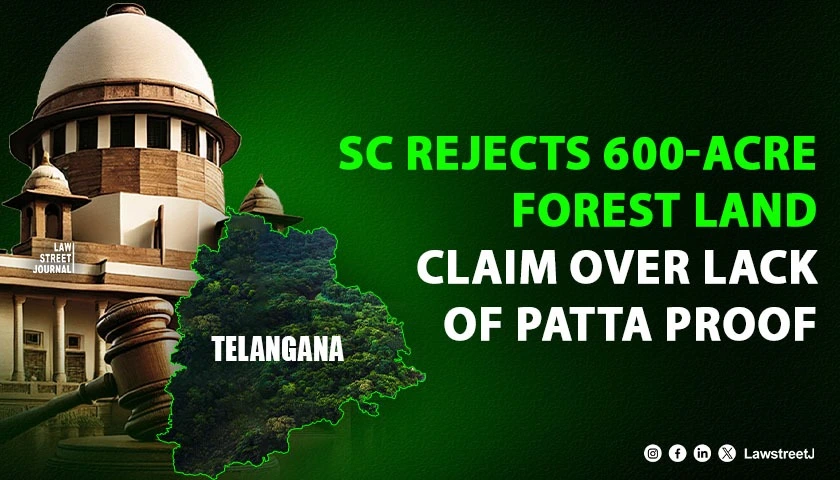
New Delhi: The Supreme Court of India has dismissed a civil appeal by claimants seeking exclusion of 600 acres of land in Survey No. 81 of Kalvalanagaram Village from proposed reservation as forest land, holding that revenue records and revenue entries cannot establish title to property in the absence of the primary title document, and that the Single Judge had erred in expanding the scope of judicial review under Article 226 of the Constitution to declare the claimants’ title.
A bench comprising Justice Pankaj Mithal and Justice S.V.N. Bhatti delivered the judgment on 06.05.2026, affirming the Division Bench of the High Court for the State of Telangana, which had reversed the Single Judge’s order.
On 06.02.1950, a Gazette Notification was issued proposing inclusion of 787 acres of land in Survey No. 81 of Kalvalanagaram Village as reserved forest land. The appellants, claiming ownership over 600 acres within Survey No. 81 situated in Karakagudem Mandal, Bhadradri Kothagudem District, Telangana, approached the Joint Collector, Khammam, seeking exclusion of the subject land from the proposed reservation. The appellants contended that during 1931–32, the then Nizam of Hyderabad had granted pattas in favour of either the appellants or their predecessors-in-interest, and that rights had earlier been created in favour of Sivai jamandars in 1920, which were subsequently mutated in favour of persons in possession.
The Mandal Revenue Officer, in a report dated 07.01.1990, recommended deletion of the patta lands from the proposed forest block, observing that the land had not yet been declared reserved forest and that the reservation process was still at a preliminary stage.
However, by order dated 19.05.2003, the Joint Collector rejected the appellants’ claim, holding that they had failed to produce original documentary evidence such as patta certificates, that mere entries in revenue records were insufficient to confer title, that the claimants had never remained in physical possession of the land for nearly seventy years as the property remained uncultivated and covered with forest growth, and that the Joint Collector was not the competent forum to adjudicate disputed questions of title.
The appellants challenged the order before the then High Court of Judicature at Andhra Pradesh. By order dated 27.03.2012, the Single Judge allowed the writ petition, holding that pattas had been granted to the claimants and ten others in 1933, that the government’s grant of pattas extinguished its proprietary rights and conferred legal title upon the pattadars, that the missing mutation records were allegedly destroyed during the 1948 police action, that the 1950 notification had been issued under the Hyderabad Forest Act, 1326 Fasli, which had already been repealed, thereby rendering the notification ultra vires and non est in law, and that since the dispute was between the claimants and the State rather than between private parties, there was no necessity to approach a civil court for declaration of title.
The State thereafter preferred a writ appeal, which was allowed by the Division Bench of the High Court for the State of Telangana. The Division Bench held that a notification is not rendered invalid merely because it refers to the wrong enactment, so long as it is not inconsistent with the new Act. It further held that the claimants had failed to produce original pattas or any documentary proof of title, and that revenue entries unsupported by foundational title documents could not be accorded evidentiary sanctity. Aggrieved thereby, the appellants approached the Supreme Court.
Appearing for the appellants, Sri Y. Rajagopal Rao argued that the revenue records, including the Faisal Patti for 1342 Fasli, Pahanies for various Fasli years, and the Vasool Baqi for 1352 Fasli, established the appellants’ claim over the land. He submitted that the MRO report dated 07.01.1990 confirmed that the revenue records stood in the names of the claimants, thereby giving rise to a presumption of title in their favour. He further argued that the government could not proceed to declare the land as forest land without first adjudicating the claim and compensating the claimants. In the alternative, he submitted that the issue ought to be left open for determination by a competent civil court through a full-fledged trial.
Opposing the appeal, Sri Kodandaram Challa and Aishwarya Bhati, Senior Counsel for the respondents, argued that the notification ought not to be treated as one issued under the repealed 1326 Fasli Act, as its purpose clearly indicated that it was traceable to the 1355 Fasli enactment. They further submitted that revenue documents such as Faisal Patti and Vasool Baqi do not create title, that the very genesis of the appellants’ claim rested upon an alleged patta which was never produced, and that leaving the dispute open for civil adjudication would only prolong litigation which had already continued for over seventy-five years since the initial reservation proceedings commenced in 1950.
The Supreme Court examined the settled legal principles governing the evidentiary value of revenue records and summarised that entries in revenue records or Jamabandi serve only fiscal purposes relating to land revenue administration; that revenue records are not documents of title and do not confer ownership; that mutation neither creates nor extinguishes title and carries no presumptive value regarding ownership; that payment of taxes or grant of loans based on revenue entries does not estop the State from disputing ownership; that revenue records may at best raise a presumption regarding possession; that stray or isolated entries for a single year do not create any presumption of rights; and that fabricated or collusive records cannot bind the State.
Applying these principles, the Court noted that the principal documents relied upon by the appellants were the Faisal Patti for 1342 Fasli and the Vasool Baqi for 1352 Fasli, whereas the Pahanie copies described Survey No. 81 of Kalvalanagaram as “Jungle.” The Court found that the entries in the Pahanies were unauthorised mutations unsupported by any patta or lawful order authorising mutation. It further observed that while the land itself continued to be recorded as “Jungle,” names of private individuals had been inserted in one column without any supporting documentary basis.
The Court further held that writ proceedings under Article 226 of the Constitution are not the proper forum for adjudicating serious disputes involving contested questions of fact and title to immovable property, and that such issues are required to be examined by a competent civil court in properly instituted proceedings. The Court observed that the Single Judge had impermissibly expanded the scope of judicial review by effectively declaring title in writ jurisdiction, which was legally impermissible.
The Supreme Court also rejected the appellants’ alternative plea seeking liberty to agitate the matter before a competent forum, observing that in light of the weak documentary foundation and the nature of the claim, prolonging the litigation by leaving open non-existent issues was unwarranted.
Finding no infirmity in the Division Bench judgment reversing the Single Judge’s order, the Supreme Court dismissed the civil appeal without any order as to costs.
Case Details:
- Case Title: Vadiyala Prabhakar Rao and Others v. The Government of Andhra Pradesh and Others
- Case Number: Civil Appeal arising from Special Leave Petition (Civil) No. 27590 of 2025 (2026 INSC 450)
- Court: Supreme Court of India
- Bench: Justice Pankaj Mithal and Justice S.V.N. Bhatti
- Date of Judgment: 06.05.2026
Appearances:
- For the Appellants: Sri Y. Rajagopal Rao, Advocate
- For the Respondents: Sri Kodandaram Challa, Senior Counsel; Aishwarya Bhati, Senior Counsel