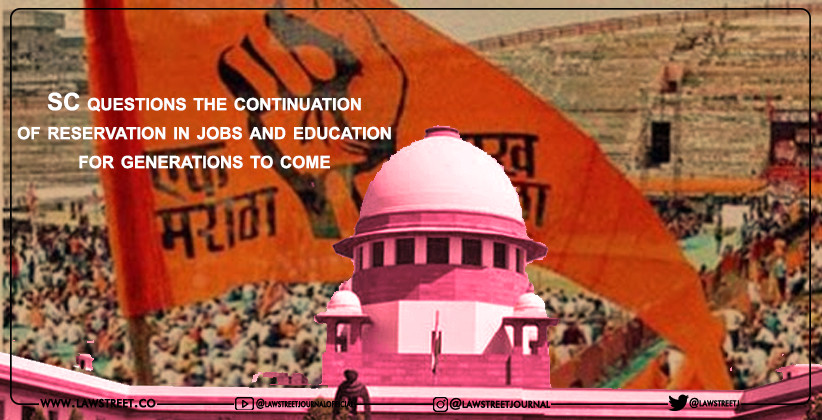
A constitutional bench of the Supreme Court on March 19, 2021, Friday questioned the persistence of reservations in jobs and education in the upcoming generations.
In relevance to the Maratha quota case, The bench further sought to know if the removal of 50% limit on reservation would affect the right to equality under as stated under Article 14 of the Constitution, further leading to a case of "resultant inequality".
The Constitution Bench of the Supreme Court was holding the 5th day of hearing on the petitions challenging the Constitutionality of the Maharashtra State Reservation For Socially and Educationally Backward Classes (SEBC) Act which provides for a quota to Marathas in jobs and education.
The pleas before the Constitution Bench challenges the Bombay High Court judgment passed in June 2019, and submits that the Socially and Educationally Backward Classes (SEBC) Act, 2018, which provides for 12% and 13% quota to the Maratha community in education and jobs respectively, violated the principles laid in the case of Indira Sawhney v. Union of India (1992) as per which the Apex Court capped the reservation limit at 50%.
The Bombay High Court, while upholding the Maratha quota, held that 16% reservation is not justifiable and ruled that reservation should not exceed 12% in employment and 13% in education as recommended by the State Backward Commission.
With Senior Advocate Rohatgi contending that the Indra Sawhney-imposed 50 percent limit on reservations has undergone a change through subsequent Constitutional amendments and case-laws and that States must now be permitted to re-assess the limit of reservations permissible, the Court asked, "If there is no 50% or no limit, as you are suggesting, what is the concept of equality? We will ultimately have to deal with it... What is your reflection on that? What will be Article 14?... What about the resultant inequality? How many generations will you continue...?"
Earlier in the hearing, the Bench also queried,
"70 years have passed since independence.. States are carrying so many beneficial schemes.. can we accept that no development has taken place, that no backward caste has moved forward?"
"Yes, we have moved forward. But it is not that backward classes have gone down from 50 to 20%. we still have starvation deaths in this country...I am not trying to say Indra Sawhney is completely wrong, throw it in the dust bin. I am raising issues - where 30 years have gone by, the law has changed, the population has grown, backwards may also have increased," Rohatgi answered.
He proceeded to make submissions on the continuation of inequality and backwardness in the country, despite the existing scheme of reservations.
Further interpretation of Articles 15 and 16 by Rohatgi, also considering the mandate of the Directive Principles of State Policy (DPSP), he submitted that Article 16 was an enabling provision, with the only limitations being public employment and adequate representation. Furthermore contending that the sweep of Article 15 was wider than Article 16.
Submitting that there was a need to consider Articles 37, 38, 39 and 36 while making a law for reservation, and that the State had the power to strike a balance, he stated that as the judgement in Balaji held that Article 16(4) was not an exception to Article 16(1), then the basis of 50% limit had been debunked, therefore, 50% cannot remain the rule.