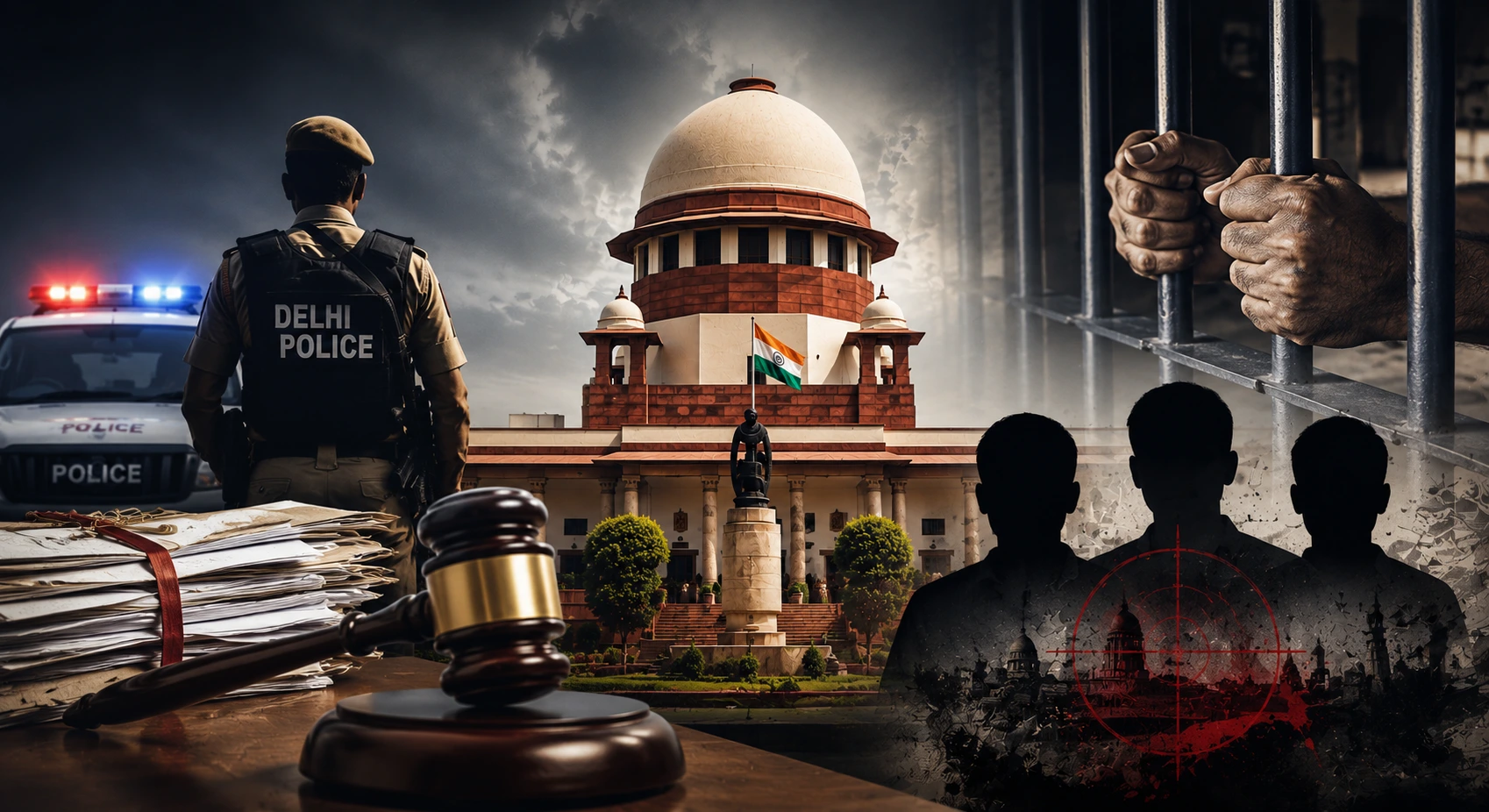
The Supreme Court on Wednesday issued notice to the Delhi Police on bail pleas filed by two alleged Indian Mujahideen operatives who have been in custody for over 12 years in connection with a terror conspiracy case linked to an alleged illegal arms and ammunition factory in Delhi.
A Bench of Justices Joymalya Bagchi and Vipul M. Pancholi issued notice on the pleas filed by Mohd Saquib Ansari and Waqar Azhar, and also observed that the principles laid down in Gulfisha Fatima v. State, the Supreme Court’s January 2026 ruling on bail in the Delhi riots case, would govern the present matter. The Court orally observed that KA Najeeb, in which prolonged delay in trial was held to be a valid ground to grant bail even under the Unlawful Activities (Prevention) Act (UAPA), would apply “with all force” to the present case, subject to the interpretation placed on it in the Gulfisha Fatima judgment.
Background
The present case arises from a First Information Report (FIR) registered by the Delhi Police Special Cell following the arrest of alleged Indian Mujahideen member Mohd Quateel Siddiqui in November 2011. According to the prosecution, the investigation uncovered a wider conspiracy involving members of the banned outfit and led to the arrest of several individuals across multiple states.
Ansari and Azhar were arrested in March 2014 after the arrest of Pakistani national Zia-ur-Rehman alias Waqas, who allegedly disclosed their names during interrogation. The prosecution claims the two men were part of the Rajasthan module of Indian Mujahideen and were involved in preparations for terrorist attacks. They have remained in custody since their arrest, making their period of incarceration exceed 12 years at the time of the present hearing.
Delhi High Court’s Refusal of Bail
In April 2026, a Division Bench of Justices Prathiba M. Singh and Madhu Jain of the Delhi High Court refused to grant bail to the two accused despite their prolonged incarceration. The High Court held that the allegations against the accused, the material allegedly recovered from them, and their conviction in a connected case in Rajasthan were sufficient to attract the bar on bail under Section 43D(5) of the UAPA.
The High Court also relied on the Supreme Court’s ruling in Gulfisha Fatima v. State to hold that prolonged incarceration, by itself, could not justify the grant of bail in the facts of the case. Ansari and Azhar thereafter approached the Supreme Court challenging the refusal.
Submissions Before the Supreme Court
Additional Solicitor General Anil Kaushik, appearing for the Delhi Police, submitted that the High Court’s order denying bail was a reasoned one and had correctly applied the principles laid down in the Gulfisha Fatima judgment. He urged the Court to dismiss the pleas.
The Court, however, expressed doubt over this submission. It questioned whether the High Court had in fact applied the Gulfisha Fatima principles, particularly noting that the judgment itself was pending consideration before a larger Bench of the Supreme Court. The Court remarked: “What reasoned order? Judgement referred to is pending for reference. What are you saying? Najeeb will apply with all force here, subject to the way it has been interpreted in Gulfisha. You will have to file a counter.”
The Evolving UAPA Bail Jurisprudence
The Bench’s oral observations carry significance given the state of flux in UAPA bail jurisprudence at the Supreme Court. Last month, while granting interim bail to Delhi riots accused Tasleem Ahmed and Khalid Saifi, a Bench of Justices Aravind Kumar and P.B. Varale referred certain questions relating to UAPA bail jurisprudence for consideration by a larger Bench of the Supreme Court.
That reference arose after a separate Bench of Justices B.V. Nagarathna and Ujjal Bhuyan, in Syed Iftikhar Andrabi v. National Investigation Agency, expressed reservations about the Supreme Court’s ruling in Gulfisha Fatima v. State, particularly the decision to deny bail to Umar Khalid and Sharjeel Imam. The Justice Nagarathna Bench opined that the Umar Khalid bail denial order appeared to conflict with the principles laid down in KA Najeeb, in which it was held that prolonged delay in trial was a ground to grant bail regardless of the stringent tests under the UAPA.
The Gulfisha Fatima judgment had taken a more nuanced view of trial delays. It held that delay cannot by itself become a ground for bail in UAPA cases; courts must also consider the nature of the allegations, the strength of the prosecution’s case, and the stage of the trial. The larger Bench reference now pending raises the broader constitutional question of how Article 21’s guarantee of personal liberty is to be applied in cases where Parliament has imposed stringent conditions on bail under Section 43D(5) of the UAPA.
It is against this unsettled legal backdrop that the Bench today signalled that KA Najeeb would apply to Ansari and Azhar’s pleas, while conditioning that application on the interpretation placed on it in the Gulfisha Fatima judgment. The Delhi Police has been directed to file a counter-affidavit.
Case Details
- Case Title: Mohd Saquib Ansari and Waqar Azhar v. State (Delhi Police)
- Court: Supreme Court of India
- Bench: Justice Joymalya Bagchi and Justice Vipul M. Pancholi
- Date of Hearing: June 17, 2026
- For Delhi Police: Additional Solicitor General Anil Kaushik