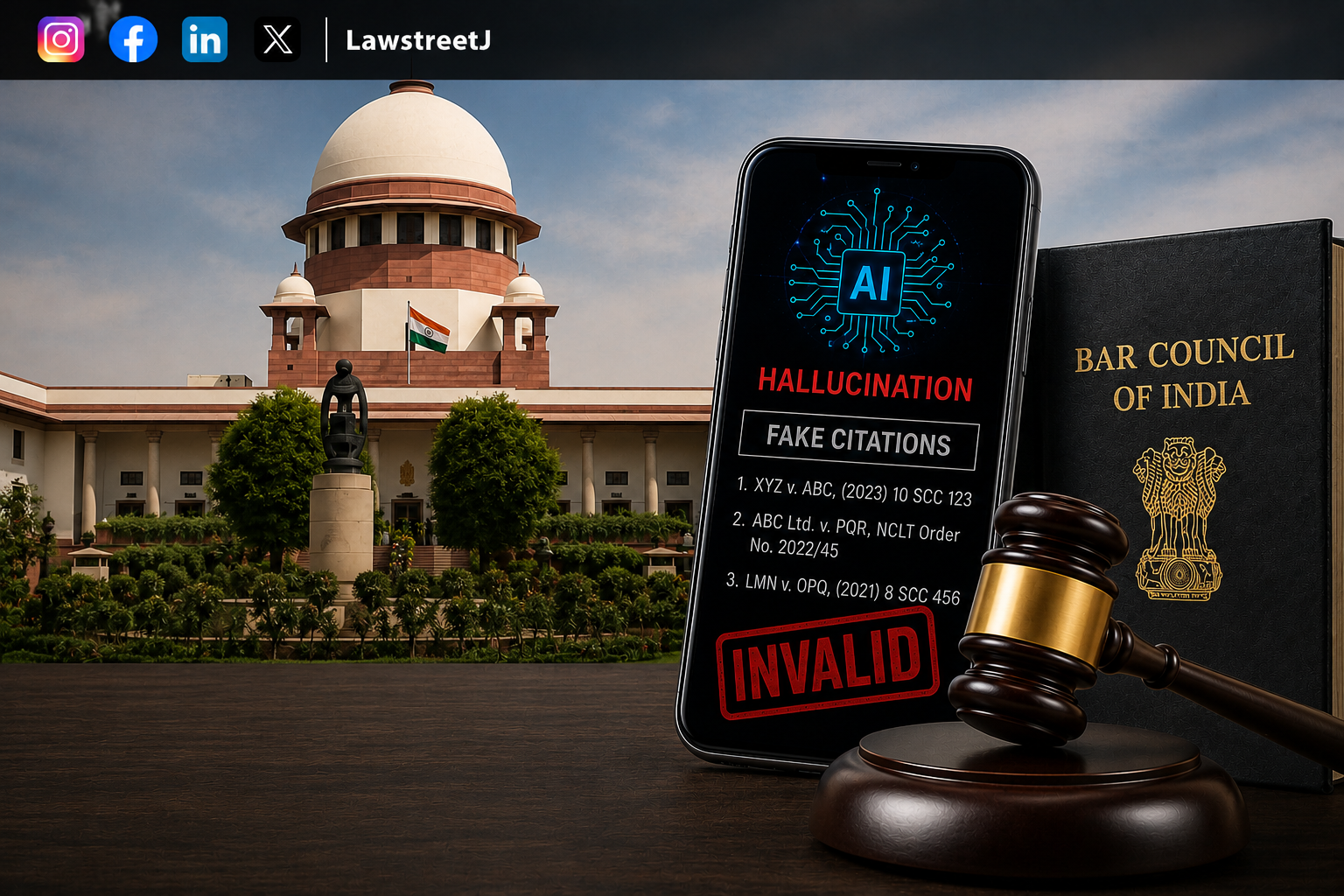
A Bench of Justices P.S. Narasimha and Alok Aradhe declares zero tolerance for AI-generated fake precedents, holds that a decision founded even partly on hallucinated material “is no decision at all” and amounts to subversion of the rule of law, and directs the Bar Council of India to constitute a committee to prescribe guidelines and disciplinary consequences for advocates who cite non-existent judgments
The Supreme Court of India on July 2, 2026 set aside orders passed by the National Company Law Tribunal (NCLT) and the National Company Law Appellate Tribunal (NCLAT) in an insolvency matter after finding that the NCLT had relied upon and cited fake, non-existent judgments, including paragraphs hallucinated by Artificial Intelligence — as binding precedents in its decision, which error went unnoticed by the appellate tribunal. The Court declared zero tolerance for the production, citation or use of AI-generated precedents without verification, and directed the Bar Council of India to constitute a committee to prescribe guiding principles and disciplinary action for advocates who present such material before courts.
A Bench of Justice Pamidighantam Sri Narasimha and Justice Alok Aradhe delivered the judgment in Civil Appeal No. 11950 of 2025 (Pooja Ramesh Singh v. Jammu and Kashmir Bank Ltd. & Anr.), bearing citation 2026 INSC 668. The Bench identified the case as “yet again” a matter where a tribunal had relied on “non-existent, fake and hallucinated material, generated through Artificial Intelligence, as if it were a precedent in support of its judgment.”
The Six Fake Citations: An Independent Verification
Senior Advocate Madhavi Divan, appearing for the appellant, pointed out at the outset of the hearing that the citations and judgments relied upon by the NCLT to arrive at its findings, as reproduced and affirmed by the NCLAT in paragraph 12 of its appellate opinion, were fake and non-existent, probably AI-generated. She further noted that even where case citations were accurate, the paragraphs excerpted from those judgments were not traceable to the reported decisions in any law report.
The Supreme Court undertook an independent examination of each of the six judgments cited by the NCLT and found the following: State Bank of India v. M/s Shree Ram Urban Infrastructure Ltd., 2020 SCC OnLine SC 341, Wrong citation of an existing reported judgment (correct title is M. Subramaniam v. S. Janaki, (2020) 16 SCC 728) with a non-existent paragraph; Everest Kento Cylinders Ltd. v. Union of India, (2015) 2 SCC 1, Correct citation but non-existent paragraph; ICICI Bank Ltd. v. Urban Infrastructure Real Estate Ltd., (2019) 16 SCC 528, Non-existent citation entirely; V.S. Dempo & Co. Ltd. v. Reliance Communications Ltd., (2021) 10 SCC 176, Non-existent citation; Canara Bank v. N.G. Subbaraya Setty & Anr., (2018) 16 SCC 228, Correct citation but non-existent paragraph; and Sarbjit Singh v. Union Bank of India, (2022) 7 SCC 464, Non-existent citation.
Respondent No. 1 (J&K Bank) filed an affidavit before the Supreme Court stating that the alleged judgments relied upon by the NCLT were not cited by its counsel at the bar, and that the so-called precedents were obtained through the NCLT’s own research, making the NCLT itself responsible for introducing the hallucinated material into the proceedings. The error then escaped scrutiny at the NCLAT level, which affirmed the NCLT’s reasoning without verifying the citations.
The Court’s Legal Holding: Zero Tolerance
The Bench made a series of significant declarations on the legal consequences of relying on AI-hallucinated material in adjudication. It held that it is professional misconduct on the part of an advocate to cite AI-generated judgments without verification, and that it constitutes a serious lapse when a judge relies on such material as precedent.
“It is necessary for Courts to adopt a zero-tolerance mode for producing, citing or using AI-generated precedents without verification. It is a misconduct on the part of an advocate to cite such judgments without verification. Equally, it is a serious lapse if a judge relies on such a fake or hallucinated AI-generated material as precedents in support of the determination.” - Supreme Court of India
Most significantly, the Court declared that a decision founded even on an iota of fake or hallucinated material is no decision at all in the eyes of the law, regardless of whether such material had a direct or indirect bearing on the outcome, and that such decisions must be set aside.
“A decision of a Court or an adjudicating authority based on material which is fake and hallucinated is no decision at all, and it amounts to subversion of the rule of law. Such a decision is unsustainable and has to be set aside at the earliest.” - Supreme Court of India
The Court drew a striking analogy to describe the danger posed by AI hallucinations in legal proceedings, comparing the infiltration of fake material as precedent to the release of methyl isocyanate: “invisible, insidious, and catastrophic by the time anyone notices.” It clarified that its judgment has no bearing on the legitimate and rightful use of AI in legal practice, but operates solely against the presentation or reliance on fake or hallucinated material as though it were court precedent.
On AI in Adjudication: Human in the Loop at Every Stage
Beyond the immediate facts, the judgment contains a broader reflection on the relationship between artificial intelligence and the judicial process. The Bench expressed its resolve to adopt AI technology in aid of adjudication while “asserting and declaring total and absolute control over adjudication, with a human in the loop at every stage.”
The Court warned that while AI has acquired the capability to better, if not fully substitute, human effort in routine and intellectual tasks, unregulated use will “insidiously enter legal practice, the process of judicial decision-making and decision-making itself.” It noted that unlike previous technologies absorbed into court systems, AI is “not just an aid to assist us in our work, but is an alternative to our own thinking, reasoning and even decision making,” making extra caution necessary.
“Wisdom and foresight compel us to recognise human vulnerability to seek comfort in delegation, but if thinking is delegated and it forms a habit, it will have serious consequences for the core of human existence, which lies in its capacity to think.” - Supreme Court of India
The Bench also noted that while AI regulations are being deliberated and will be notified in due course through public policy and enforceable rules, the real safeguard lies in “the power of the will of the Bar as well as the Bench” to harness AI with care and caution. It observed that no other facet of legal practice had ever demanded a higher corroboration and coordination between the Bar and the Bench than the question of applying AI to adjudication.
The Court also referenced an international development: the Solicitors Regulation Authority in the United Kingdom approved in 2025 the first purely AI-driven law firm, Garfield Law Limited, which has since successfully obtained a county court decree in a fee recovery suit, illustrating that AI’s capability, if left unregulated, may render professionals dependent on it in ways that carry serious institutional risks.
Directions
The Supreme Court set aside the orders of the NCLT dated August 28, 2024 and the NCLAT dated September 11, 2025. The Section 7 application (RCP (IB) 6/MB/2023) was restored to its original number before the NCLT. The NCLT was directed to take up and dispose of the application expeditiously, preferably within two weeks, without any expression of opinion on the merits. The parties were directed to maintain status quo pending disposal.
The Bar Council of India was directed to constitute a committee to deliberate on the issue of members of the bar submitting fake and hallucinated material before courts as precedents of law, to prescribe guiding principles to prevent such occurrences, and to specify the disciplinary action that will follow a violation of such norms.
Case Details
- Case Title: Pooja Ramesh Singh v. Jammu and Kashmir Bank Ltd. & Anr.
- Citation: 2026 INSC 668
- Court: Supreme Court of India
- Bench: Justice Pamidighantam Sri Narasimha and Justice Alok Aradhe
- Case Number: Civil Appeal No. 11950 of 2025
- Date of Judgment: July 2, 2026
- For Appellant: Senior Advocate Madhavi Divan