38.6c New Delhi, India, Thursday, January 29, 2026
Top Stories Supreme Court
Political NEWS Legislative Corner Celebstreet International Videos
Subscribe Contact Us
close
Judiciary

SC Stays 2026 UGC Equity Regulations Over Concerns Of Vagueness And Misuse

By Saket Sourav      29 January, 2026 05:42 PM      0 Comments
SC Stays 2026 UGC Equity Regulations Over Concerns Of Vagueness And Misuse

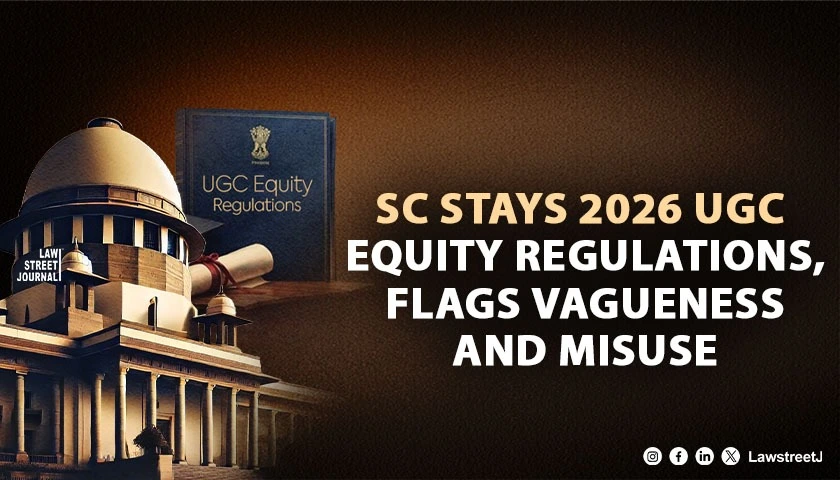
New Delhi: The Supreme Court has directed that the recently notified University Grants Commission (Promotion of Equity in Higher Education Institutions) Regulations, 2026, be kept in abeyance, observing that the regulations are “prima facie vague” and “capable of misuse.”

A Bench led by Chief Justice Surya Kant and Justice Joymalya Bagchi ordered that the 2012 Regulations shall continue to remain in force while the constitutional validity of the new framework is examined.

The controversy centres on Regulation 3(1)(c), which defines “caste-based discrimination” specifically as unfair treatment directed towards members of Scheduled Castes (SC), Scheduled Tribes (ST), and Other Backward Classes (OBC).

The petitioners, including Advocate Vineet Jindal and Rahul Dewan, argued that this definition is “non-inclusionary” and “manifestly arbitrary” as it excludes students and faculty from the “general” or non-reserved categories who may also face caste-based hostility.

Counsel for the petitioners contended that the regulations violate Article 14 (Right to Equality) and Article 15(1) of the Constitution by creating a “hostile classification” based solely on caste. It was argued that the regulations proceed on an “untenable presumption” that discrimination operates only in one direction, thereby ignoring the possibility of “reverse discrimination.”

The petitioners also pointed out that the regulations are redundant, as Regulation 3(1)(e) already provides a general definition of discrimination that could cover all students, regardless of identity.

During the proceedings, the Bench expressed sharp concerns over the potential for social segregation. Chief Justice Surya Kant questioned whether the framework was taking the country backwards, asking, “Whatever we have gained in terms of achieving a casteless society, are we now becoming regressive?”

The Court also flagged a proposed remedial provision for separate hostels for different castes, with the CJI remarking, “For God’s sake, don’t do this! We all used to stay together.”

Justice Bagchi emphasised that the “unity of India” must be reflected in educational institutions and questioned why a broader, more inclusive policy from 2012 was being replaced by a narrower framework.

The Bench warned that the 2026 rules could have “sweeping consequences” and a “dangerous impact” by effectively dividing society.

The Supreme Court has issued notice to the Centre and the University Grants Commission, returnable on March 19, 2026. The Court suggested that the government consider constituting a committee of eminent jurists and scholars to revisit and potentially redraft the regulations to ensure they are inclusive and constitutionally compliant.

Until further orders, the status quo ante shall remain, meaning Higher Education Institutions (HEIs) must continue to follow the 2012 UGC Regulations.

The 2026 Regulations were originally notified on January 13, 2026, and were intended as a robust response to a 2019 PIL filed by the mothers of Rohith Vemula and Payal Tadvi, seeking stricter anti-discrimination measures following their children’s suicides.

While some officials and political leaders, including the Tamil Nadu Chief Minister, welcomed the rules as a necessary safeguard for marginalised communities, the notification triggered widespread protests across Uttar Pradesh, Delhi, and Bihar. Protesters labelled the rules a “black law” and criticised the lack of representation for general category members in the mandated equity committees.

Case Title: Vineet Jindal v. Union of India & Anr.



Share this article:

About:

Saket is a law graduate from The National Law University and Judicial Academy, Assam. He has a keen ...Read more

Follow:
Linkedin


Leave a feedback about this
Related Posts
View All

Another CBI Officer Investigating Rakesh Asthana Moves SC Against Transfer, Makes Startling Revelations Another CBI Officer Investigating Rakesh Asthana Moves SC Against Transfer, Makes Startling Revelations

After A.K. Bassi, another CBI officer who was investigating corruption allegations against Special Director Rakesh Asthana moved the Supreme Court.

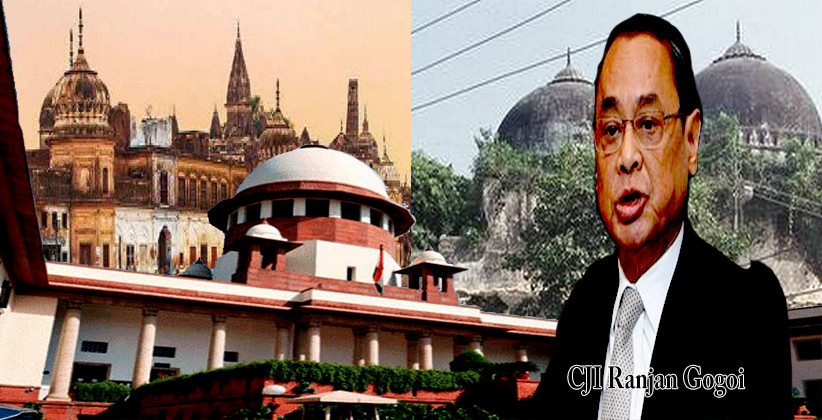
Ayodhya verdict: SC rules in favour of Ram Lalla, Sunni Waqf Board gets alternate land Ayodhya verdict: SC rules in favour of Ram Lalla, Sunni Waqf Board gets alternate land

SC bench led by CJI Ranjan Gogoi has allotted the dispute site to Ram Janmabhoomi Nyas, while directing the government to allot an alternate 5 acre land within Ayodhya to Sunni Waqf Board to build a mosque.

Supreme Court: Money Spent On Judiciary Less Than 1% In All States Except Delhi Supreme Court: Money Spent On Judiciary Less Than 1% In All States Except Delhi

The court guided all states to document their response to the commission's report within four weeks. If any of the states fail to file a response, it will be presumed that they have no objections to the recommendations made by the commission, the court said.

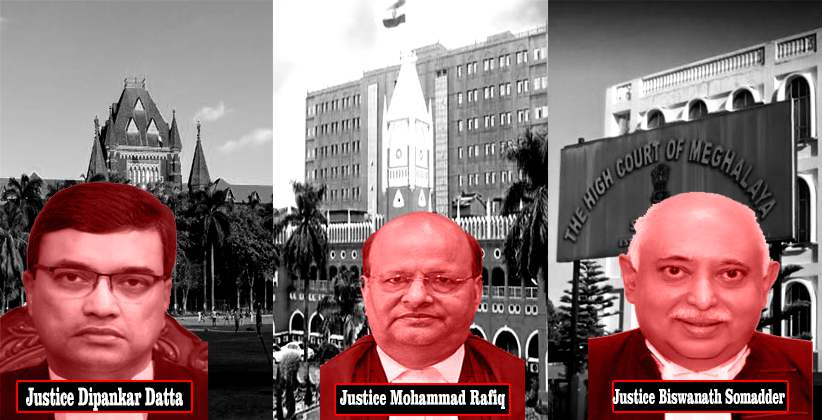
Supreme Court Top Panel Names Chief Justices for Bombay, Orissa and Meghalaya High Courts Supreme Court Top Panel Names Chief Justices for Bombay, Orissa and Meghalaya High Courts

On April 18, 2020, the Supreme Court Collegium recommended new Chief Justices for three High Courts. Justice Dipankar Datta was proposed as Chief Justice of the Bombay High Court, succeeding Justice B.P. Dharmadhikari. Justice Biswanath Somadder was nominated as Chief Justice of Meghalaya High Court, while Justice Mohammad Rafiq was recommended for transfer as Chief Justice of Orissa High Court.

TRENDING NEWS

vande-mataram-at-150-constitutional-reverence-judicial-restraint-and-the-limits-of-legal-nationalism
Trending Know The Law
Vande Mataram at 150: Constitutional Reverence, Judicial Restraint, and the Limits of Legal Nationalism

At 150, Vande Mataram’s constitutional status, judicial restraint, and the limits of legal nationalism reveal India’s unresolved debate on law and reverence.

28 January, 2026 12:19 PM
delhi-hc-upholds-family-pension-for-remarried-childless-widow-of-crpf-personnel-parents-not-entitled
Trending Judiciary
Delhi HC Upholds Family Pension for Remarried Childless Widow of CRPF Personnel; Parents Not Entitled [Read Judgment]

Delhi High Court rules that a remarried childless widow of a CRPF personnel remains entitled to family pension; dependent parents have no claim under Rule 54.

28 January, 2026 03:56 PM

TOP STORIES

national-green-tribunal-takes-suo-motu-cognisance-of-techies-drowning-in-waterlogged-trench
Trending Environment
National Green Tribunal Takes Suo Motu Cognisance Of Techie’s Drowning In Waterlogged Trench [Read Order]

National Green Tribunal takes suo motu cognisance of a techie’s drowning in a waterlogged trench in Noida, citing environmental lapses and violation of law.

23 January, 2026 03:20 PM
vande-mataram-at-150-constitutional-reverence-judicial-restraint-and-the-limits-of-legal-nationalism
Trending Know The Law
Vande Mataram at 150: Constitutional Reverence, Judicial Restraint, and the Limits of Legal Nationalism

At 150, Vande Mataram’s constitutional status, judicial restraint, and the limits of legal nationalism reveal India’s unresolved debate on law and reverence.

28 January, 2026 12:19 PM
delhi-hc-upholds-family-pension-for-remarried-childless-widow-of-crpf-personnel-parents-not-entitled
Trending Judiciary
Delhi HC Upholds Family Pension for Remarried Childless Widow of CRPF Personnel; Parents Not Entitled [Read Judgment]

Delhi High Court rules that a remarried childless widow of a CRPF personnel remains entitled to family pension; dependent parents have no claim under Rule 54.

28 January, 2026 03:56 PM
iran-warns-of-unprecedented-retaliation-amid-renewed-us-threats-over-nuclear-program
Trending International
Iran Warns of Unprecedented Retaliation Amid Renewed U.S. Threats Over Nuclear Program

Iran warns of unprecedented retaliation as U.S. threats over its nuclear program intensify, raising legal, diplomatic, and geopolitical concerns.

29 January, 2026 11:51 AM

ADVERTISEMENT


Join Group

Signup for Our Newsletter

Get Exclusive access to members only content by email