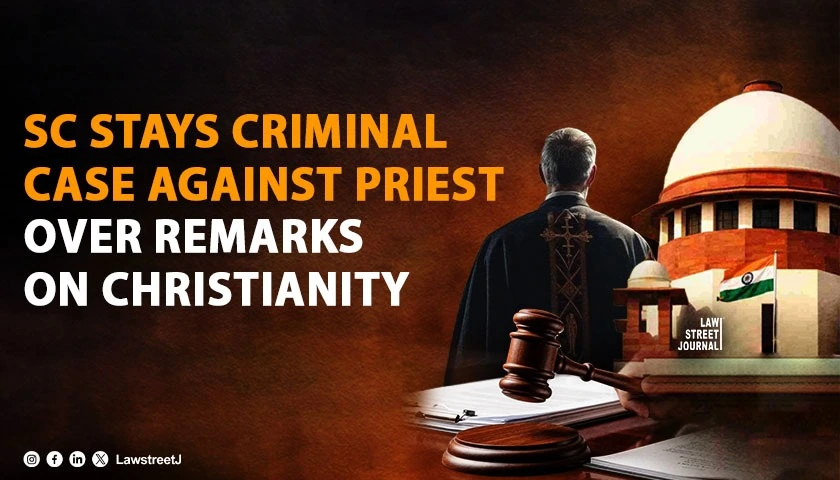
New Delhi: The Supreme Court of India on Friday stayed the criminal proceedings against a Christian priest who had been booked by the Uttar Pradesh Police for allegedly stating that Christianity is the only true religion.
A Bench comprising Justice Vikram Nath and Justice Sandeep Mehta issued notice to the Uttar Pradesh government on the priest’s plea challenging the criminal case. The Court directed that the trial shall remain stayed during the pendency of the proceedings.
The case arises from allegations that the priest, during prayer meetings, repeatedly stated that Christianity is the only true religion, which allegedly hurt the religious sentiments of Hindus.
Earlier, the Allahabad High Court had refused to quash the proceedings against the priest. In its ruling, Justice Saurabh Srivastava observed that India is a secular country where people of all faiths coexist, and that it would be wrong for any religion to claim that it is the “only true religion,” as such a claim implies disparagement of other faiths.
The High Court, upon examining the FIR, noted that the applicant had allegedly made repeated statements during prayer meetings asserting the exclusivity of Christianity, which was stated to have hurt the sentiments of a particular community. It held that such conduct could fall within the ambit of Section 295A of the Indian Penal Code, which penalises deliberate and malicious acts intended to outrage religious feelings.
The Court observed:
“Upon a bare perusal of the FIR, it is noted that during prayer meetings, the applicant frequently stated that there is only one religion, namely Christianity, and thereby hurt the sentiments of a particular religion, i.e., Hinduism. India is a land where people of all faiths and beliefs live together in a secular state as defined by the Constitution of India. Therefore, it is wrong for any religion to claim that it is the only true religion, as it implies disparagement of other faiths.”
The High Court further observed that, at the stage of consideration, it could not be said that no prima facie case was made out against the accused.
Before the High Court, the petitioner’s counsel had argued that the priest was falsely implicated and that no illegal religious conversion had taken place. It was also contended that the FIR did not disclose an offence under Section 295A IPC, and that the charge sheet had been filed without a fair investigation. Additionally, it was argued that the magistrate had taken cognisance of the offence without proper application of mind.
The accused subsequently challenged the charge sheet, as well as the trial court’s order taking cognisance, before the Supreme Court, which has now granted interim relief by staying the proceedings.