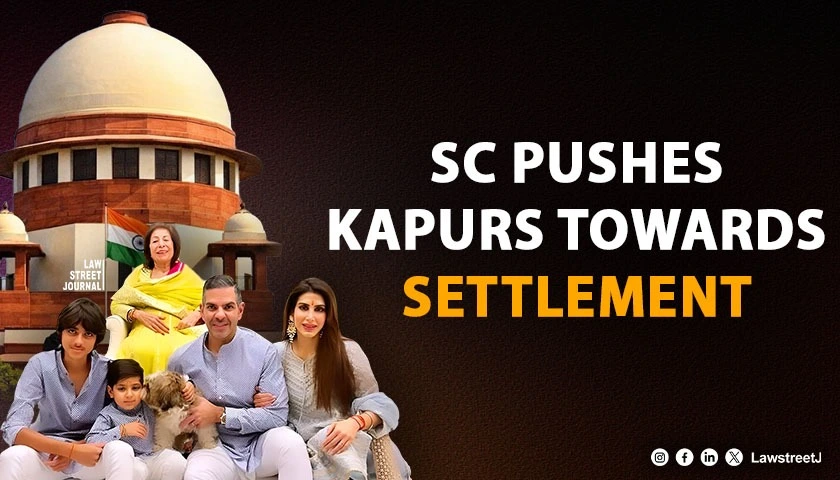
New Delhi: The Supreme Court on May 14, 2026, declined to stay a board meeting of Raghuvanshi Investment Private Limited (RIPL), which owns a major portion of the disputed estate of the late Sunjay Kapur, while urging the Kapur family to resolve their ongoing inheritance dispute through mediation in the case of Rani Kapur v. Priya Kapur.
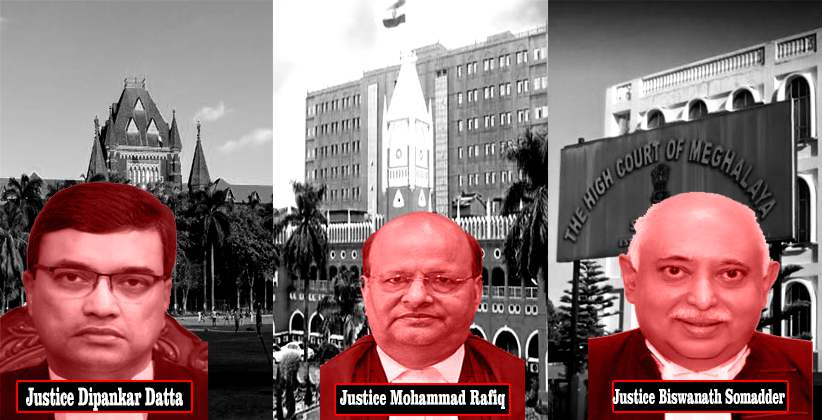
A Bench of Justices J.B. Pardiwala and Ujjal Bhuyan, however, directed that the agenda items concerning the appointment of two independent directors and the change of signatory for bank accounts shall not be discussed during the board meeting. The Bench also stated that it would examine the progress of the ongoing mediation regarding the dispute over Sunjay Kapur’s estate.
The Bench observed: “We have already requested the mediator to start with the mediation proceedings. For the present, we request the opponents not to do anything which may directly affect mediation. Time and again, we have said it will be in the interest of all parties to put an end to this dispute, else it will be a long-drawn battle.”
The Court again appealed to the family members to settle the dispute, referring to the advancing age of Rani Kapur. “She is an 80-year-old woman. We all came with empty hands and we have to go with empty hands. All we carry is our souls. There has to be a will to settle the matter. Don’t go before the mediator with a heavy heart just because the Court has pushed us. Each one of you try,” the Bench said.
Rani Kapur, the 80-year-old widow of late Dr Surinder Kapur, has alleged that she has been divested of her legacy, estate, and home through a fraudulent instrument called the RK Family Trust or Rani Kapur Family Trust. The plea states that though the Trust purportedly names her as settlor and trustee, it makes Priya Sachdev Kapur and others the sole beneficiaries, to the exclusion of Rani Kapur and the rest of the Kapur family.
The immediate grievance before the Court concerns a notice dated May 8, 2026, issued by RIPL calling a board meeting for May 18, a notice served barely 24 hours after the Supreme Court had referred the family dispute to mediation before former Chief Justice of India D.Y. Chandrachud on May 7.
At the outset of the hearing, the Bench questioned the filing of yet another application. “Why are you again here? If you all are not interested in mediation, we will not waste any time and we will hear it. Once we have sent it to mediation, we expect the parties to participate,” the Court said.
Senior Advocate Navin Pahwa, appearing for Rani Kapur, submitted that the board meeting had been called to ensure that she would be “completely drowned out.” He submitted that her shareholding had been placed into the trust without her knowledge and that her daughter-in-law had transferred the majority shareholding into the trust.
Senior Advocate Kapil Sibal, appearing for the respondents, informed the Court that the Reserve Bank of India had conducted an inspection and directed that two independent directors be appointed by May 21. The Court said it would take care of the RBI directive and passed an order to the effect that the RBI’s directives and statutory compliances need not be enforced for the time being by the RBI or other statutory authorities.
The case arises from a suit filed by Rani Kapur, who has alleged that after she suffered a stroke in 2017, her late son Sunjay Kapur and his wife Priya Kapur exploited her physical condition and the trust she reposed in them. She has alleged that her assets were transferred into the family trust without informed consent and that she was made to sign documents, including blank papers, under the pretext of administrative convenience.
The dispute intensified following Sunjay Kapur’s death in June 2025, after which Rani Kapur alleged that Priya Kapur moved swiftly to assume control over key Sona Group entities. Rani Kapur has claimed that a substantial portion of the family assets has gone to Priya Kapur and the children, leaving her with nothing. Parallel proceedings over control of the estate and assets are pending before the Delhi High Court.
On April 30, 2026, the Delhi High Court allowed an interim injunction plea filed by Bollywood actor Karisma Kapoor’s two children born out of her marriage with Sunjay Kapur and restrained Priya Sachdev Kapur from creating any third-party rights over the assets left behind by Sunjay Kapur.
Before the Supreme Court, Rani Kapur has sought a status quo on the alienation of all properties of the trust.
Case Details: Rani Kapur v. Priya Kapur, Supreme Court of India. Before Justices J.B. Pardiwala and Ujjal Bhuyan. Hearing dated May 14, 2026. Senior Advocate Navin Pahwa appeared for the Petitioner. Senior Advocate Kapil Sibal appeared for the Respondents.