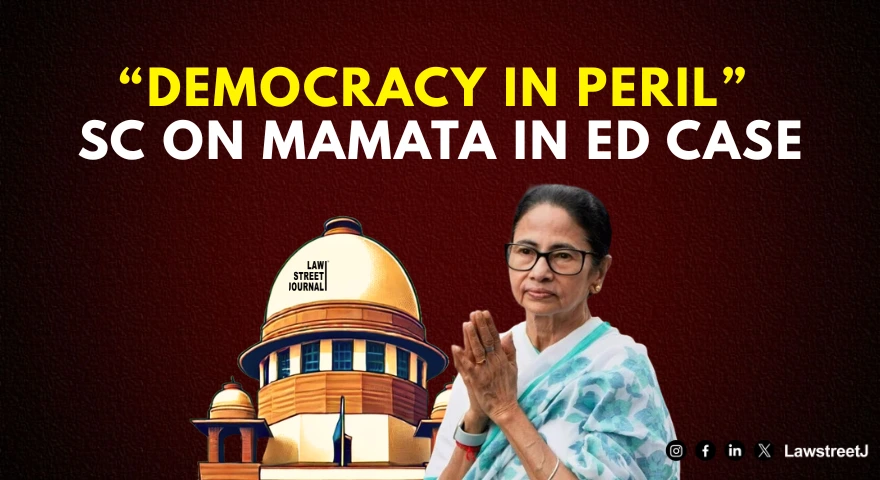
New Delhi: On 22 April 2026, the Supreme Court of India delivered a series of sharp oral observations regarding the alleged interference by West Bengal Chief Minister Mamata Banerjee in an ongoing investigation by the Enforcement Directorate (ED).
A bench comprising Justices Prashant Kumar Mishra and N. V. Anjaria, while hearing a batch of writ petitions, remarked that the conduct of a sitting Chief Minister walking into an active investigation site has the potential to put “democracy in peril.” The court emphasized that such actions undermine institutional integrity and public confidence in the investigative process, raising serious constitutional concerns beyond the scope of conventional federal disputes.
The proceedings stem from an incident on 8 January 2026, when ED officials were conducting search operations at the Kolkata office of political consultancy firm I-PAC and the residence of its director, Prateek Jain. The ED alleges that Chief Minister Banerjee, accompanied by senior party leaders and state police officials, entered the premises during the search. According to the agency, she confronted the investigating officers and purportedly removed several files and electronic devices crucial to a money laundering investigation linked to alleged coal smuggling activities. In the aftermath, the West Bengal Police registered three separate FIRs against the ED officials involved in the raid.
During the hearing, the Supreme Court bench addressed the West Bengal government’s preliminary objection regarding the maintainability of the ED’s writ petition under Article 32 of the Constitution. Senior Advocate Menaka Guruswamy, appearing for the state officials, argued that the matter should be treated as a dispute between the Union and the State, necessitating a suit under Article 131 rather than a writ petition. She contended that a government department like the ED cannot invoke fundamental rights jurisdiction against a state. However, the court objected to this characterization, questioning what specific “right of the state” was involved in a Chief Minister entering an investigation.
Justice Mishra noted that even those involved in the Kesavananda Bharati case could never have conceived of a situation where a sitting Chief Minister would walk into the office of an investigating agency during an inquiry. The court stated that the act was committed by an individual holding a constitutional office, rather than constituting a federal disagreement between two governments. The bench reiterated that when a high functionary interferes with a central agency’s probe, it cannot be brushed aside as a mere intergovernmental dispute.
Senior Advocate Abhishek Manu Singhvi, representing a state police official, presented a separate argument regarding the legal standing of the ED. He argued that the ED, as a statutory authority and a governmental body, does not possess the legal personality of a “citizen” and therefore cannot invoke fundamental rights under Article 32 or Article 19. He further argued that allowing a central department to file such a writ against a state would be “dangerous to the federal structure.”
In response, the Supreme Court probed whether officials of the agency cease to be citizens entitled to constitutional protection simply because they are acting in an official capacity. The court noted that accepting the state’s narrow interpretation could unduly restrict access to constitutional remedies. The bench also declined a request to refer the matter to a five-judge Constitution Bench. While the state argued that the case presented a “unique proposition of law,” Justice Mishra remarked that every petition contains some question of law, but that does not necessitate referral to a larger bench in every instance.
Chief Minister Banerjee, in a counter-affidavit filed before the court, denied all allegations of unlawful obstruction. She asserted that her presence at the premises was limited to retrieving proprietary and confidential data belonging to her party, the All India Trinamool Congress (AITC). She claimed that this data was essential for the party’s strategy for the upcoming 2026 Legislative Assembly elections and was being accessed by the ED without authority. The affidavit stated that she “politely requested” the officials to allow her to retrieve specific devices and files, and claimed that the ED officers present did not object at the time.
The state’s defense further questioned the timing and intent of the ED’s search operations, alleging that they were carried out with “mala fide intent” just before the state elections. The Chief Minister’s affidavit pointed out that neither the AITC nor its officials were accused in the coal smuggling case under investigation. It also alleged that the ED failed to produce audio or video recordings of the searches as required by statutory safeguards, creating a “strong presumption” that the operations were clandestine. In its rejoinder, the ED disputed this version, maintaining that the materials were removed without its consent.
The Supreme Court had previously issued notice on January 15 and stayed the FIRs registered by the West Bengal Police against the ED officials. At that time, the court observed that the matter raised a serious issue requiring examination to prevent a “situation of lawlessness.” The court had also directed the state government to preserve all CCTV footage and digital recordings from the vicinity of the I-PAC office and the director’s residence related to the January 8 searches.
Case title: Directorate of Enforcement v. State of West Bengal.
Court: Supreme Court of India
Bench: Justice Prashant Kumar Mishra and Justice N. V. Anjaria
Date of Hearing: 22 April 2026
Provision Involved: Article 32 and Article 131 of the Constitution of India
Parties: Directorate of Enforcement (Petitioner) vs. State of West Bengal & Ors. (Respondents)