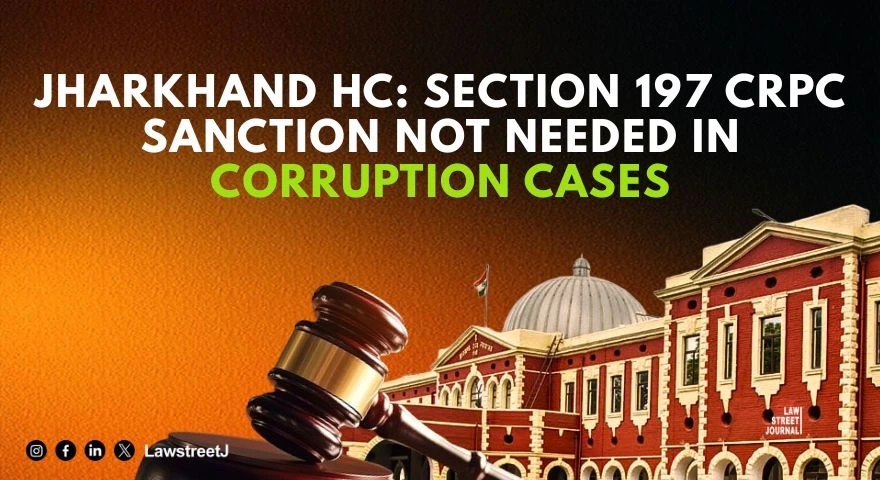
Jharkhand: The Jharkhand High Court has held that the requirement of prior sanction under Section 197 of the Code of Criminal Procedure applies only to acts reasonably connected with the discharge of official duties, and not to personal or illegal acts merely because they are committed by a public servant.
The Court clarified that accumulating ill-gotten wealth by siphoning State funds cannot be said to be part of the official duty of any public servant, and that the protection under Section 197 CrPC is not intended to shield corrupt officials from criminal prosecution.
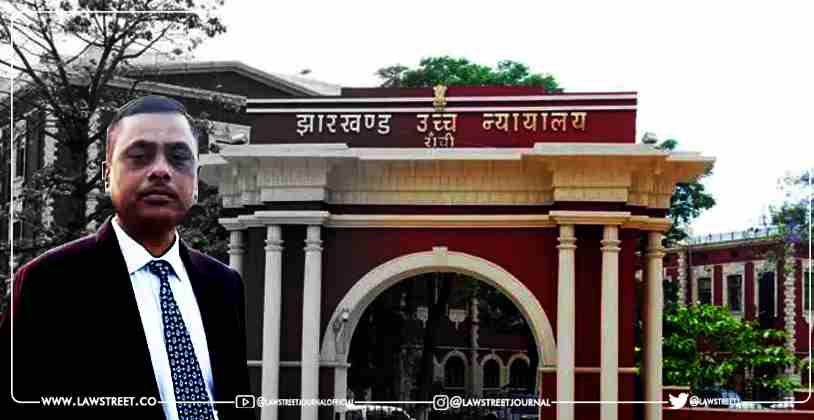
Justice Ambuj Nath delivered the decision on December 22, 2025, while dismissing a writ application filed by Pooja Singhal, an IAS officer and former Deputy Commissioner of Khunti, seeking to quash cognizance taken against her under the Prevention of Money Laundering Act, 2002, for want of prior sanction under Section 197 CrPC.
The Directorate of Enforcement had filed a prosecution complaint in connection with 13 FIRs registered by the Jharkhand Police at Khunti. During the investigation, it transpired that defalcation of huge amounts of government money running into crores was found against the named accused persons, as reflected in the audit report. The petitioner, who was officiating as the Deputy Commissioner, Khunti, allegedly defalcated government money in several projects. The Audit Committee suggested that defalcation to the tune of ₹18.06 crore was committed during the period from February 16, 2009, to July 19, 2010, when she was the principal authority for sanctioning funds for various development projects, in connivance with engineers who were also named accused.
During the investigation, various premises, including those of the petitioner and her associates, were raided and searched, and huge cash amounting to ₹19.76 crore was recovered, apart from documents, records, and digital devices relevant to the investigation. The petitioner was confronted with the recovery but failed to provide any legal source of income. She was arrested on May 11, 2022. It was further alleged that ill-gotten money was invested by the petitioner through her husband, who is also an accused in the case.
The Special Judge took cognizance of offences under Sections 3 and 4 of the Prevention of Money Laundering Act, 2002. The petitioner challenged the cognizance, contending that the Court had taken cognizance without obtaining prior sanction under Section 197(1) of the Code of Criminal Procedure, which was mandatory since she was admittedly a public servant.
The petitioner relied on the Supreme Court’s decision in Enforcement Directorate v. Bibhu Prasad Acharya (2024 SCC OnLine SC 3181), which held that the provisions of Section 197(1) CrPC are applicable to complaints under Section 44(1)(b) of the PMLA through Section 65 of the Act, which makes CrPC provisions applicable to PMLA proceedings.
The Enforcement Directorate contended that the requirement of sanction under Section 197(1) CrPC is meant to protect responsible public servants against the institution of vexatious criminal proceedings while they are acting in the discharge of official duties. However, such protection has limits and is available only when the alleged act is reasonably connected with official duty, and not where the act is merely a cloak for doing an objectionable or illegal act.
The Enforcement Directorate relied on State of Orissa v. Ganesh Chandra Jew (2004) 8 SCC 40, wherein the Supreme Court held that protection under Section 197 is available only when the alleged act is reasonably connected with the discharge of official duty. If, in performing official duty, the public servant acts in excess of duty but there exists a reasonable connection between the act and official functions, such excess would not deprive the public servant of protection. However, an offence entirely unconnected with official duty would not attract such protection.
The High Court examined the scope of Section 197 CrPC and observed that it protects public servants employed under the Central or State Government from vexatious criminal proceedings while acting in their official capacity. Judicial pronouncements have extended this protection even to acts in excess of official duty, provided there exists a reasonable nexus with the discharge of official functions.
However, the Court made a crucial distinction and held:
“However, accumulating ill-gotten wealth by siphoning State funds cannot be said to be part of the official duty of any public servant.”
The Court observed that, on the facts of the present case, the petitioner had sanctioned funds for development projects which she was not authorized to sanction, and had in turn accumulated ill-gotten money. Prima facie, as per the case of the Enforcement Directorate, she had failed to account for the money recovered or alleged to have been recovered from her or her associates.
Emphasizing the legal position, the Court held:
“Sanction under Section 197 of the Code of Criminal Procedure is only for acts reasonably connected with official duty, and not for personal illegal acts, even if committed by public servants. The provision is not meant to shield corrupt officials.”
The Court also referred to Gurmeet Kaur v. Devendra Gupta (2024 SCC OnLine SC 3761), where the Supreme Court reiterated that the decisive test for sanction is whether the impugned act is reasonably connected to official duty. If the act is wholly unconnected or manifestly devoid of any nexus to official functions, sanction is not required. Conversely, where a reasonable link exists, the protection of Section 197 CrPC is attracted.
On the issue of whether the Special Judge ought to have obtained sanction before taking cognizance, the High Court noted that it is settled law that the question of sanction under Section 197 CrPC can be raised at any stage of the proceedings, depending on the nature of evidence led during trial. Sanction may even be obtained at any stage prior to pronouncement of judgment.
The High Court held that taking cognizance without prior sanction in the present case did not vitiate the cognizance order. Accordingly, the writ application was dismissed.
Case Title: Pooja Singhal v. Directorate of Enforcement & Anr., W.P. (Cr.) No. 1043 of 2024


![Supreme Court Collegium approves new Chief Justices for five key High Courts in India [Read Recommendations]](/secure/uploads/2023/12/lj_8000_380d1135-6f3a-4988-a00a-4d5cd5901815.jpg)
!['Arbitrary, impermissible,' SC quashes HC's resolution raising aggregate cut off marks on district judges appointment [Read Judgment]](/secure/uploads/2024/02/lj_3605_Rule-for-Judge-Selection.webp)