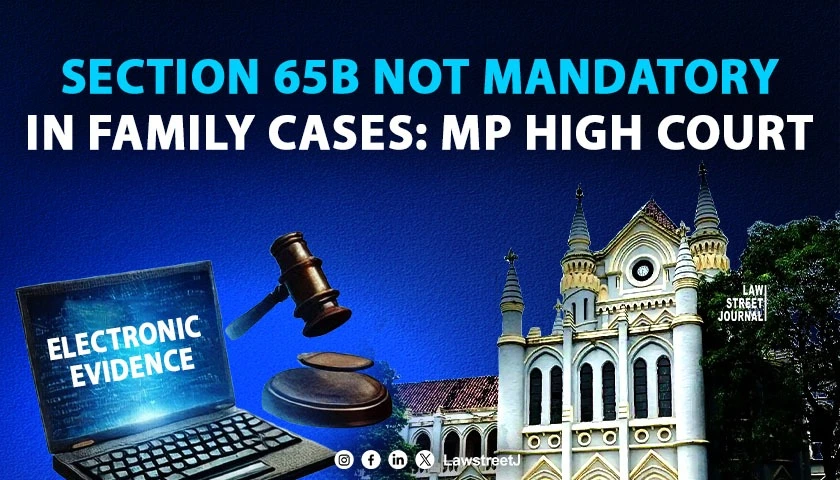
Bhopal: The Madhya Pradesh High Court has held that compliance with Section 65-B of the Indian Evidence Act, 1872—which mandates certification for electronic evidence—is not strictly applicable to proceedings before Family Courts. The Court observed that Family Courts, under Section 14 of the Family Courts Act, 1984, possess broad powers to receive any evidence that may assist them in effectively adjudicating matrimonial disputes.
A Division Bench of Justice Vishal Dhagat and Justice B.P. Sharma delivered the ruling while dismissing a first appeal challenging the Family Court’s decree of divorce on the ground of adultery. The decree had been based primarily on photographs that were allegedly secondary electronic evidence admitted without a certificate under Section 65-B.
The case arose from a petition filed by the husband under Section 13 of the Hindu Marriage Act seeking dissolution of marriage. The Family Court, Balaghat, allowed the petition on November 17, 2021, dissolving the marriage solemnised on February 13, 2006, relying on photographic material indicating the wife’s alleged adulterous relationship.
Challenging the decree, the wife argued that the Family Court had erred in law by admitting the photographs without a mandatory certificate under Section 65-B. Her counsel relied on the Supreme Court’s decision in Arjun Panditrao Khotkar v. Kailash Kushanrao Gorantyal (2020) 7 SCC 1, which affirms the mandatory nature of Section 65-B compliance.
The appellant also contended that she had deposed that the original photographs were on her mobile phone, later transferred to her husband’s device, and that the husband had subsequently broken her phone. She argued that these circumstances undermined the authenticity of the photographs and rendered their admission into evidence improper.
The High Court, however, held that the Arjun Panditrao judgment was not applicable to matrimonial disputes where Section 14 of the Family Courts Act governs admissibility. The Court reiterated that Section 14 authorizes Family Courts to receive “any report, statement, documents, information or matter” that may assist in reaching the truth, irrespective of the technical rules of the Indian Evidence Act.
Since the strict provisions of the Evidence Act do not apply to Family Court proceedings, the High Court found no illegality in the Family Court’s reliance on the photographs without a Section 65-B certificate.
On examining the evidence, the Court noted that the wife, in her deposition as NAW-1, did not deny that she appeared in the photographs. She merely claimed they were fabricated using “some trick” without explaining how or by whom. The Court found this to be a vague and unsubstantiated assertion.
The Bench further observed that the sequence of events narrated by the wife—that the photographs were transferred from her phone to her husband’s phone, followed by the husband breaking her phone—appeared natural. It reasoned that upon discovering proof of adultery, a spouse may act impulsively out of anger to prevent further communication with the alleged paramour.
Additionally, the photographer who developed the photographs, Shailendra Gurubele (AW-5), was examined and his testimony supported the evidentiary value of the photographs.
Considering the totality of the material, including the wife’s partial admissions and the corroborating testimony of the photographer, the Court concluded that no ground existed to interfere with the Family Court’s findings.
The judgment reinforces that Family Courts, as specialised forums, operate under a liberal evidentiary regime designed to facilitate truth-finding and timely resolution of matrimonial disputes. They are not bound by the rigid formalities applicable to regular civil or criminal proceedings under the Evidence Act.
Dismissing the appeal, the High Court upheld the Family Court’s decree dissolving the marriage on the ground of adultery.
[First Appeal No. 866 of 2021]



.jpeg)

![Supporting defamatory WhatsApp posts doesn’t constitute involvement in offence of defamation: MP HC [Read Order]](/secure/uploads/2024/09/lj_6675_WhatsApp_Image_2024-09-16_at_12.24.54_PM.webp)