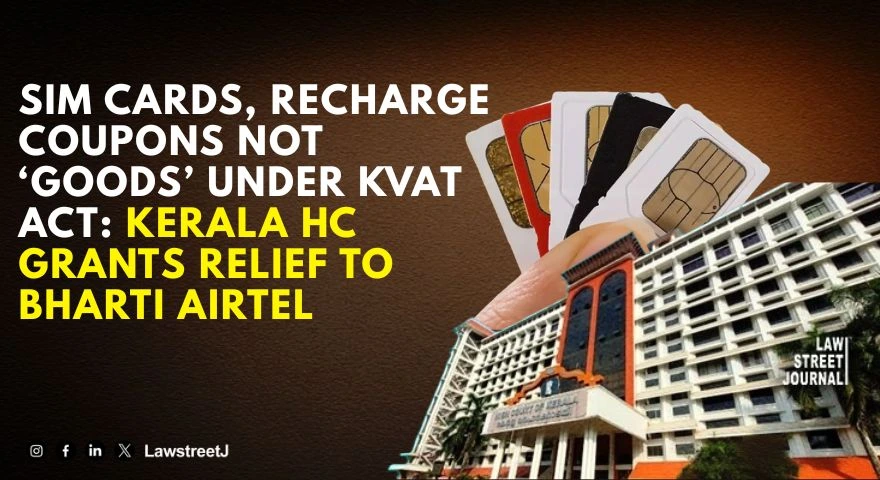
Kerala: The Kerala High Court has granted significant relief to Bharti Airtel Limited by holding that SIM cards, recharge coupons, fixed monthly charges, and telecom value-added services cannot be treated as “goods” under the Kerala Value Added Tax Act, 2003. Consequently, no tax under the KVAT Act can be levied on amounts received towards these items.
Dr. Justice A.K. Jayasankaran Nambiar and Justice Jobin Sebastian were hearing Writ Appeal No. 1745 of 2025 filed by Bharti Airtel Limited, challenging a Single Judge’s judgment dated September 29, 2020, specifically to the extent that it did not address the merits of the assessment order impugned in the original writ petition.
The complex procedural history revealed that Bharti Airtel had initially approached the Court through W.P.(C) No. 12941 of 2020, impugning an assessment order on the ground that it was barred by limitation under Section 25(1) of the KVAT Act, which provided a six-year period for completion of assessment. The company had also raised an alternate challenge to the merits of the assessment order.
The learned Single Judge accepted the limitation argument and allowed the writ petition by setting aside the assessment order. However, the Court noted, “The contention of the petitioner with regard to the merits of the assessment was not gone into by the learned Single Judge.”
Aggrieved by the finding on limitation, the Revenue filed W.A. No. 1748 of 2020, contending that “it was an erroneous appreciation of facts” that led the Single Judge to allow the writ petition. The Revenue pointed out that the notice under Section 25(1) was issued on January 16, 2019, within the six-year limitation period applicable to the assessment year 2013–14.
The Division Bench hearing the State’s appeal found that the amendment to Section 25(1), enlarging the time limit from five to six years, had come into effect in 2017, and that the notice was issued within the prescribed period. Consequently, the Division Bench allowed the State’s appeal and dismissed Bharti Airtel’s writ petition on limitation grounds, while clarifying that “it would be open to the appellant herein to approach the first appellate authority under the KVAT Act in a challenge against Ext.P6 assessment order on merits by filing a statutory appeal within a month.”
Meanwhile, a significant development occurred when “many writ petitions, including writ petitions filed by the appellant herein impugning assessment orders passed by the authorities under the KVAT Act for different assessment years (other than 2013–14), and involving the same issue, came up for consideration before a Single Bench of this Court.”
These writ petitions were disposed of by the learned Single Judge through a judgment dated June 28, 2024, in W.P.(C) No. 482 of 2021 and connected cases, finding in favour of the assessees on the substantive issue. The Single Judge relied on the Andhra Pradesh High Court’s judgment in State of Andhra Pradesh v. Bharat Sanchar Nigam Ltd. [(2012) 49 VST 98] and, critically, the Supreme Court’s order dated April 11, 2023, dismissing the Special Leave Petitions against the Andhra Pradesh judgment.
The Single Judge held that “the order of the Supreme Court affirming the judgment of the Andhra Pradesh High Court constituted a binding precedent for the purposes of Article 141 of the Constitution of India.”
Following this precedent, the Single Judge concluded that “SIM cards, rechargeable coupons, fixed monthly charges and value-added services (towards SMS, ringtones, download music etc.) could not be termed as ‘goods’ for the purposes of the KVAT Act.”
Significantly, the Division Bench noted, “It is significant that the State has not preferred any writ appeal against the said judgment dated 28.06.2024 of the learned Single Judge, which concludes the issue involved in the assessment order in the instant case on merits.”
Although the State claimed to be considering an appeal, the Court observed, “We have not been shown any material that would suggest that the State has taken any positive action towards that end during the last 18 months.” The Court further stated, “We must therefore proceed on the assumption that the State has accepted the aforementioned judgment of the learned Single Judge.”
In the present appeal, the State raised the doctrine of merger, arguing that since the Single Judge’s judgment had already been carried in appeal and decided by a Division Bench, a belated writ appeal could not be entertained. The Special Government Pleader relied on M/s. Gojer Bros. (Pvt.) Ltd. v. Shri Ratan Lal Singh [(1974) 2 SCC 453].
The State also contended that “the assessing authority had made a valid distinction between the telecommunication service rendered by the appellant and those which fell outside the purview of sales tax,” citing precedents including Bharat Sanchar Nigam Ltd. v. Union of India and CST v. Quick Heal Technologies Ltd.
Rejecting these contentions, the Court held, “We are of the view that the principles of merger would have no application in a situation such as the present.” It emphasized that “the earlier Division Bench, while disposing of the appeal preferred by the State, had only reserved a liberty in the assessee to pursue its alternative remedy under the statute.”
The Court reasoned that “when the issue on merits is now covered by a binding precedent of the Supreme Court, and the attempt of the State to distinguish the said precedent did not meet with any success before a learned Single Judge of this Court—against whose judgment no appeal was preferred—it would be meaningless to relegate the appellant-assessee to the statutory authorities.”
It further emphasized practical considerations, stating that “the finality conferred on the said judgment of the learned Single Judge also renders meaningless any liberty granted to the assessee to pursue a statutory remedy, since the statutory authority cannot ignore the binding judgment.”
In its final order, the Division Bench allowed the writ appeal, quashing Ext.P6 assessment order to the extent it demanded tax under the KVAT Act on amounts received by the appellant towards SIM cards, rechargeable coupons, fixed monthly charges, and value-added services, holding that these were not “goods” on which tax could be levied under the KVAT Act.
Advocates Smt. G. Mini, Sri A. Kumar (Senior Advocate), Sri P.J. Anilkumar, and Sri P.S. Sree Prasad appeared for Bharti Airtel Limited. Sri Mohammed Rafiq, Special Government Pleader, appeared for the State, while Shri V. Girishkumar, Standing Counsel for the Central Board of Indirect Taxes and Customs, represented the Union.
Case Title: Bharti Airtel Limited v. Union of India & Ors.



![Kerala HC Quashes 498A Dowry Harassment Case Against Live-In Partner, Citing Lack of Relative Status [Read Order]](/secure/uploads/2023/08/lj_5693_1057c042-1e57-4e27-8c9e-25af0ec38ec4.jpg)
![Watching porn on mobile: Kerala HC highlights importance of mother cooked meals, outdoor sports [Read Order]](/secure/uploads/2023/09/lj_9155_Parental_supervision_of_mobile_phone_usage.jpg)
![Lakshadweep MP Mohammed Faizal Disqualified from Lok Sabha After Conviction Suspension Plea Rejected by Kerala High Court [Read Notice]](/secure/uploads/2023/10/lj_9640_87b5fd97-0e05-4ff8-9a99-3be1e4446192.jpg)