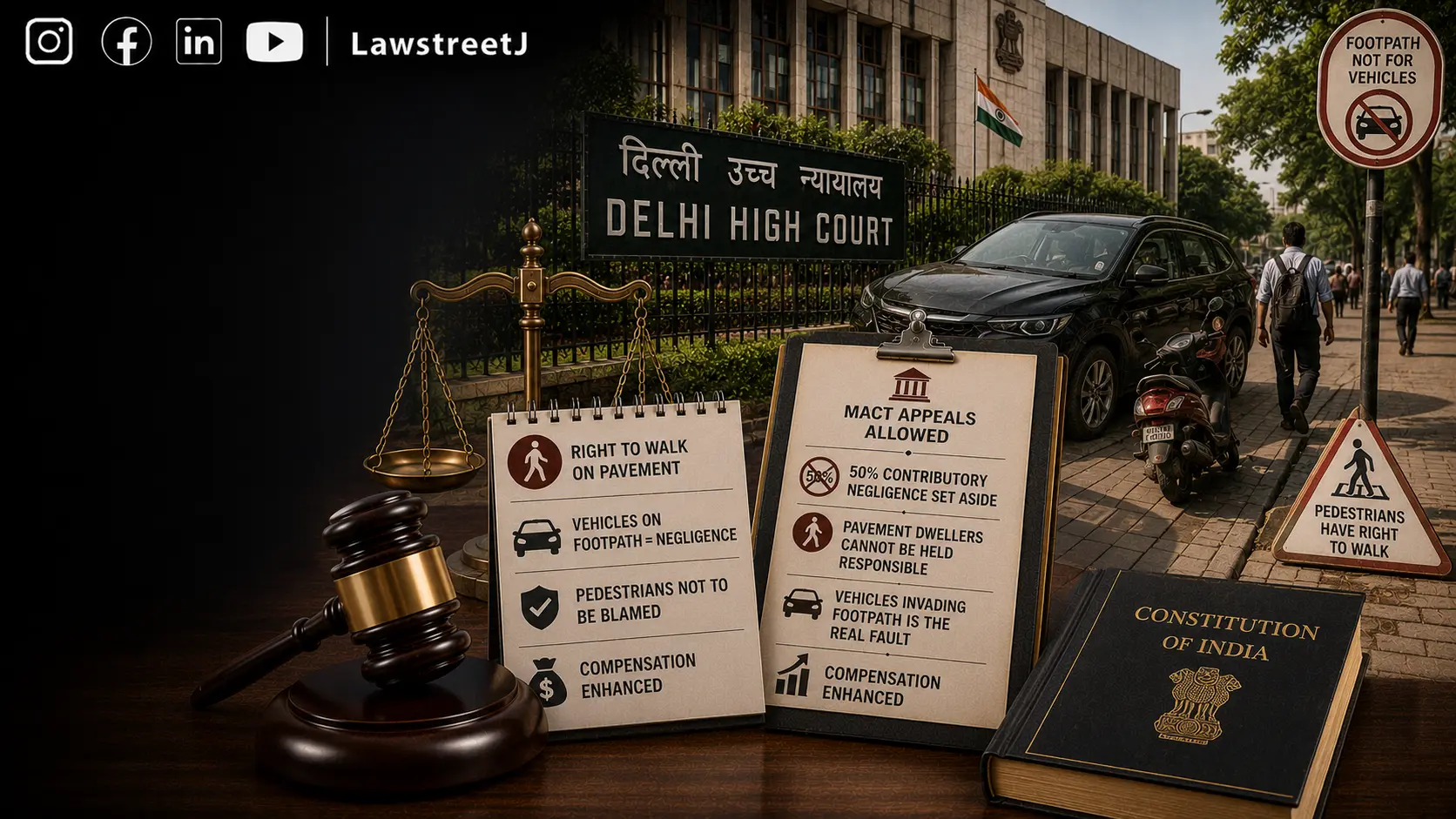
New Delhi: The High Court of Delhi has set aside a Motor Accident Claims Tribunal's finding of 50 per cent contributory negligence against two men killed and two others injured while sleeping on a pavement beneath the Madipur Metro Station, holding that a pedestrian resting on a footpath cannot be expected to anticipate that a motor vehicle would be driven onto it, and that the entire responsibility in such circumstances lies upon the driver who invaded a space reserved exclusively for pedestrians.
The Accident
The four connected appeals arose out of an accident that occurred on October 11, 2015, at approximately 4:30 a.m., when Digambar Kumar, Lekh Raj, Anil Bedi and Ramesh Chand were sleeping on the pavement under the Madipur Metro Station. A truck bearing registration number HR-37B-4372, driven by the second respondent and owned by the third respondent, arrived from the direction of Punjabi Bagh at high speed, struck all four men, and then collided with a metro pillar before the driver fled the scene, abandoning the vehicle. Two of the four, Anil Bedi and Ramesh Chand, succumbed to their injuries after being taken to SGM Hospital, Mangolpuri.
The Tribunal's Finding on Contributory Negligence
The Motor Accident Claims Tribunal, in awards dated March 9, 2017, and February 27, 2018, had attributed 50 per cent contributory negligence to the victims solely on the ground that they were sleeping on the pavement, observing that pavements on the roads are not meant for sleeping and as such, to my mind, the insurance has been able to prove that there was contributory negligence on the part of the deceased person and the injured as well. This finding halved the compensation awarded in each case.
The High Court's Analysis
Justice Anish Dayal, hearing the matter, expressed considerable surprise at the Tribunal's reasoning, holding that the correct question was not whether the victims ought to have been sleeping on the pavement, but whether the truck driver had any right to drive onto a pavement meant for pedestrians in the first place. The Court held that whatever activity is happening on the pavement, whether people are sleeping, or hawkers are present, or people are walking, cannot come within the purview of contributory negligence.
Tracing the statutory position, the Bench noted that Section 2(r) of the Delhi Police Act, 1978 defines a "street" to include footways accessible to the public, that Rule 39(3) of the Motor Vehicles (Driving) Regulations, 2017 bars a driver from driving on a footpath except with police permission, and that Rule 15 of the Rules of the Road Regulations, 1989 prohibits parking on a footpath altogether.
The Court relied heavily on the Supreme Court's foundational holding in Olga Tellis & Ors. v. Bombay Municipal Corporation & Ors., (1985) 3 SCC 545, which held that footpaths are public property intended for pedestrians and that any use for a private purpose frustrates the very object for which they are carved out of public streets. More significantly, the Bench drew extensively on the recent Supreme Court decision in Maniyar Iliyaz @ Shaik Riyaz & Anr v. P. Ayyappan & Ors., 2026 INSC 647, which elevated the right to walk on demarcated footpaths to a fundamental right flowing from Articles 19(1)(d) and 21 of the Constitution, declaring that the right to walk is a fundamental right under Part III of the Constitution and that this right takes priority over movement by motorised vehicles, with municipal and urban development authorities bearing a correlative duty to construct and safeguard pedestrian infrastructure.
Justice Dayal observed that many persons in the country are homeless or engaged in night labour without a place to sleep, for whom pavements become a relatively safer place to rest precisely because they do not expect vehicles to be driven onto them, holding that even if they had taken a calculated risk sleeping on the pavement, it certainly cannot be translated into contributory negligence.
On the legal contours of contributory negligence itself, the Court relied on Municipal Corporation of Greater Bombay v. Laxman Iyer, (2003) 8 SCC 731, which clarified that contributory negligence applies solely to the conduct of the injured party and requires an act or omission on their part that materially contributed to the harm, and on Syad Akbar v. State of Karnataka, (1980) 1 SCC 30, which held that where a vehicle mounts a pavement and injures a person, the very nature of the accident ordinarily speaks of negligence, attracting the doctrine of res ipsa loquitur unless the driver furnishes a reasonable explanation. Finding no material to show that the conduct of the injured or deceased had contributed to the accident, the Bench held the Tribunal's finding of 50 per cent contributory negligence unsustainable and set it aside in all four appeals.
Revised Compensation
Having set aside the contributory negligence deduction, the Court proceeded to recompute compensation in each appeal, applying settled principles from Sarla Verma & Ors v. Delhi Transport Corporation & Anr., (2009) 5 SCC 121, Reshma Kumari v. Madan Mohan, (2013) 9 SCC 65, National Insurance Company Ltd. v. Pranay Sethi & Ors., (2017) 16 SCC 680, and United India Insurance Co. Ltd. v. Satinder Kaur @ Satwinder Kaur and Ors., (2021) 11 SCC 780.
In MAC.APP. 288/2018 (Digambar Kumar), the Court enhanced compensation for pain and suffering from Rs 10,000 to Rs 1,00,000 in view of fractures sustained in both legs requiring surgical rods, and, after removing the contributory negligence deduction, enhanced the total award to Rs 1,20,005.
In MAC.APP. 289/2018 (Anil Bedi), the Court held that the Tribunal had erred in applying a multiplier of 5 based on the age of the deceased's mother rather than the deceased himself, holding, in line with the Supreme Court's clarification that the age of the deceased should be the basis for applying the multiplier, that the correct multiplier for a 41-year-old deceased was 14. The Court also added 25 per cent towards future prospects, revised funeral expenses and loss of estate in accordance with Pranay Sethi, and substituted the Tribunal's award for loss of love and affection with Rs 40,000 towards loss of consortium, taking the enhanced compensation to Rs 10,06,360.
In MAC.APP. 290/2018 (Ramesh Chand), the Court applied 25 per cent future prospects for the 48-year-old deceased, and awarded loss of consortium of Rs 40,000 each to five family members, wife, mother and three sons, aggregating Rs 2,00,000, taking the total enhanced compensation to Rs 9,92,848.
In MAC.APP. 197/2019 (Lekh Raj, since deceased and represented by legal heirs), no separate enhancement was pressed beyond restoration of the amount earlier deducted towards contributory negligence, namely Rs 9,05,285.
Directions for Disbursement
The Court directed the Insurance Company to deposit the enhanced amounts, along with accrued interest, with the Tribunal within six weeks, with lump sum releases to claimants and the balance to be held in staggered Fixed Deposit Receipts credited to designated savings accounts upon maturity.
Case Details
Case: Digamber Kumar v. National Ins Co Ltd & Ors, along with connected appeals Shashi Bedi v. National Ins Co Ltd & Ors, Lajwanti & Ors v. National Ins Co Ltd & Ors, and Lekh Raj v. Babloo Yadav & Ors Court: High Court of Delhi Bench: Justice Anish Dayal Case Nos.: MAC.APP. 288/2018, MAC.APP. 289/2018, MAC.APP. 290/2018 and MAC.APP. 197/2019 Counsel: Anshuman Bal for Appellants in MAC.APP. 288/2018, 289/2018 and 290/2018; S N Parashar and Ritik Singh for Appellant in MAC.APP. 197/2019; Manu Luv Shahalia for the Insurance Company Date of Judgment: July 8, 2026 Key Precedents Relied Upon: Olga Tellis & Ors. v. Bombay Municipal Corporation & Ors., (1985) 3 SCC 545; Maniyar Iliyaz @ Shaik Riyaz & Anr v. P. Ayyappan & Ors., 2026 INSC 647; Municipal Corporation of Greater Bombay v. Laxman Iyer, (2003) 8 SCC 731; Syad Akbar v. State of Karnataka, (1980) 1 SCC 30; Sarla Verma & Ors v. Delhi Transport Corporation & Anr., (2009) 5 SCC 121; Reshma Kumari v. Madan Mohan, (2013) 9 SCC 65; National Insurance Company Ltd. v. Pranay Sethi & Ors., (2017) 16 SCC 680; United India Insurance Co. Ltd. v. Satinder Kaur @ Satwinder Kaur and Ors., (2021) 11 SCC 780

![Delhi High Court Sets Aside Arbitral Tribunal's Award Against NHAI in Highway Project Delay Case [Read Judgment]](/secure/uploads/2023/07/lj_9605_23374c2e-392c-4491-a2fe-f2f12fc5272f.jpg)
![Delhi Court Rejects Stay Request in Defamation Case Against Rajasthan CM Ashok Gehlot [Read Order]](/secure/uploads/2023/08/lj_5208_80de1ddc-d76a-4f7f-b180-408e3ae14fb4.jpg)
.jpeg)