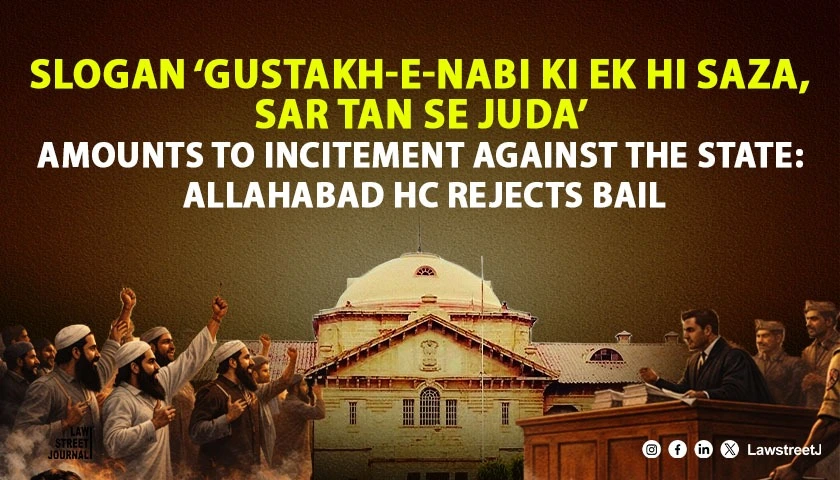
Prayagraj: The Allahabad High Court has ruled that the slogan “gustakh-e-nabi ki ek saza, sar tan se juda, sar tan se juda” (for insulting the Prophet, there is only one punishment: beheading, beheading) amounts to a challenge to the authority of law as well as the sovereignty and integrity of India, as it incites people to armed rebellion. The Court held that such slogans are punishable under Section 152 of the Bharatiya Nyaya Sanhita (BNS) and are also against the basic tenets of Islam.
Justice Arun Kumar Singh Deshwal delivered the decision on December 17, 2025, while rejecting a bail application filed by Rihan in connection with Case Crime No. 489 of 2025, registered under multiple provisions of the BNS and other laws at Police Station Kotwali, District Bareilly.
According to the prosecution, an FIR was lodged on September 26, 2025, alleging that the President of the Ittefaq Minnat Council, Maulana Taukir Raza, had called upon members of the Muslim community to assemble at the grounds of Islamia Inter College to protest against the State over alleged atrocities and the lodging of false cases against Muslim youth. The police received information that Maulana Taukir Raza and another INC leader, Nadeem Khan, had incited people to assemble at the venue after the conclusion of namaz on the same day. At the relevant time, prohibitory orders under Section 163 of the Bharatiya Nagarik Suraksha Sanhita (BNSS) were in force in District Bareilly, prohibiting the assembly of more than five persons.
The first informant, who was posted near the residence of INC leader Nadeem Khan, found that he was inciting people to assemble and proceed towards Islamia Inter College, following which a crowd emerged from his house. A mob of around 500 people assembled at Biharipur and began raising slogans against the Government, including the slogan “gustakh-e-nabi ki ek saza, sar tan se juda, sar tan se juda.” When the police attempted to stop the crowd, the mob allegedly snatched police batons, tore uniforms, and resorted to stone-pelting, firing, and throwing petrol bombs. Several police personnel sustained injuries, and multiple police and private vehicles were damaged. Seven persons, including the present applicant, were arrested from the spot. Subsequently, an FIR was lodged against 25 named accused and 1,700 unknown persons.
The applicant contended that he had been falsely implicated and was arrested from his home, contrary to the police claim that he was apprehended at the spot. He submitted that he had no criminal antecedents and that there was no incriminating material against him, entitling him to bail.
Opposing the bail plea, the State argued that the actions of the applicant and the co-accused not only promoted enmity between religious communities but also constituted an offence against the State and the unity and integrity of India. The learned Additional Advocate General submitted that the slogan used by the crowd reflected complete disregard for the Indian legal system. It was argued that disrespect to any God or Prophet is punishable under the BNS through prescribed legal sanctions, and there is no sanction of beheading under Indian criminal law. Therefore, advocating such punishment amounted to a direct challenge to the sovereignty and integrity of India.
The Court examined the statutory framework under the BNS and noted that offences relating to religion are comprehensively addressed under Sections 196, 298, 299, and 302. Section 196 provides punishment for promoting enmity between different groups on the ground of religion, with enhanced punishment where such acts are committed in places of worship.
The Court held that the BNS adequately addresses acts involving disrespect to religion or promotion of religious enmity, and therefore, chanting a slogan advocating beheading as punishment for blasphemy amounts to challenging the authority of the Indian legal system and constitutional governance.
The Court further observed that while the Constitution guarantees freedom of speech and expression and the right to assemble under Article 19, these freedoms are subject to reasonable restrictions under Article 19(2). Any slogan that calls for capital punishment contrary to statutory law and incites violence undermines constitutional values and attracts penal consequences under Section 152 of the BNS.
Distinguishing between religious slogans and inflammatory calls, the Court noted that devotional proclamations—such as “Allahu Akbar,” “Jo bole so nihaal, Sat Sri Akal,” “Jai Shri Ram,” or “Har Har Mahadev”—are expressions of faith and do not constitute offences unless used maliciously to intimidate or provoke violence against others.
Tracing the origin of the impugned slogan, the Court observed that it finds no mention in the Quran or other Islamic religious texts and appears to have emerged in Pakistan in the context of stringent blasphemy laws. The Court referred to historical events involving the misuse of the slogan and noted its subsequent spread and misuse to intimidate other communities and challenge State authority.
The Court also referred to instances from the life of Prophet Mohammad, highlighting his compassion and restraint even in the face of disrespect. The Court cited the incident from Taif involving a non-Muslim neighbour, observing that the Prophet’s response demonstrated kindness and forgiveness rather than retribution. The Court held that slogans advocating violence are contrary to the Prophet’s teachings and disrespect the core values of Islam.
Applying these principles, the Court found sufficient material to show that the applicant was part of an unlawful assembly that raised objectionable slogans, assaulted police personnel, and damaged public and private property. The applicant was found to have been arrested from the spot, contrary to his claim.
Finding no grounds for granting bail, the Court rejected the application.
Case Title: Rihan v. State of U.P., Criminal Misc. Bail Application No. 43604 of 2025


!["No Loudspeakers For Azan, No Fundamental Right To Create Noise," Says Allahabad HC To Two Mosques [Read Judgment]](/secure/uploads/2020/01/lj_4995_Allahabad_HC_AZAN.jpg)