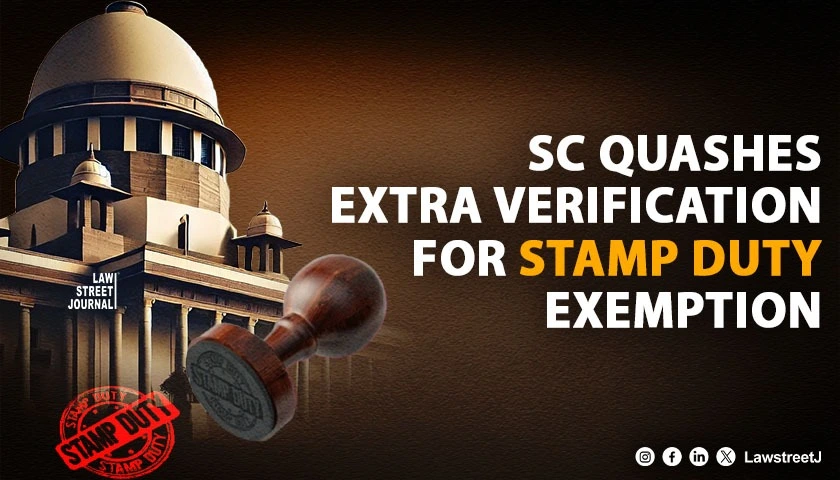
New Delhi: The Supreme Court has struck down a Jharkhand Government memorandum that required cooperative societies to obtain an Assistant Registrar’s recommendation before claiming stamp duty exemption, holding that administrative actions mandating unnecessary and excessive requirements that are superfluous and redundant must be set aside as illegal.
The Bench of Justice Pamidighantam Sri Narasimha and Justice Atul S. Chandurkar delivered the decision while allowing an appeal filed by Adarsh Sahkari Grih Nirman Swawlambi Society Ltd. challenging the Jharkhand High Court’s refusal to strike down the memorandum.
The dispute arose from a memorandum dated February 20, 2009, issued by the Principal Secretary, Department of Registration, Jharkhand, directing all District Sub-Registrars to ensure that exemption under Section 9A of the Indian Stamp (Bihar Amendment) Act, 1988, would be given only when supported by a recommendation from the Assistant Registrar, Cooperative Society. The memorandum stated that such verification was necessary to ensure that “unfair advantage is not taken” of the exemption.
Section 9A of the Stamp Act, inserted by the Bihar Amendment Act of 1988, exempts stamp duty on instruments relating to transfer of premises by cooperative societies to their members. The provision was enacted to encourage the cooperative movement by granting societies a statutory right to transfer premises without payment of stamp duty, and placing a corresponding duty on authorities to register such instruments without insisting on duty payment.
The appellant—registered under Section 5 of the Jharkhand Self-Supporting Cooperative Societies Act, 1996—challenged the memorandum on multiple grounds:
- that it created an additional tier of approval not contemplated under the Stamp Act;
- that it undermined the independence and self-reliance envisaged for cooperative societies;
- that the Assistant Registrar had no authority to grant or refuse approval; and
- that the memorandum was issued without affording an opportunity of hearing, violating principles of natural justice.
Both the Single Judge and Division Bench refused to exercise judicial review, holding that the memorandum was not contrary to the Stamp Act and was necessary to ensure that only validly registered cooperative societies receive the benefit. The High Court reasoned that while the registering authority has powers under Section 34 of the Registration Act to make inquiries, this does not extend to evaluation of the validity of a society’s registration, and that the executive instruction was intended to simplify the process for cooperative societies.
Before the Supreme Court, the State argued that the memorandum was essential to prevent fake societies from misusing the exemption, and that the Principal Secretary was competent to issue such administrative directions.
The Supreme Court began its judgment by underscoring that simplicity in public transactions is an essential component of good governance. It explained that administrative procedures must avoid complexity, redundant requirements, and unnecessary burdens that waste time, increase expense, and disrupt peace of mind.
The Court then articulated an important administrative law principle: while courts set aside executive decisions that are illegal because they rely on irrelevant considerations or ignore relevant ones, they must equally strike down executive actions that mandate unnecessary or excessive requirements.
The Bench held that once a cooperative society is registered and a certificate is issued under Section 5 of the 1996 Act, Section 5(7) declares such certificate to be conclusive proof of the society’s existence and continuity as a body corporate. When the law itself grants this finality, any additional requirement—such as an Assistant Registrar’s recommendation—becomes unwarranted.
The Court explained that a cooperative society registered under Section 5 acquires the status of a body corporate under Section 6, enabling it to function and transact in its own name. Chapter II of the 1996 Act makes it clear that the certificate of registration conclusively establishes the existence of a cooperative society, and the State and its instrumentalities are bound by this certification. No further inquiry into existence or authenticity is permissible.
In this backdrop, the requirement of an Assistant Registrar’s recommendation was termed superfluous, adding no value to the integrity of the transaction and undermining the statutory declaration under Section 5(7).
The Court reiterated that administrative actions become unlawful when they impose requirements that have no relevance to the statutory purpose. Insistence on filing documents or performing acts that do not advance the object of the law—and instead introduce unnecessary burdens—constitutes illegality.
The State’s justification that the requirement was necessary to curb “fake societies” was rejected as an irrelevant consideration. The Court held that when the Stamp Act itself grants exemption and the registration certificate conclusively proves the society’s existence, the State cannot introduce a new pre-condition through an executive memorandum.
Setting aside the High Court’s judgment, the Supreme Court declared the memorandum illegal, holding that it imposed a redundant and unauthorized layer of verification. When a registration certificate serves as conclusive proof of a society’s existence, mandating additional recommendations amounts to an unnecessary procedural burden that must be struck down.
Case Title: Adarsh Sahkari Grih Nirman Swawlambi Society Ltd. v. The State of Jharkhand & Ors.
Civil Appeal arising from SLP(C) Diary No. 7678 of 2024