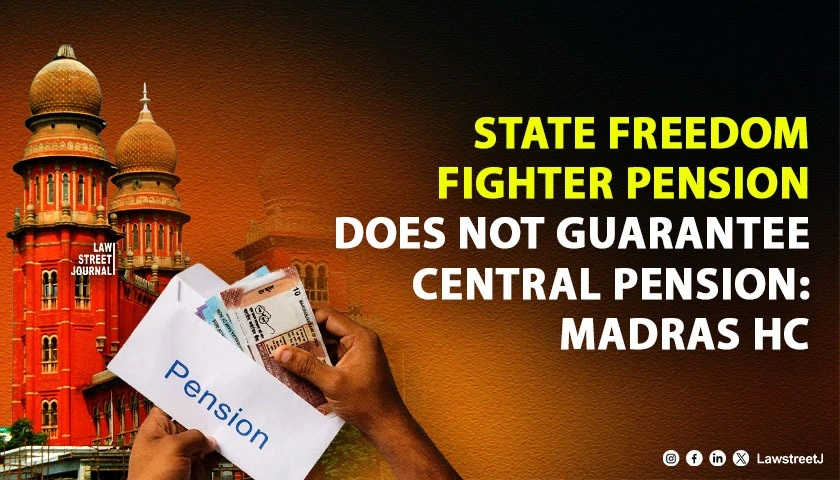
Chennai: The Madras High Court has held that the grant of a State pension to a freedom fighter does not automatically entitle the recipient to a Central pension. The Court emphasized that for the grant of pension under the Central Government Pension Scheme, the conditions stipulated in the Swatantrata Sainik Samman Pension Scheme (SSS Scheme) must be strictly followed, and that High Courts cannot expand the scope of pension schemes in the exercise of their powers of judicial review.
A Division Bench comprising Justice S.M. Subramaniam and Justice C. Kumarappan delivered the decision on December 15, 2025, while allowing a writ appeal filed by the Government of India challenging a Single Judge’s order directing the extension of Central pension to a freedom fighter who was already receiving a State pension.
The case concerned S. Somasundaram (deceased), a freedom fighter who had participated in the freedom struggle in Coimbatore District against the British Government as part of the national movement for independence led by Mahatma Gandhi. He had participated in the Quit India Movement and several other agitations and was lodged in Coimbatore Central Prison as a trial prisoner from September 1, 1942, to April 16, 1943, for a period exceeding six months.
After being granted pension under the State Government’s Freedom Fighters Pension Scheme, Somasundaram applied for pension under the Central Scheme. However, the competent authority of the Central Government rejected his application by an order dated July 27, 2005. He thereafter filed a writ petition challenging the rejection. Following his death, his legal heirs were substituted as parties.
The learned Single Judge allowed the writ petition, holding that the eligibility criteria need not be strictly applied in every case. The Writ Court took the view that once the State Government had extended the benefit of the Freedom Fighters Pension Scheme, the Central Government was bound to extend the same benefit, and that strict adherence to the eligibility criteria under the Central Scheme was not necessary.
Aggrieved by this decision, the Union of India preferred a writ appeal, contending that the deceased freedom fighter was ineligible for the Central Freedom Fighters Pension as he had not fulfilled the requisite eligibility conditions, and that the Writ Court had failed to properly consider the statutory requirements under the Central Scheme.
The Division Bench examined the legal principles governing welfare and pension schemes and observed that the Freedom Fighters Pension Scheme is a welfare measure introduced by both the State Governments and the Government of India to recognize the contributions of freedom fighters. The Court held that such welfare schemes are concessions and must be implemented strictly in accordance with their terms and conditions.
The Court emphasized that “the High Court, in the exercise of its powers of judicial review, cannot expand the scope of policy decisions, particularly in matters relating to the grant of pension under special schemes.” It cautioned that dilution of eligibility conditions would open a “Pandora’s box,” allowing ineligible persons to claim benefits, resulting in financial loss to the public exchequer.
The Court relied upon several Supreme Court decisions, including Jagdamba Devi v. Union of India (2017) 3 SCC 688, Union of India v. A. Alagam Perumal Kone (2021) 4 SCC 535, and W.B. Freedom Fighters’ Organization v. Union of India (2004) 7 SCC 716, all of which reiterated that the SSS Scheme is a document-based scheme and that courts cannot assess the sufficiency of documents required under the scheme.
Upon examining the SSS Scheme, 1980, the Court noted that Clause 4 expressly states that not all participants in the freedom movement are eligible for Samman Pension. Eligibility is subject to strict compliance with documentary requirements, including imprisonment certificates or valid secondary evidence supported by a Non-Availability of Records Certificate (NARC).
The Court observed that although the State Government had granted pension to the respondent, such grant did not automatically entitle him to pension under the Central Scheme. The Ministry of Home Affairs had rejected the application due to the absence of acceptable documentary proof, non-submission of NARC, and defective co-prisoner certificates.
Upholding this position, the Court referred to a Kerala High Court decision in K. Gopinathan Pillai v. Union of India, which held that pension under the State Scheme does not confer eligibility under the Central Scheme.
The Madras High Court concluded that the Writ Court’s view that eligibility criteria need not be strictly applied was contrary to settled legal principles. While noting that the respondent was at liberty to re-submit the application upon procuring the requisite documents, the Court held that judicial expansion of the scheme was impermissible.
Accordingly, the Division Bench set aside the order dated October 28, 2020, and allowed the writ appeal.
Case Title: Government of India v. S. Somasundaram (deceased) & Ors.,
WA No. 806 of 2022



![TN Medical Council declares change of gender identity of LGBTQIA+ as misconduct [Read Notification]](/secure/uploads/2022/12/lj_5268_5cebb05a-97fb-40fb-8045-25cdf8f4207a.jpg)
![Madras High Court Directs Tamil Nadu Government to Ensure Quota for Transgenders in Local Body Elections [Read Order]](/secure/uploads/2023/08/lj_2507_7a03d113-08b1-4670-b6fb-9058aee481d0.jpg)
![Anti Corruption sleuths acted like "puppets in The Muppet Show", HC notice to ex TN CM in disproportionate assets case [Read Order]](/secure/uploads/2023/09/lj_8675_7b37fc02-1b2d-4f4a-9816-3df20545b37e.jpg)