

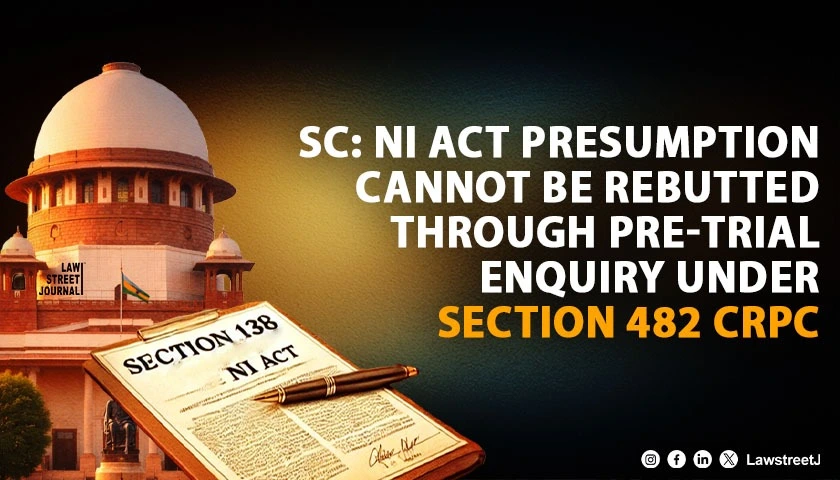
New Delhi: The Supreme Court of India has held that it is impermissible for High Courts to quash cheque dishonour proceedings under Section 482 of the Code of Criminal Procedure, 1973, by undertaking a pre-trial enquiry into disputed facts, particularly when a statutory presumption under Section 139 of the Negotiable Instruments Act, 1881, operates in favour of the complainant. The Court emphasized that such presumption can be rebutted only by evidence led during trial.
A Bench comprising Justice Manoj Misra and Justice Ujjal Bhuyan delivered the decision on December 19, 2025, while allowing an appeal filed by M/s Sri Om Sales, challenging the Patna High Court’s order quashing cheque dishonour proceedings.
The appellant had lodged a complaint under Section 138 of the Negotiable Instruments Act against the first respondent, alleging that the respondent had taken delivery of goods from the complainant and, in lieu thereof, issued a cheque dated March 4, 2013, for ₹20,00,000. On the same day, the cheque was presented with the complainant’s banker for collection. However, it was returned unpaid on March 11, 2013, with the remark “insufficient funds” in the drawer’s account.
The complainant thereafter met the first respondent on March 12, 2013, who assured that if the cheque was presented after a week, it would be honoured. Consequently, the cheque was re-presented on March 17, 2013, but was again returned unpaid on March 18, 2013, with the same remark. As a result, a legal notice of demand dated April 2, 2013, was issued. In reply dated April 8, 2013, the first respondent denied having issued the cheque and refused to make payment. Since no payment was made within the stipulated period, the complaint was filed.
The learned Magistrate took cognizance of the complaint and, vide order dated September 27, 2013, summoned the first respondent under Section 138 of the NI Act. Aggrieved thereby, the first respondent approached the Patna High Court by filing an application under Section 482 CrPC.
By the impugned order dated June 20, 2019, the High Court quashed the complaint proceedings on the ground that the cheque had not been issued for the discharge, in whole or in part, of any debt or other liability.
Challenging this order before the Supreme Court, the appellant contended that the High Court exceeded its jurisdiction under Section 482 CrPC by conducting an enquiry into whether the cheque was issued for the discharge of debt or liability. It was argued that under Section 139 of the NI Act, a statutory presumption arises in favour of the holder of the cheque, which can only be rebutted during trial. Therefore, the complaint—having disclosed all essential ingredients of an offence under Section 138—could not have been quashed at the threshold.
The first respondent, on the other hand, argued that the complaint was mala fide and that the High Court was justified in examining whether the cheque had been issued towards discharge of liability.
The Supreme Court reiterated the settled principles governing quashing of criminal complaints at the threshold, observing that courts must only assess whether the complaint and accompanying materials disclose a prima facie case. If such a case is made out, appreciation of evidence is impermissible at the pre-trial stage, except in exceptional circumstances where continuance of proceedings would amount to abuse of process.
In the present case, the Court found that the complaint clearly disclosed all ingredients of an offence under Section 138 of the NI Act, including issuance of cheque towards discharge of liability, dishonour due to insufficient funds, issuance of statutory notice, and failure to make payment.
The Court held that the High Court erred in testing whether the cheque was issued towards discharge of liability at the pre-trial stage, ignoring the statutory presumption under Section 139. Such an issue could only be adjudicated during trial or in appellate or revisional proceedings.
Reliance was placed on earlier decisions including Maruti Udyog Ltd. v. Narender, Rangappa v. Sri Mohan, Rajeshbhai Muljibhai Patel v. State of Gujarat, and Rathish Babu Unnikrishnan v. State (NCT of Delhi), reiterating that disputed questions of fact cannot be adjudicated in proceedings under Section 482 CrPC.
Allowing the appeal, the Supreme Court set aside the High Court’s order and restored the criminal complaint to the file of the concerned Magistrate for adjudication in accordance with law. The Court clarified that it had expressed no opinion on the merits of the defence, which would be independently considered by the Trial Court.
This decision reinforces the principle that statutory presumptions under the NI Act cannot be diluted through pre-trial enquiries and that cheque dishonour complaints must ordinarily proceed to trial where presumptions may be rebutted through evidence.
Case Title: M/s Sri Om Sales v. Abhay Kumar @ Abhay Patel & Anr., Criminal Appeal No. 5588 of 2025 (arising out of SLP (Crl.) No. 8703 of 2019)