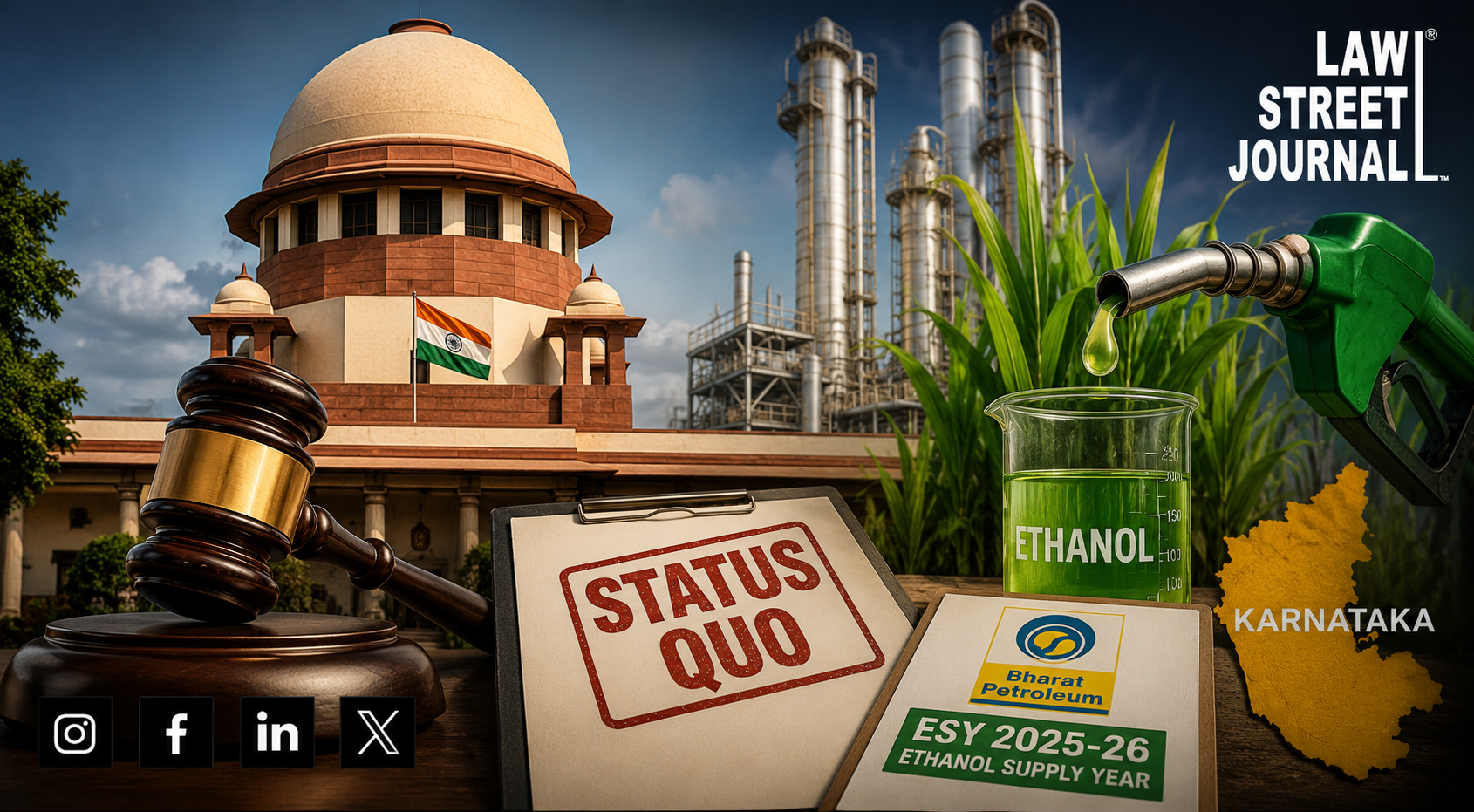
A partial Court working days bench stays the operation of a Karnataka High Court order that directed Oil Marketing Companies to reconsider a distillery’s ethanol allocation, after the Attorney General warned that reopening allocations for ESY 2025–26 could destabilise the national E20 ethanol-blending policy.
The Supreme Court on June 30, 2026 ordered status quo with regard to ethanol supply allocation for the Ethanol Supply Year (ESY) 2025–26, in a plea filed by Bharat Petroleum Corporation Ltd. (BPCL) against a Karnataka High Court order concerning the reopening of ethanol allocation for the year.
A partial Court working days bench of Justice M.M. Sundresh and Justice Sheel Nagu passed the order after hearing Attorney General R. Venkataramani, appearing for BPCL, and Senior Advocate Siddharth Dave, appearing for the respondents.
Arguments Before the Supreme Court
The Attorney General contested the Karnataka High Court’s order, which had directed various Oil Marketing Companies (OMCs) to consider and decide a representation submitted by a distillery seeking enhancement of its ethanol allocation for 2025–26. He argued that the High Court’s order could destabilise the national policy for 20% ethanol-petrol blending, commonly known as the E20 policy.
On being questioned by the bench as to why the Division Bench of the High Court could not be approached instead, the Attorney General informed the Court that ethanol supply contracts for the year had already been finalised in October 2025, and that several connected petitions were pending before various High Courts across the country. He sought time to file appropriate transfer petitions to consolidate these proceedings.
“Dedicated Ethanol Plants, which have hitherto supplied ethanol exclusively to the OMCs and which are contractually prohibited from either manufacturing anything else or supplying ethanol to any third party, cannot now be relegated to the short end of the stick, thereby visiting them with grave and manifest prejudice.” — Karnataka High Court
After hearing the parties, the Supreme Court issued notice in the matter and ordered status quo to be maintained with respect to ethanol supply allocation for ESY 2025–26, pending further proceedings.
Background: The Karnataka High Court Order
The order impugned before the Supreme Court was passed by the Karnataka High Court on a plea filed by M/S Vinp Distilleries and Sugar Private Limited, a dedicated ethanol manufacturer. The distillery had approached the High Court challenging a reduced allocation of ethanol supply for ESY 2025–26, despite having established a dedicated ethanol production plant.
It was the distillery’s case that although its plant had an annual production capacity of approximately 9.90 crore litres, it was allotted only 3.92 crore litres for ESY 2025–26, even though its bid had been for 9.26 crore litres.
Opposing the plea before the High Court, the Attorney General had submitted that preferential allocation on a best-endeavour basis could not become an enforceable right entitling the petitioner company to seek a writ of mandamus compelling the OMCs to act in terms of the agreement entered into between the parties. He argued that considering the representation in the petitioner’s favour would amount to a modification of government policy itself, which could not be permitted in law.
Allowing the plea, the Karnataka High Court held that the petitioner company had a legitimate expectation of continuance of the prevailing policy, arising directly from the agreement entered into between the parties and from the consistent past conduct of the OMCs. The High Court further held that the petitioner was entitled to issuance of a writ of mandamus directing the concerned OMCs to act in consonance with Clause 6.8 of the agreement, particularly since the OMCs had themselves invoked the same clause on an earlier occasion to enhance procurement from 1.44 crore litres to 3.92 crore litres.
Case Details
- Case Title: Bharat Petroleum Corporation Ltd. v. Union of India and Ors.
- Court: Supreme Court of India
- Bench: Justice M.M. Sundresh and Justice Sheel Nagu
- Case Number: SLP(C) No. 22411/2026
- Date of Order: June 30, 2026
- For Petitioner (BPCL): Attorney General R. Venkataramani
- For Respondents: Senior Advocate Siddharth Dave

![Order to appoint One Man Committee of Justice (Retd.) Lokur for the Prevention of Stubble Burning Kept in Abeyance by SC itself [READ ORDER]](/secure/uploads/2020/10/lj_8849_Order_to_appoint.jpeg)