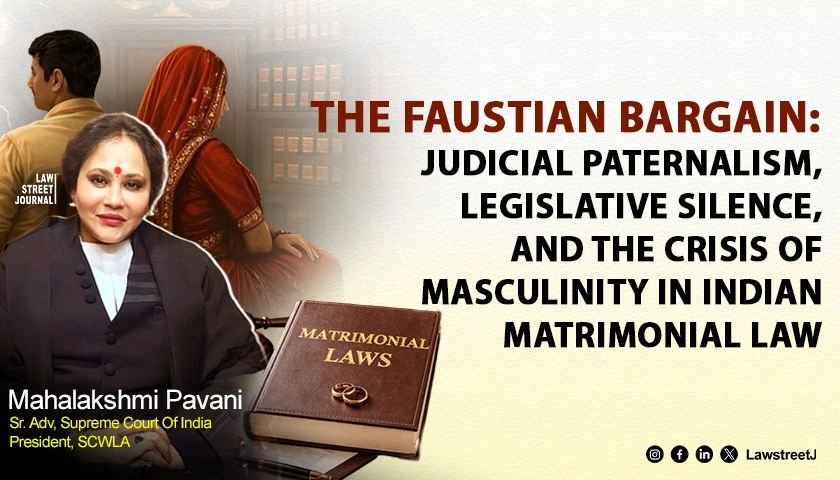
Introduction: The Death of a Judge and the Birth of a Discourse
The recent and tragic demise of a young judge in the Delhi judiciary, followed by the registration of an FIR for abetment to suicide against his spouse, has punctured the long-standing legal myth that the domestic sphere is a site of unilateral vulnerability for women. This incident serves as a grim harbinger of a deeper, systemic crisis: the "Faustian Bargain" inherent in Indian gender jurisprudence. In its zeal to rectify historical wrongs against women, the legislature has struck a pact that trades the principle of "Gender Neutrality" for a regime of "Statutory Paternalism," leaving men in a state of jurisprudential abandonment.
The death of an individual entrusted with the solemn task of interpreting the law, balancing rights, and administering justice, under alleged matrimonial distress has produced a profound jurisprudential irony and apparent systemic failure. This is not an argument against women’s rights, nor a repudiation of the historic necessity of feminist legal reform. Indian women continue to face pervasive domestic violence, economic dependence, coercive control, abandonment, and structural discrimination. The constitutional commitment to substantive equality under Articles 14, 15, and 21 demands robust legal protection for women. Yet constitutionalism equally demands that justice must resist absolutism. A legal system that begins as a shield for the vulnerable may, through institutional inertia and ideological paternalism, transform into an instrument of asymmetrical suffering.
Indian matrimonial law today stands precariously suspended between two competing moral narratives: the historic oppression of women and the contemporary invisibility of male vulnerability. The State, the judiciary, and the legislature appear trapped in a Faustian bargain—one in which the pursuit of corrective justice for one gender has gradually normalised a jurisprudence of presumptive male culpability. The result is neither equality nor justice, but a dangerous moral asymmetry.
The Architecture of Protective Paternalism- A legal imperative or tool for weaponisation?
The Indian legal landscape is punctuated by special provisions under Article 15(3) of the Constitution, which empower the State to make affirmative laws for women. While this was envisioned as a tool for substantive equality, its manifestation in matrimonial law—specifically under the erstwhile Section 498A of the IPC (now Section 85 of the Bharatiya Nyaya Sanhita), the Protection of Women from Domestic Violence Act (PWDVA), 2005, and the laws governing maintenance—has created a unilateral legal architecture.
Post-independence Indian matrimonial jurisprudence emerged from a deeply patriarchal social structure. Dowry deaths, domestic violence, marital abandonment, and economic dependence necessitated strong statutory intervention. Laws such as Section 498A of the Indian Penal Code, the Protection of Women from Domestic Violence Act, 2005, and maintenance provisions under Section 125 CrPC evolved within this socio-historical context. The moral legitimacy of these laws was undeniable. The State could not remain neutral in the face of systemic violence against women. However, over time, the judicial discourse surrounding matrimonial litigation developed a distinct paternalistic orientation. Courts increasingly began to operate upon implicit assumptions:
- The woman is ordinarily the vulnerable party.
- The male spouse is presumptively more powerful.
- Allegations by women deserve immediate institutional credibility.
- Male emotional suffering is secondary to structural gender justice.
While these assumptions may historically have emerged from social realities, their indiscriminate application has produced doctrinal distortions. The jurisprudence of matrimonial law has gradually shifted from a fact-sensitive inquiry into a morality-driven presumption.
The Supreme Court itself has repeatedly acknowledged the misuse of matrimonial provisions. In Sushil Kumar Sharma v. Union of India 2005 (6) SCC 281, the Court warned that Section 498A could become “legal terrorism” if abused vindictively. Similarly, in Arnesh Kumar v. State of Bihar (2014) 8 SCC 273., the Court recognised the routine misuse of arrest powers in matrimonial disputes and imposed safeguards against automatic incarceration. Yet these judicial observations, though significant, have remained episodic rather than transformative. The broader institutional culture continues to operate within a framework where male suffering is often viewed with suspicion, embarrassment, or ideological discomfort.
The "Faustian Bargain" here is evident: the State offers protection to the vulnerable at the cost of the presumption of innocence for the other. Violence against men, whether physical, emotional, or economic, lacks a specific nomenclature in the Indian statute book. When a man is the victim of domestic cruelty, he is met with a "Legal Void." He cannot invoke the PWDVA, as the Act defines the "aggrieved person" exclusively as a woman. This statutory exclusion presumes that masculinity is an inherent deterrent to victimhood—a fallacy that ignores the intersectional realities of mental health, social stigma, and judicial bias.
Abetment to Suicide and the "Cruelty" Paradox
The case of the Delhi judge brings into sharp focus Section 306 of the IPC (now Section 108 of the BNS). In matrimonial disputes involving male victims, the threshold for proving "instigation" or "abetment" by a spouse is significantly higher than in cases where the victim is female. In cases of female suicide, Section 113A of the Evidence Act provides a legal presumption of abetment against the husband if cruelty is proven. No such presumption exists for a husband who is driven to the brink by relentless litigation, social isolation, or emotional blackmail.
This asymmetry creates a "Strategic Litigative Advantage." The threat of criminal prosecution is often used as a tool for "legal extortion" in settlement negotiations. The male litigant, faced with the prospect of immediate arrest (despite the safeguards in Arnesh Kumar v. State of Bihar(supra)), often concedes to unreasonable demands. The "Faustian Bargain" is thus completed: the man trades his assets and his dignity for the cessation of a criminal process that is structurally biased against him.
The Psychological Frontier: Beyond the Physical Bruise
The gendered nature of our laws fails to account for "Emotional and Psychological Violence." For a man, the threat of being separated from his children or the public shaming associated with a "dowry harasser" label constitutes a form of violence that is as debilitating as physical assault.
Judicial paternalism often views the man as the "Provider" and the "Protector," making it culturally and legally difficult for him to occupy the space of the "Victim." This "Masculine Burden" is exacerbated by Section 125 of the CrPC (now Section 144 of the BNSS), where the obligation to maintain is almost entirely unilateral. Even when a man is unemployed or suffering from mental health crises, the courts often apply the "capacity to earn" doctrine with a rigor that is seldom applied to able-bodied female litigants.
Constitutional Infirmity: The Tryst for Neutrality
The refusal to acknowledge violence against men is a violation of the "Equality Code" enshrined in Articles 14 and 15. While Article 15(3) allows for special provisions for women, it does not mandate the total exclusion of men from protective umbrellas. The PWDVA, by being gender-exclusive, creates a class of citizens who are denied the "Right to a Violence-Free Home" solely based on their sex.
The Supreme Court in Joseph Shine v. Union of India (the adultery case) struck down Section 497 of the IPC on the grounds that it treated the woman as the property of the man and ignored her agency. By the same logic, laws that refuse to recognize the man as a victim of domestic abuse treat him as an indestructible "social unit" rather than a human being with fundamental rights. The "Faustian Bargain" of the past—protecting the family unit by suppressing the individual—must be renegotiated in favor of Gender-Neutral Jurisprudence.
The Path Forward: From Paternalism to Parity
To remedy this crisis, the following legislative and judicial shifts are imperative:
- Gender-Neutral Domestic Violence Laws: The PWDVA must be amended to replace "aggrieved person" with a gender-neutral term, acknowledging that violence in a domestic relationship is a human rights violation, regardless of the gender of the perpetrator or the victim.
- Recognition of Parental Alienation: The law must recognize the weaponization of child custody as a form of psychological abuse against fathers.
- Strict Penalties for Litigative Perjury: To balance the "Faustian Bargain," the courts must move beyond "adverse remarks" and actively prosecute the filing of false and malicious complaints under Section 182 and 211 of the IPC.
- Mental Health Support for Male Litigants: The judicial system must incorporate mandatory counseling and mediation that is sensitive to the high rates of male suicide during matrimonial litigation.
Conclusion
The death of a member of the judiciary—a person who himself was an arbiter of justice—is a stark reminder that the law, in its current form, is a blunt instrument. We have traded the soul of "Equal Protection" for the convenience of "Categorical Protection."
The Faustian Bargain of Indian matrimonial law—buying social justice for women at the cost of legal justice for men—has reached its breaking point. For a tryst with equality to be genuine, it must be inclusive. We must look beyond the bruise and recognize that when the law ignores the suffering of one half of its citizens, it ceases to be an instrument of justice and becomes an accomplice to the very violence it seeks to curb.
The time for a gender-neutral "Domestic Violence Act" is not just a matter of policy; it is a matter of constitutional survival.
The Author acknowledges the assistance of Ms.Sumedha Sen, Advocate.