38.6c New Delhi, India, Wednesday, January 07, 2026
Top Stories Supreme Court
Political NEWS Legislative Corner Celebstreet International Videos
Subscribe Contact Us
close
Judiciary

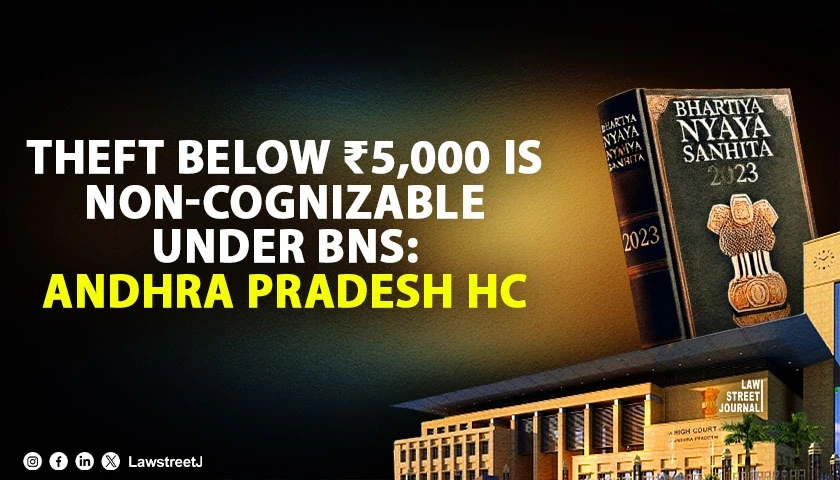
Theft Worth Below ₹5,000 Is Non-Cognizable Offence Under BNS; Police Cannot Register FIR Without Magistrate’s Permission: Andhra HC [Read Order]

By Saket Sourav      05 January, 2026 07:31 PM      0 Comments
Theft Worth Below 5000 Is Non Cognizable Offence Under BNS Police Cannot Register FIR Without Magistrates Permission Andhra HC

Andhra Pradesh: The Andhra Pradesh High Court has held that theft of property valued below ₹5,000 is a non-cognizable offence under the Bharatiya Nyaya Sanhita, 2023 (BNS), and that the police cannot mechanically register an FIR and proceed with investigation without obtaining prior permission from the concerned Magistrate.

Justice Dr. Venkata Jyothirmai Pratapa quashed criminal proceedings against an accused in a sand theft case where the stolen material was valued at merely ₹1,500, holding that the police action in registering the FIR and filing a chargesheet without obtaining appropriate directions from the Magistrate constituted a “clear abuse of process of law.”

The case arose from Crime No. 720 of 2025 registered at C. Belagal Police Station, Kurnool District, for offences punishable under Section 303(2) of the BNS and Section 21(1) of the Mines and Minerals (Development and Regulation) Act, 1957 (MMDR Act). The petitioner, P. Rashidulla, was arrayed as Accused No. 3 in the case, where authorities had found sand in one trailer attached to a tractor, while another tractor was empty.

Senior Counsel Posani Venkateswarlu, appearing for the petitioner along with Advocate K.V. Raghuveer, argued that the complaint and chargesheet did not mention the value of the property. He contended that when the offence is non-cognizable, the police have no authority to register the case and file a report on their own. He further submitted that the case was lodged against the petitioner based on the confession of a co-accused, which is merely corroborative evidence and not substantive evidence sufficient to sustain the case.

The Senior Counsel also raised procedural objections, pointing out that the petitioner was not the owner of the tractor and that the informant and the investigating officer were the same person. He highlighted that under Section 22 of the MMDR Act, only an authorised officer from the Mining Department can file a private complaint, and the police cannot register a case and file a report before the Court.

Assistant Public Prosecutor K. Priyanka Lakshmi conceded that the value of the sand, as per the Tahsildar’s report, was ₹1,500, and admitted that the police had not obtained any permission from the Court to conduct investigation into the non-cognizable offence.

Justice Pratapa undertook a detailed analysis of Section 303 of the BNS, which defines and prescribes punishment for theft. The Court noted that Section 303(1) defines theft as the act of dishonestly taking movable property out of another’s possession without consent, with the intention of taking it. Section 303(2) prescribes punishment of imprisonment up to three years, or fine, or both, with enhanced punishment for repeat offenders.

Crucially, the Court highlighted the proviso to Section 303(2), which states:

“Provided that in cases of theft where the value of the stolen property is less than five thousand rupees, and a person is convicted for the first time, such person shall, upon return of the value of the property or restoration of the stolen property, be punished with community service.”

The Court drew a critical distinction between the erstwhile Indian Penal Code (IPC) and the new BNS. While theft under Sections 378 and 379 of the IPC was an entirely cognizable offence, the offence under Section 303 of the BNS is punishable based on the severity of the offence. Where the value of the stolen property does not exceed ₹5,000, it attracts only community service as punishment upon restoration or return of the property in the case of a first conviction—a lesser punishment indicating the non-cognizable nature of such offences.

The Court held unequivocally:

“There is no doubt that the offence under Section 303(2) of the BNS is a non-cognizable offence. In such circumstances, the police shall follow the procedure laid down under Section 174 of the Bharatiya Nagarik Suraksha Sanhita, which mandates obtaining appropriate directions from the concerned Magistrate before proceeding with the investigation.”

Section 174 of the Bharatiya Nagarik Suraksha Sanhita, 2023 (BNSS), which has replaced the Code of Criminal Procedure, 1973, lays down the procedure for investigation of non-cognizable cases and requires the police to obtain magisterial permission before proceeding.

On the MMDR Act aspect, Justice Pratapa observed that the Trial Court is barred under Section 22 of the MMDR Act from taking cognizance of offences under the Act except upon a written complaint by the authority notified by the government. Consequently, police-initiated action in MMDR cases also suffered from jurisdictional infirmity.

Finding merit in the petitioner’s contentions and noting the prosecution’s concession that the stolen sand was valued at only ₹1,500—well below the ₹5,000 threshold—the Court held that the police had “mechanically registered the FIR against the petitioner without obtaining appropriate direction from the concerned Magistrate and proceeded with the investigation and filed the chargesheet.”

Allowing the criminal petition, Justice Pratapa quashed the proceedings in Crime No. 720 of 2025 pending before the Judicial Magistrate of First Class-cum-Special Mobile Court, Kurnool. However, the Court clarified that the order “does not preclude the competent authority under the MMDR Act from taking further action in accordance with law, if so advised.”

Case Title: P. Rashidulla v. The State of Andhra Pradesh and Another

[Read Order]


Share this article:

About:

Saket is a law graduate from The National Law University and Judicial Academy, Assam. He has a keen ...Read more

Follow:
Linkedin


Leave a feedback about this
Related Posts
View All

Andhra Pradesh High Court Refuses to Recall Order for Examining 'Constitutional Breakdown' of State Machinery; Govt to Move Supreme Court Andhra Pradesh High Court Refuses to Recall Order for Examining 'Constitutional Breakdown' of State Machinery; Govt to Move Supreme Court

order,a 11-judge bench assembled to suspend it after observing that Justice Kumar's observations as judicial and administrative overreach. Andhra Pradesh High Court, Justice Rakesh Kumar, AG Subrahmanyam Sriram

Andhra Pradesh High Court permits Anandaiahs Ayurvedic concoction for COVID patients Andhra Pradesh High Court permits Anandaiahs Ayurvedic concoction for COVID patients

The Court directed Anandaiah and the district administration to discuss ways to manage COVID and to ensure a smooth flow of the medicines. Andhra Pradesh High Court, Andhra Pradesh High Court judgement, Andhra Pradesh High Court order

Andhra Pradesh High Court seeks Centres response on insufficient allocation of resources for treatment of Mucormycosis Andhra Pradesh High Court seeks Centres response on insufficient allocation of resources for treatment of Mucormycosis

to be fully equipped with the required man-power to handle the situation. In view of this, the Court directed the State to file a memo with regard to steps taken by it with regard to recruitment of paramedical staff. Andhra Pradesh High Court, Andhra Pradesh High Court order, Andhra Pradesh High Court judgement

Andhra Pradesh High Court seeks Centre and State Governments response on PIL seeking Optical Fibre Network, IT Infrastructure for District Courts Andhra Pradesh High Court seeks Centre and State Governments response on PIL seeking Optical Fibre Network, IT Infrastructure for District Courts

The Himachal Pradesh High Court had recently observed that, the need of the hour is to provide adequate bandwidth, network-attached storage and routers etc. to facilitate the conducting of educational courses, conferences, court proceedings etc. on virtual platform. Andhra Pradesh High Court order, Andhra Pradesh High Court judgement, Fibre Network in India, IT Infrastructure components

TRENDING NEWS

wrong-bail-orders-alone-without-evidence-of-corruption-cannot-justify-removal-of-judicial-officer-sc
Trending Judiciary
Wrong Bail Orders Alone, Without Evidence of Corruption, Cannot Justify Removal of Judicial Officer: SC [Read Judgment]

Supreme Court rules that wrong bail orders alone cannot justify removal of a judicial officer without proof of corruption, misconduct, or extraneous considerations.

06 January, 2026 07:43 PM
divorced-muslim-woman-can-seek-maintenance-under-crpc-even-after-receiving-amount-under-muslim-women-protection-act-kerala-hc
Trending Judiciary
Divorced Muslim Woman Can Seek Maintenance Under CrPC Even After Receiving Amount Under Muslim Women Protection Act: Kerala HC [Read Order]

Kerala High Court holds that a divorced Muslim woman can claim maintenance under Section 125 CrPC even after receiving amounts under the 1986 Act.

06 January, 2026 08:19 PM

TOP STORIES

india-signs-4666-crore-defence-contracts-for-carbines-and-torpedoes-to-bolster-armed-forces
Trending International
India Signs ₹4,666-Crore Defence Contracts for Carbines and Torpedoes to Bolster Armed Forces

India signs ₹4,666-crore defence contracts for CQB carbines and heavyweight torpedoes, boosting armed forces readiness and Aatmanirbhar Bharat goals.

01 January, 2026 12:52 AM
telangana-hc-cannot-seek-extension-beyond-45-day-limit-to-file-written-version-in-consumer-cases
Trending Judiciary
Telangana HC: Cannot Seek Extension Beyond 45-Day Limit to File Written Version in Consumer Cases [Read Order]

Telangana High Court rules written versions in consumer cases cannot be filed beyond the mandatory 45-day limit under the Consumer Protection Act, 2019.

02 January, 2026 07:13 PM
preventive-detention-cannot-be-used-to-silence-dissenting-voices-of-journalists-madras-hc
Trending Judiciary
Preventive Detention Cannot Be Used to Silence Dissenting Voices of Journalists: Madras HC [Read Order]

Madras High Court warns against misuse of preventive detention to silence journalists, calls it a threat to free speech and liberty.

02 January, 2026 08:04 PM
delhi-hc-upholds-discharge-of-accused-in-gang-rape-case-expresses-concern-over-misuse-of-sexual-offence-laws-and-victim-compensation
Trending Judiciary
Delhi HC Upholds Discharge of Accused in Gang Rape Case; Expresses Concern Over Misuse of Sexual Offence Laws and Victim Compensation [Read Judgment]

Delhi High Court upholds discharge in a gang rape case, flags misuse of sexual offence laws, and issues directions on recovery of victim compensation.

02 January, 2026 08:28 PM

ADVERTISEMENT


Join Group

Signup for Our Newsletter

Get Exclusive access to members only content by email