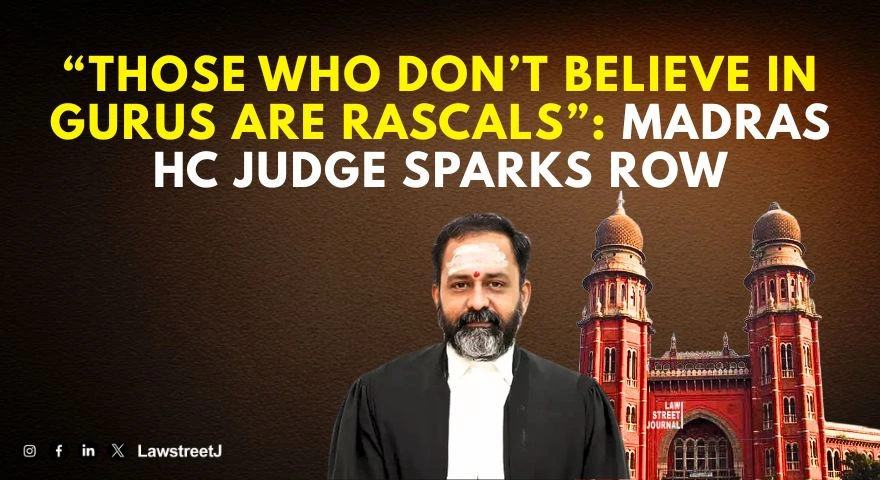
Chennai: Madras High Court Justice G.R. Swaminathan has triggered a significant national controversy following his remarks directed at non-believers during a spiritual event in Tamil Nadu. Addressing a gathering organised by a spiritual body on February 23, 2026, he asserted that individuals who do not believe in spiritual gurus or the power of God are “rascals, fools, and barbarians.” Explaining his choice of words, he stated that certain rationalists in the state had historically used these terms to describe believers, and that he was now reclaiming those labels for those who reject spiritual authority. Noting that devotees are often mocked for regarding a Guru as a manifestation of God, he declared that those who ridicule believers are themselves the “rascals.”
During the address, Justice Swaminathan emphasised the importance of spiritual guidance in overcoming personal struggles, stating that courage and resilience in difficult times can be strengthened through a Guru’s grace. Referring to his own experiences, he mentioned recent interactions with a yogi near Tenkasi and spoke about the concept of a spiritual “aura” that, in his view, enables devotees to overcome weaknesses through proximity to spiritual masters. In remarks that have drawn further attention, he observed that he has four years of judicial service remaining and intends to “step up and act more courageously” during the remainder of his tenure.
The comments come amid an already contentious phase in his judicial career, with a pending impeachment motion adding to the political and legal turbulence. In December 2025, around 120 Members of Parliament from the opposition bloc submitted an impeachment motion to the Speaker of the Lok Sabha. The move followed a controversial order concerning the lighting of a ceremonial lamp at a stone pillar known as the Deepathoon, situated near a historic dargah in Tirupparankundram. The Tamil Nadu government had opposed the directive, contending that it altered long-standing practice and created law and order concerns. Those backing the motion accused him of demonstrating partiality towards specific communities and right-wing ideologies, arguing that such conduct conflicts with the secular framework of the Constitution.
Born in 1968 and appointed as a permanent judge of the Madras High Court in April 2019, Justice Swaminathan has long been associated with high-profile decisions. In 2019, he received international recognition for his ruling in Arun Kumar v. Inspector General of Registration, which recognised a trans woman as a “bride” under the Hindu Marriage Act and barred genital-normalising surgery on intersex infants. However, subsequent years have seen criticism from some quarters alleging that his public statements blur the line between personal religious conviction and constitutional responsibility. Critics contend that overt alignment with particular religious ideologies risks undermining the neutrality expected of a secular judiciary.
Additionally, his past public appearances have also attracted scrutiny. On earlier occasions, he reportedly stated that Sanatana Dharma would guide his remaining judicial years and described the Constitution as largely derived from the Government of India Act. He further sparked debate by suggesting that the Constitution’s relevance could be affected by changes in the country’s “demographic profile.” At a Vedic conference in July 2025, he recounted assisting a Vedic scholar friend in securing an acquittal during his years as a practising lawyer, describing the episode as transformative for his spiritual outlook and invoking the phrase, “If you protect the Vedas, the Vedas protect you.”
Concerns regarding his courtroom conduct have likewise surfaced. In July 2025, Vanchinathan, Tamil Nadu coordinator for the People’s Rights Protection Centre, wrote to the Chief Justice of India alleging preferential treatment, caste prejudice, and political partisanship. Justice Swaminathan responded by initiating suo motu contempt proceedings against the complainant, a step that drew criticism from eight former High Court judges who maintained that filing a complaint does not amount to contempt. During the hearing, he reportedly referred to the advocate as a “comedy piece” and a “coward” after the latter declined to make an oral submission.
The unfolding controversy has divided the legal community. While activists and political leaders in Chennai have expressed concern that the remarks compromise the appearance of judicial impartiality, others have defended him. In December 2025, 56 former Supreme Court judges issued an open letter opposing the impeachment motion, describing it as a “brazen attempt to browbeat judges” whose views may not align with prevailing political expectations. A subsequent statement by 36 former judges similarly urged Parliament to reject the motion.
As Justice Swaminathan continues in office, his characterisation of non-believers has placed the Madras High Court at the centre of a broader national debate on secularism and judicial conduct. While he maintains that spiritual guidance and a Guru’s grace are vital sources of strength, critics argue that such public assertions by a sitting constitutional authority risk eroding public confidence in institutional neutrality. With retirement scheduled for May 31, 2030, the legal fraternity remains attentive to how his stated resolve to act “more courageously” will shape the years ahead.



![TN Medical Council declares change of gender identity of LGBTQIA+ as misconduct [Read Notification]](/secure/uploads/2022/12/lj_5268_5cebb05a-97fb-40fb-8045-25cdf8f4207a.jpg)
![Madras High Court Directs Tamil Nadu Government to Ensure Quota for Transgenders in Local Body Elections [Read Order]](/secure/uploads/2023/08/lj_2507_7a03d113-08b1-4670-b6fb-9058aee481d0.jpg)
![Anti Corruption sleuths acted like "puppets in The Muppet Show", HC notice to ex TN CM in disproportionate assets case [Read Order]](/secure/uploads/2023/09/lj_8675_7b37fc02-1b2d-4f4a-9816-3df20545b37e.jpg)