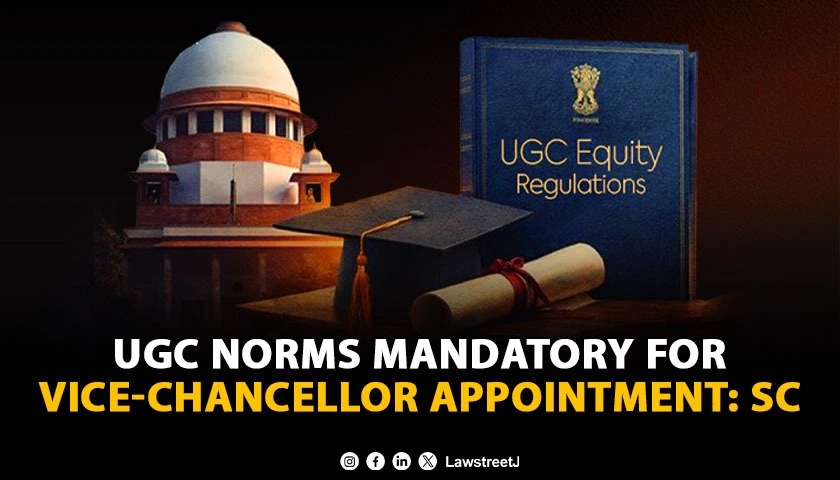
New Delhi: The Supreme Court of India has held that the composition of the Search-cum-Selection Committee for appointment of a University Vice-Chancellor is part of the standards governing higher education falling within Parliament’s exclusive legislative domain under Entry 66 of List I, and that any deviation from the University Grants Commission Regulations, 2018, renders the appointment process illegal, while exercising its powers under Article 142 of the Constitution to allow the incumbent Vice-Chancellor to complete his tenure in the absence of any allegations regarding qualifications or performance.
A Bench of Justices Vikram Nath and Sandeep Mehta delivered the judgment on January 30, 2026, addressing Civil Appeals No. 54–55 of 2025 arising from Special Leave Petition (C.) No. 4593–4594 of 2024 filed by Dr. S. Mohan challenging the common judgment dated December 19, 2023, passed by the Madras High Court, which set aside his appointment as the Vice-Chancellor of Puducherry Technological University. The Court noted the factual background, stating:
“The appellant, Dr. S. Mohan, has approached this Court by way of the instant appeals with special leave under Article 136 of the Constitution of India for assailing the common judgment and order dated 19th December, 2023, passed by the High Court of Judicature at Madras in Writ Petition Nos. 28147 of 2022 and 4174 of 2023, whereby the High Court allowed the two separate writ petitions and set aside the appointment of the appellant as the Vice-Chancellor of the Puducherry Technological University.”
The Court observed the High Court’s interim relief, noting:
“However, the High Court, in order to avoid a vacuum, permitted the appellant to continue in office until a duly selected incumbent assumes charge in accordance with law or until 30th June, 2024, whichever was earlier.”
The Court also noted its own interim order, stating:
“While entertaining the special leave petitions, this Court vide order dated 26th February, 2024 issued notice and stayed the operation of the impugned judgment and order dated 19th December, 2023 and, as a consequence, the appellant continues to hold the post of the Vice-Chancellor. His tenure of five years ends in December, 2026.”
The Court examined the statutory framework, observing:
“The Legislative Assembly of the Union Territory of Puducherry, in exercise of its legislative powers under Article 246 read with the Seventh Schedule of the Constitution, enacted the Puducherry Technological University Act, 2019, which received the assent of the Hon’ble President on 31st March, 2020.”
The Court noted the composition of the Search-cum-Selection Committee under Section 14(5) of the PTU Act, which comprised “Prof. V. Ramgopal Rao, Director, Indian Institute of Technology, Delhi, as the Convenor, while Dr. V. Jagadeesh Kumar, Professor, Department of Electrical Engineering, Indian Institute of Technology, Madras, and the Secretary to Government (Higher & Technical Education), Government of Puducherry, were nominated as Members.”
Addressing the central legal challenge, the Court stated:
“It was contended before the High Court that the constitution of the Search-cum-Selection Committee for the appointment of the 1st Vice-Chancellor of the University was not in conformity with Regulation 7.3 of the UGC Regulations on Minimum Qualifications for Appointment of Teachers and other Academic Staff in Universities and Colleges and Measures for the Maintenance of Standards in Higher Education, 2018, as it did not include a nominee of the Chairman, UGC.”
The Court noted the additional challenge regarding conflict of interest, observing that the inclusion of the Secretary (Higher & Technical Education), Government of Puducherry, in the Search-cum-Selection Committee contravened the same Regulation, since he was connected with the University in the capacity of Pro-Chancellor and had earlier served as a member of the Governing Body of the erstwhile Puducherry Engineering College, thereby giving rise to a conflict of interest.
Addressing the constitutional framework, the Court stated:
“The scheme of legislative distribution under the Constitution is delineated in Article 246 read with the Seventh Schedule. Parliament is vested with the power to legislate on matters enumerated in List I of the Seventh Schedule, whereas the State Legislatures are competent to enact laws on subjects falling within List II.”
The Court examined Entry 25 of List III, which provides for “Education, including technical education, medical education and universities, subject to the provisions of entries 63, 64, 65 and 66 of List I,” and emphasized Entry 66 of List I, which deals with “Co-ordination and determination of standards in institutions for higher education or research and scientific and technical institutions.”
Analyzing legislative competence, the Court held:
“This Court in Dr. Preeti Srivastava (supra) held that both the Union and the States have legislative competence over education, including medical education, subject to Entry 66 of List I, which exclusively vests Parliament with the power to determine standards in higher education. While the State may regulate education so long as the field is unoccupied, it cannot, in doing so, impinge upon or dilute the standards prescribed by the Union under Entry 66 of List I.”
On the source of the UGC Regulations, the Court stated:
“The UGC Regulations, 2018 trace their source to Entry 66 of List I, inasmuch as the said Regulations have been framed by the UGC in exercise of the powers conferred under Section 26(1)(e) and 26(1)(g) read with Section 14 of the UGC Act, which itself has been enacted by Parliament in exercise of its exclusive legislative competence under Entry 66 of List I of the Constitution.”
The Court held unequivocally:
“On that anvil, the PTU Act was required to operate in strict conformity with Regulation 7.3 of the UGC Regulations, 2018, which lays down a mandatory framework for appointment of a Vice-Chancellor and, inter alia, stipulates that the Search-cum-Selection Committee must necessarily include one nominee of the Chairman, UGC.”
Finding a critical deviation, the Court stated:
“In the present case, it is undisputed that the Search-cum-Selection Committee was constituted without the inclusion of the nominee of the Chairman, UGC, in clear disregard of Regulation 7.3 of the UGC Regulations, 2018. Consequently, Section 14(5) of the PTU Act, to the extent it prescribes a composition of the Search-cum-Selection Committee contrary to the mandate of the UGC Regulations, 2018, has to be declared ultra vires the UGC Regulations, 2018.”
The Court also addressed the conflict of interest issue, observing:
“Regulation 7.3(ii) of the UGC Regulations, 2018 mandates that members of the Search-cum-Selection Committee shall not be connected in any manner with the concerned University or its affiliated colleges. However, the proviso to Section 14(5) of the PTU Act includes the Secretary to the Government (Higher & Technical Education) as a member of the Search-cum-Selection Committee for appointment of the 1st Vice-Chancellor.”
Emphasizing the binding nature of the UGC Regulations, the Court cited Gambhirdan K. Gadhvi v. State of Gujarat, stating:
“This Court held that the UGC Regulations, being subordinate legislation framed under the UGC Act and laid before Parliament as statutorily mandated, form an integral part of the Central enactment and that any appointment made in derogation thereof amounts to a violation of statutory provisions and is consequently unsustainable in law, warranting judicial interference.”
On the question of repugnancy, the Court clarified:
“The legislative provisions under consideration trace their source to different entries in the Seventh Schedule, with the UGC Act and the UGC Regulations, 2018 framed thereunder being referable to Entry 66 of List I, while the PTU Act is traceable to Entry 25 of List III. The two enactments, therefore, do not operate in the same legislative field.”
Relying on Hoechst Pharmaceuticals Ltd. v. State of Bihar, the Court emphasized:
“The doctrine of repugnancy and the provisions of Article 254 of the Constitution are attracted only when both legislations operate within the Concurrent List.”
In its final determination, the Court held:
“Upon an exhaustive examination of the material placed on record and a careful consideration of the submissions advanced by the learned counsel for the parties, we are of the considered view that the findings recorded and the conclusions arrived at by the High Court in the impugned judgment do not suffer from any legal infirmity, perversity, or jurisdictional error warranting interference by this Court.”
However, exercising its equitable jurisdiction, the Court noted:
“Having affirmed the impugned judgment insofar as it holds the constitution of the Search-cum-Selection Committee to be illegal, we are now called upon to decide as to whether the grave consequences of removal from the post of the Vice-Chancellor should befall the appellant before us.”
Recognizing the appellant’s credentials, the Court stated:
“There is not even a whisper of an allegation by the writ petitioners before the High Court impugning the qualifications, integrity or administrative acumen of the appellant, who has been continuing to administer the affairs of the University without any complaint from December, 2021.”
Exercising powers under Article 142, the Court held:
“Therefore, having regard to the peculiar facts and circumstances of the case, particularly the facts that (i) the appellant was found meritorious and was duly selected by the Search-cum-Selection Committee with due regard to his qualifications and credentials; (ii) that he has continuously and without any demur discharged the functions of the Vice-Chancellor of the University for the past four years; and (iii) that his tenure is due to expire in December, 2026, this Court is of the considered view that an immediate cessation of his tenure may result in grave stigma to the appellant and also avoidable disruption in the academic and administrative functioning of the University.”
Accordingly, the Court directed:
“We, in order to do complete justice, exercise our powers under Article 142 of the Constitution and direct that the appellant shall continue to hold the post of Vice-Chancellor till the end of his normal tenure or till a new Vice-Chancellor is selected in accordance with law, whichever is earlier.”
The Court further protected the appellant’s future prospects, stating:
“We further provide that the appellant shall be entitled to participate in the selection process, if any, undertaken for fresh selection to the post of Vice-Chancellor of the University, without being prejudiced by the impugned judgment.”
Finally, the Court kept legislative options open, stating:
“The Legislature of the Union Territory of Puducherry remains fully empowered and at liberty to take such appropriate and necessary steps, including amendment or modification of the existing statutory framework, as may be required to bring the provisions of the PTU Act in conformity with the UGC Regulations, 2018, in accordance with law.”
Case Title: Dr. S. Mohan v. The Secretary to the Chancellor, Puducherry Technological University & Ors.