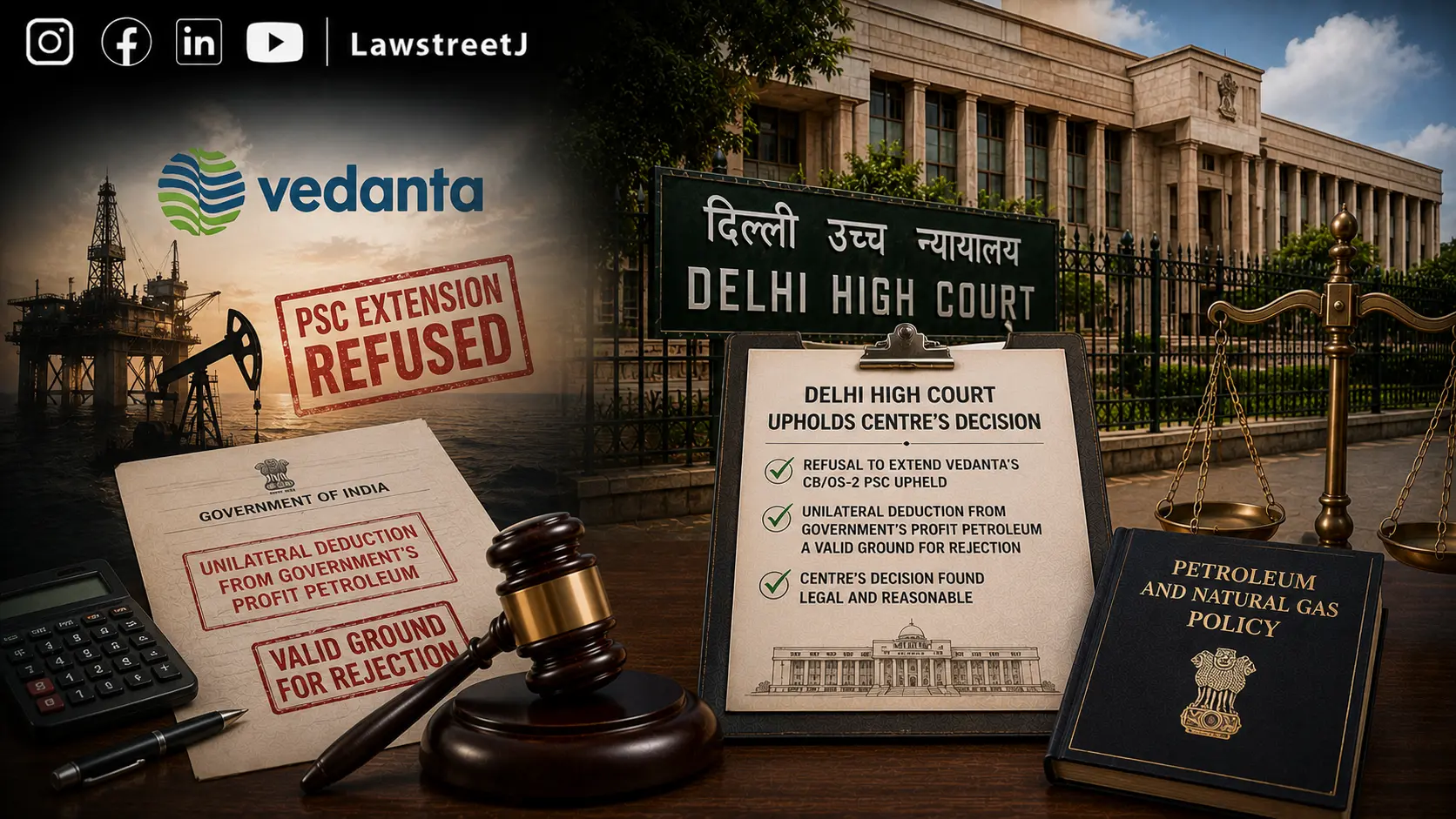
New Delhi: The Delhi HC in a single-judge bench comprising of Justice Purushaindra Kumar Kaurav has recently held that Vedanta's unilateral deduction from the Centre's share of profit petroleum was a valid ground to deny extension of the 1998 production sharing contract, and directs no interference with the government's decision to hand the block to ONGC.
Petition Dismissed After Nearly a Year of Hearings
The Delhi High Court has dismissed a writ petition filed by Vedanta Limited, through its Cairn Oil and Gas division, challenging the Ministry of Petroleum and Natural Gas's rejection of its application to extend the Production Sharing Contract for the CB/OS-2 Block off the coast of Suvali, Gujarat. Justice Purushaindra Kumar Kaurav, delivering judgment on July 22, 2026, in W.P.(C) 14738/2025, held that the Impugned Order dated September 19, 2025 rejecting the extension, along with the accompanying direction to Oil and Natural Gas Corporation to take over the block's assets and operations, did not warrant interference.
The judgment came after the matter was reserved on May 18, 2026, following hearings that stretched across multiple dates before both a predecessor Bench, which had earlier granted interim status quo in Vedanta's favour on January 6, 2026, and the present Bench, which heard the main matter through April and May 2026.
Background of the Dispute
The CB/OS-2 Block was awarded in the 1990s to Cairn Energy (India) Pvt. Ltd., predecessor of Vedanta, along with Tata Petrodyne Ltd. (now Invenire Petrodyne Ltd.) and ONGC, under a Production Sharing Contract signed on June 30, 1998. The contract, originally for 25 years, carried a further extendable period linked to commercial production of Non-Associated Natural Gas. Two significant discoveries, the Gauri and Lakshmi gas fields, were made within the block in 2000.
The Contractor Parties applied on June 28, 2021 for a 10-year extension of the PSC under the Ministry's 2017 Extension Policy, which governs 10 pre-NELP blocks including CB/OS-2. While the application remained pending, the original PSC term expired on June 29, 2023, and the petitioner continued operations under five successive interim extensions, the last of which lapsed on September 29, 2024. The Impugned Order rejecting the extension was passed nearly a year later, on September 19, 2025, prompting the petition three days afterward.
The Excise Duty Dispute at the Heart of the Rejection
The Court's decision turned substantially on conduct unconnected to the extension application itself. In June 2022, the Government imposed a Special Additional Excise Duty on crude petroleum production. Vedanta proposed adjusting its SAED liability against the Government's share of Profit Petroleum under the PSC, relying on Article 16.7 of the contract, which allows for revisions where a change in Indian law materially affects a party's expected economic benefits. The Ministry rejected this proposal in categorical terms in September 2022, calling the reliance on Article 16.7 "untenable and contrary to the terms of the PSC."
Despite this, Vedanta went ahead and deducted the disputed amount, roughly USD 9.33 to 10.13 million, from the Centre's share of Profit Petroleum across multiple quarters between 2022 and 2024. The Directorate General of Hydrocarbons flagged this as a serious breach in January 2025 and called for repayment within seven days. Vedanta remitted the deducted amount, without interest, only on September 12, 2025, a week before the rejection order was passed.
Why the Court Sided With the Government
The Court rejected the Attorney General's broader argument that judicial review has no role once a contract is in the extension stage, holding that Article 14 of the Constitution applies to State action in contractual matters throughout, including under a policy that has the force of statute. It also held that the Extension Policy must be read through the Public Trust Doctrine, since the PSC concerns natural resources vested in the Union under Article 297 of the Constitution as a trustee for the people of India.
On the central questions, the Court held that expiry of the Extension Policy's timelines does not result in an automatic extension, and that the Ministry may take into account facts arising after an application is filed, including Vedanta's own conduct in updating its field development plan post-application. It further held that Clause 5 of the Extension Policy, which lists technical grounds for rejection, is not the only source of the Government's power to reject an application. Clause 9(b), a residuary provision allowing the Government to decline extension "without assigning any reason," was found to support a wider set of grounds, including an applicant's conduct.
On the SAED deduction itself, the Court found it to be a unilateral and not bona fide act, since Vedanta had effectively acted "as a judge, jury and executioner in its own case" by assuming a material change in law and adjusting the Government's share without any prior adjudication under Article 16.7 or resort to the PSC's dispute resolution mechanism. Since the petitioner was handling a public resource on India's behalf, this conduct was held to be a valid, independent ground for rejecting the extension, regardless of the fact that the amount was eventually repaid.
The Court also rejected Vedanta's arguments on legitimate expectation and on a 2021 DGH communication that Vedanta claimed amounted to a recommendation in its favour, holding that the interim extensions were expressly stated not to reflect any decision on the merits, and that the DGH letter had in fact flagged unpaid statutory dues rather than endorsing the application.
What This Means Going Forward
With the petition dismissed, the rejection of the extension application stands, along with the Ministry's direction to ONGC to take over the block's assets and operations. The judgment is significant for how it treats a contractor's post-application conduct, particularly unilateral financial adjustments made against the Government's share of natural resource revenue, as a standalone ground capable of defeating an otherwise pending extension claim, independent of the technical evaluation criteria set out elsewhere in the policy.
Case Details
- Case Title: Vedanta Limited v. Union of India and Ors.
- Case Number: W.P.(C) 14738/2025, with CM Appl. 60479/2025, CM Appl. 60480/2025, CM Appl. 77491/2025 and CM Appl. 18128/2026
- Court and Bench: Delhi High Court, Justice Purushaindra Kumar Kaurav
- Date Reserved / Pronounced: May 18, 2026 / July 22, 2026
- Petitioner's Counsel: Mr. Jayant K. Mehta, Senior Advocate, with Ms. Anuradha Dutt, Mr. Anish Kapur, Ms. Nikhita K. Suri, Ms. Suman Yadav, Mr. Gurudas Khurana and Mr. Raghav Dutt
- Respondents' Counsel: Mr. R. Venkatramani, Attorney General for India, with counsel for the Union of India, MoPNG, DGH, ONGC and Invenire Petrodyne Ltd.
- Key Precedents Relied On: Shreelekha Vidyarthi v. State of U.P., (1991) 1 SCC 212; Food Corporation of India v. Kamdhenu Cattle Feed Industries, (1993) 1 SCC 71; MP Power Management Company Ltd. v. Sky Power Southeast Solar India Pvt. Ltd., (2023) 2 SCC 703; Bharti Airtel Limited v. Union of India, (2015) 12 SCC 1; Reliance Natural Resources Ltd. v. Reliance Industries Ltd., (2010) 7 SCC 1; Union of India v. Vedanta Ltd., LPA 346/2018; State of Tamil Nadu v. Hind Stone, (1981) 2 SCC 205
- Relief Granted: Petition dismissed; rejection of PSC extension application and direction to ONGC to take over the CB/OS-2 Block upheld

![Delhi High Court Sets Aside Arbitral Tribunal's Award Against NHAI in Highway Project Delay Case [Read Judgment]](/secure/uploads/2023/07/lj_9605_23374c2e-392c-4491-a2fe-f2f12fc5272f.jpg)
![Delhi Court Rejects Stay Request in Defamation Case Against Rajasthan CM Ashok Gehlot [Read Order]](/secure/uploads/2023/08/lj_5208_80de1ddc-d76a-4f7f-b180-408e3ae14fb4.jpg)