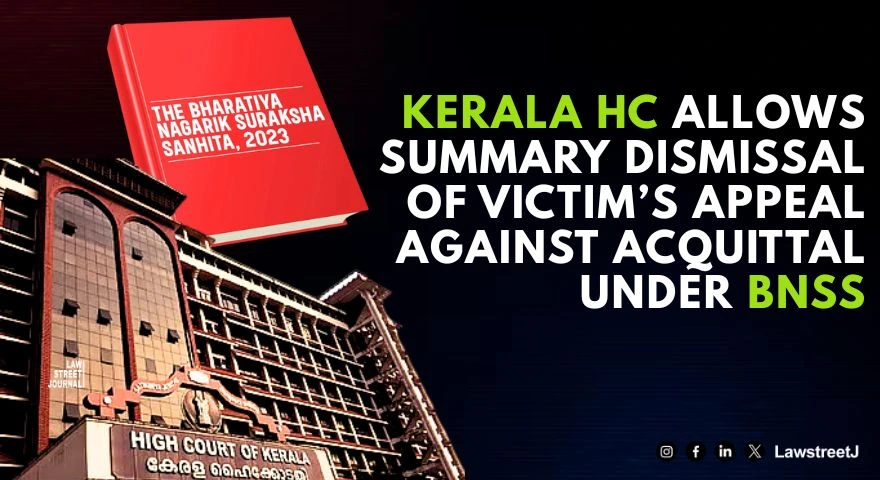
Kerala: The Kerala High Court has held that a victim’s appeal against an acquittal under the proviso to Section 413 of the Bharatiya Nagarik Suraksha Sanhita, 2023 (BNSS) can be summarily dismissed when there is no prima facie material to show that the victim has an arguable case. The Court applied, mutatis mutandis, the provision for summary dismissal under Section 425 of the BNSS.
A Division Bench comprising Justice Dr. A.K. Jayasankaran Nambiar and Justice Jobin Sebastian summarily dismissed the victim’s appeal challenging the acquittal of the accused in a rape case, holding that the trial court’s view could not be said to be perverse, illegal, or grossly unjust.
The case arose from allegations that on December 3, 2018, at approximately 8:30 p.m., while the victim (PW1), a member of a Scheduled Caste/Scheduled Tribe community, was waiting for her husband in front of a house, the accused—belonging to a non-SC/ST community—dragged her to a rocky place and committed rape, knowing that she belonged to an SC/ST community. It was further alleged that after the offence, the accused threatened to kill her if she disclosed the incident.
The Sessions Court, Kasaragod, acquitted the accused in S.C. No. 257 of 2019. The victim thereafter filed an appeal under the proviso to Section 413 of the BNSS, challenging the acquittal judgment dated July 8, 2025.
When the appeal came up for admission on December 11, 2025, the Court expressed doubt as to whether the appeal required admission or was liable to be summarily dismissed. After hearing counsel for both parties and perusing the impugned judgment and the appeal memorandum, the Court proceeded to examine the matter in detail.
Justice Jobin Sebastian, authoring the judgment, articulated important principles governing the admission of victims’ appeals against acquittal. The Court observed that while the right of a victim to file an appeal is a statutory right—and such appeals ordinarily merit admission if there is at least a prima facie arguable case, particularly in sexual offence cases—the Court must also consider the inconvenience and stigma caused to the accused until the appeal is finally decided.
The Court observed:
“After having secured an order of acquittal, if an appeal is admitted casually and notice is issued to the accused, such proceedings may hang as a ‘Damocles’ sword’ over his head until the appeal is concluded.”
The Court acknowledged that allegations in such cases can have a drastic impact on the accused’s family life, social standing, and even the future of his children.
It further recognized that allegations of sexual offences are sometimes raised with the intention of effecting out-of-court settlements or extracting money under the guise of compromise. At the same time, it acknowledged instances where accused persons are acquitted due to improper appreciation of evidence. Therefore, the Court held that while a victim-centric approach must ordinarily be adopted, bearing in mind the vulnerability of victims, “where there is not even prima facie material to take a view different from the view already taken by the trial court while acquitting the accused, the appeal is liable to be summarily dismissed.”
The Court elaborated on the legal yardsticks applicable to appeals against acquittal, noting that they differ from those applicable to appeals against conviction. Ordinarily, an appellate court would not interfere with an acquittal unless it is demonstrated that the trial court’s view is perverse, manifestly illegal, or grossly unjust, and that the only possible conclusion based on the evidence was that the accused was guilty.
Citing Sanwat Singh v. State of Rajasthan (AIR 1961 SC 715), K. Gopal Reddy v. State of Andhra Pradesh (1979) 1 SCC 355, and Chandrappa v. State of Karnataka (2007) 4 SCC 415, the Court held that if two views are possible on the evidence and the trial court has taken one view leading to acquittal, the appellate court would generally refrain from substituting its own view merely because it might have arrived at a different conclusion.
However, the Court clarified that this does not mean that an appellate court cannot reverse an erroneous acquittal. Where appreciation of evidence is patently erroneous or perverse, or runs contrary to settled principles of law, and where the evidence clearly establishes guilt leaving no room for any other plausible conclusion, the appellate court can reverse the acquittal.
Applying these principles to the present case, the Court found that the sole evidence relied upon by the prosecution was the testimony of PW1, the alleged survivor. The trial court had found that her solitary testimony was neither convincing nor trustworthy and could not form the basis for conviction, assigning several reasons for this conclusion.
The Court noted that according to PW1’s testimony, when the accused allegedly dragged her away from the front of a house where her husband and son were present inside, she did not raise any alarm. Immediately after the alleged incident, she met her husband, who inquired about her whereabouts, but she failed to disclose the incident. Her silence led her husband to assault her in a public place and instruct her not to return home until she disclosed the truth—yet even then, she did not reveal the incident.
The Court held:
“We are also of the view that the fact that even then PW1 did not disclose the incident to her husband is a serious circumstance which favours the case of the accused that PW1 was a consenting party to the alleged coitus.”
While PW1 explained in response to a court query that she did not raise an alarm because she was gagged by the accused, the trial court found this explanation unbelievable as it was offered only during trial.
The Court also affirmed the trial court’s finding regarding the long delay in reporting the matter to the police. While acknowledging that delay in lodging an FIR in sexual offence cases is generally not treated as fatal due to concerns regarding married life, children’s future, and family stigma, the Court noted specific circumstances in the present case.
PW1 explained the delay by stating that the accused threatened to kill her if she disclosed the incident. However, the trial court found that in her statement recorded under Section 164 of the CrPC before the Magistrate, PW1 had stated that the accused threatened to commit suicide if she disclosed the matter. The Court held that, in the specific facts and circumstances of the case, it found no reason to disagree with the trial court’s conclusion that the delay in lodging the FIR was fatal.
The Court also noted that PW1 was “a mature, married woman with two children,” which was relevant in assessing the explanation for delay.
Further, the Court affirmed the trial court’s finding that despite allegations of the accused dragging the victim to a rocky area and committing rape, there was no evidence of physical injury on the victim, nor any tear or damage to her clothing. The Court held that the absence of such damage, particularly given the alleged location of the offence, raised serious doubt about the prosecution’s version of forceful sexual intercourse.
The Court concluded that the trial court had assigned sufficient reasons for acquitting the accused and that even upon re-appreciation of evidence, the view taken could not be said to be patently erroneous, perverse, or contrary to settled principles of law.
On the procedural issue, the Court held that although the BNSS does not expressly provide for summary dismissal of a victim’s appeal against acquittal, Section 425 BNSS applies mutatis mutandis to such appeals filed under the proviso to Section 413 BNSS.
Finding no prima facie material to show that the victim had an arguable case, the Court dismissed the appeal in limine.
Case Title: [Victim’s name withheld] v. Gopalan K.T. & State of Kerala



![Kerala HC Quashes 498A Dowry Harassment Case Against Live-In Partner, Citing Lack of Relative Status [Read Order]](/secure/uploads/2023/08/lj_5693_1057c042-1e57-4e27-8c9e-25af0ec38ec4.jpg)
![Watching porn on mobile: Kerala HC highlights importance of mother cooked meals, outdoor sports [Read Order]](/secure/uploads/2023/09/lj_9155_Parental_supervision_of_mobile_phone_usage.jpg)
![Lakshadweep MP Mohammed Faizal Disqualified from Lok Sabha After Conviction Suspension Plea Rejected by Kerala High Court [Read Notice]](/secure/uploads/2023/10/lj_9640_87b5fd97-0e05-4ff8-9a99-3be1e4446192.jpg)