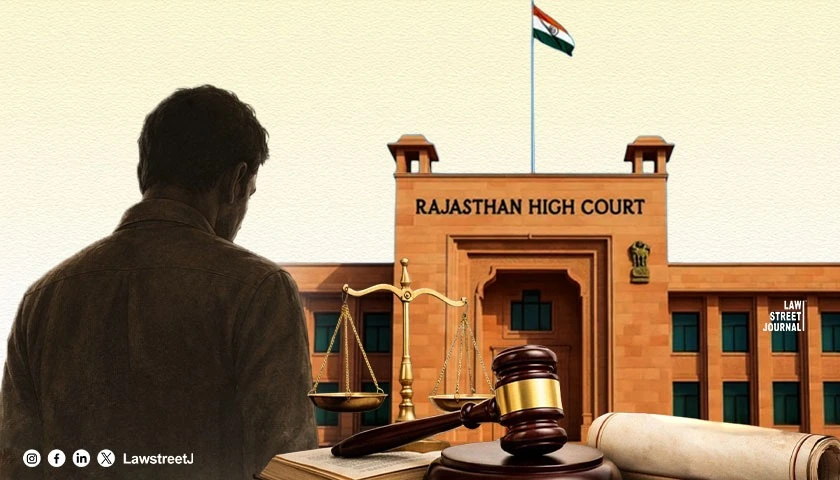
The Rajasthan High Court has held that the legal heirs and representatives of a deceased victim-complainant fall within the definition of ‘victim’ under Section 2(wa) of the Code of Criminal Procedure (CrPC) and are entitled to continue an appeal filed by the deceased victim against an order of acquittal, and that such appeal does not abate merely on account of the victim’s death during its pendency.
Justice Anoop Kumar Dhand pronounced the order on April 18, 2026 in Smt. Shimla Sharma (Legal Heirs) v. State of Rajasthan & Ors. [S.B. Criminal Miscellaneous (Petition) No. 111/2014], quashing an order of abatement passed by the Additional District & Sessions Judge No. 8, Jaipur Metropolitan and restoring the appeal to its original number. In a significant parting observation, the Court held that the legislature’s failure to amend the proviso to Section 394 CrPC while conferring appeal rights on victims through the 2008 amendment is “discriminatory” and amounts to a violation of Article 14 of the Constitution of India, and directed that a copy of the order be sent to the Law Commission of India for recommending necessary legislative amendment.
Background
Smt. Shimla Sharma had filed a criminal complaint alleging that after the death of her grandfather Shri Govind Narayan in 1974, the accused-respondents, in collusion with the Sarpanch of the Gram Panchayat and revenue officers, fraudulently opened mutation of his land bearing Khasra No. 102 (measuring 1 Beegha 5 Bisva) in their own names by falsely representing that Govind Narayan had died issueless, whereas her father Dhanna Lal Sharma was his son and lawful legal representative.
On the basis of the complaint, FIR No. 22/2011 was registered at Police Station Kanota, District Jaipur Rural. After investigation and trial before the Court of Metropolitan Magistrate No. 24, Bassi, Jaipur Metropolitan, the accused-respondents were acquitted vide judgment dated December 20, 2012 of offences under Sections 420, 467, 468, 471 and 120B IPC. Aggrieved, Smt. Shimla Sharma filed a Criminal Appeal before the Additional District & Sessions Judge No. 8, Jaipur Metropolitan.
During the pendency of the appeal, Smt. Shimla Sharma passed away on September 25, 2013. The Appellate Court abated the appeal vide order dated October 21, 2013, without bringing the legal heirs on record. Her legal heirs, husband Brijkishore Pathak (since also deceased), son Vinay Pathak, and daughters Vinita Pathak and Bulbul Pathak, challenged the order of abatement before the Rajasthan High Court in the present petition.
Rival Contentions
Counsel for the petitioners argued that under Section 2(wa) CrPC, the definition of ‘victim’ expressly includes the guardian and legal heir of the person who suffered loss or injury. Therefore, the petitioners fell within the definition of ‘victim’ and were entitled to continue the appeal filed by the deceased, which ought not to have abated. Reliance was placed on the Supreme Court’s recent ruling in Khem Singh (D) Through LRs v. State of Uttarakhand [2025 SCC OnLine SC 1778].
Counsel for the accused raised a maintainability objection, contending that the impugned abatement order was a final and revisable order against which only a Revision Petition lay, making the present miscellaneous petition not maintainable. On merits, it was argued that the proviso to Section 394 CrPC, which permits near relatives of a deceased accused-appellant to continue the appeal with leave of the court, applies only where the accused-appellant dies. No corresponding provision enables legal representatives of a deceased complainant-appellant to continue an appeal against acquittal. Since the legislature had not amended Section 394 CrPC when it introduced the expanded definition of ‘victim’ in 2008-09, the appeal of a victim-appellant must necessarily abate on the victim’s death. Reliance was placed on judgments of the Punjab & Haryana High Court in Avtar Singh Dhesi v. Ajaib Singh @ Jabba [2015 SCC OnLine P&H 10017] and the Allahabad High Court in Prithvi Singh v. State of U.P. [2022 SCC OnLine All 1253].
Court’s Analysis And Reasoning
On The Scope Of Section 2(wa) And The Proviso To Section 372 CrPC
The Court held that Section 2(wa) CrPC “thoughtfully accorded an expansive understanding to the term ‘victim’ and not a narrow or restricted meaning.” The proviso to Section 372 confers upon the victim an unambiguous right to prefer an appeal against any order of acquittal, conviction for a lesser offence, or imposition of inadequate compensation. Since the definition of ‘victim’ expressly includes the legal heir of the victim, legal heirs are entitled to exercise this right.
The Court extensively relied on the Supreme Court’s constitution bench judgment in Mallikarjun Kodagali v. State of Karnataka [(2019) 2 SCC 752], which had held that the proviso to Section 372 CrPC must be given a “realistic, liberal, progressive and beneficial” meaning in favour of the victim, drawing support from the United Nations Declaration of Basic Principles of Justice for Victims of Crime (1985). It also relied on Mahabir v. State of Haryana [2025 SCC OnLine SC 184], in which the Supreme Court had held that the proviso to Section 372 is a substantive enactment creating a right in favour of victims, not merely a procedural exception.
On Section 394 CrPC And The Khem Singh Ruling
The Court then examined the key question of whether Section 394(2) CrPC, which provides that every appeal other than one under Sections 377 or 378 shall “finally abate on the death of the appellant”, operates to abate a victim’s appeal. Relying on the Supreme Court’s recent decision in Khem Singh (D) Through LRs v. State of Uttarakhand [2025 SCC OnLine SC 1778], the Court held that the expression “every other appeal” in Section 394(2) relates to an appeal against a conviction (such as under Section 374 CrPC) filed by an accused, and not to an appeal filed by a victim. The Supreme Court had reasoned in Khem Singh that Sections 377 and 378 deal with appeals against the accused, and therefore when the accused dies, those appeals abate. The “every other appeal” category therefore refers to conviction appeals by accused persons, not victim appeals. The Court quoted the Supreme Court’s reasoning:
“If the same logic is to apply to the proviso to Section 372 CrPC, it would imply that the heirs of a victim can also pursue an appeal filed under that provision as the definition of victim under Section 2(wa) includes the heir of a victim. The expression ‘prefer an appeal’ in proviso to Section 372 CrPC has to be given an expanded meaning to include prosecution of an appeal or effectively pursue an appeal.”
The Court also relied on the Supreme Court’s rulings in Shri Balasaheb K. Thackerey v. Shri Venkat @ Babru [AIRONLINE 2006 SC 316] and Jimmy Jahangir Madan v. Bolly Cariyappa Hindley (Dead) by LRs [(2004) 12 SCC 509] — which had held that the heir of a deceased complainant can be permitted to continue the prosecution — to reinforce its conclusion.
The Legislative Gap And Article 14
In a significant parting observation, the Court expressed its concern that while the legislature introduced the expanded definition of ‘victim’ under Section 2(wa) and the right of appeal under the proviso to Section 372 CrPC through the Code of Criminal Procedure (Amendment) Act, 2008, it failed to correspondingly amend the proviso to Section 394 CrPC. Under the existing proviso to Section 394, near relatives of a deceased accused-appellant may apply for leave to continue his appeal, and if such leave is granted, the appeal does not abate. However, no equivalent right has been conferred on legal representatives or near relatives of a deceased victim-appellant to apply for leave to continue the victim’s appeal against acquittal. The Court observed:
“The victim’s family members/legal heirs must have the same rights to save the victim’s family’s honour. But no such right has been granted by the legislature to the near relatives/legal heirs of the deceased-victim to continue the appeal after his/her death. Such an act of the legislature is discriminatory and it is creating a differentiation between two equals and the same amounts to utter violation of Article 14 of the Constitution of India.”
The Order
The Court quashed and set aside the impugned order dated October 21, 2013 abating the appeal, and directed restoration of the appeal to its original number. The petitioners, legal heirs of the deceased Smt. Shimla Sharma, were permitted to file an application seeking leave to continue the appeal before the Appellate Court. The Appellate Court was directed to hear and decide the leave application on its merits strictly in accordance with law, after hearing both sides. The parties were directed to appear before the Appellate Court on May 20, 2026.
The Court further directed that a copy of the order be sent to the Law Commission of India, New Delhi to consider and recommend to the legislature the carrying out of necessary amendments to the proviso attached to Section 394 CrPC, so as to confer upon legal heirs of deceased victim-appellants the right to continue appeals in the event of their death.
Case Details
Case Title: Smt. Shimla Sharma (Legal Heirs) v. State of Rajasthan & Ors.
Case Number: S.B. Criminal Miscellaneous (Petition) No. 111/2014
Court: High Court of Judicature for Rajasthan, Bench at Jaipur
Judge: Justice Anoop Kumar Dhand
Date of Pronouncement: April 18, 2026
Petitioners’ Counsel: Mr. H.C. Ganeshia with Mr. M.L. Sharma
Respondents’ Counsel: Mr. Narendra Singh Dhakar (PP), Mr. Abhishek Parashar

![Women cant be denied job for not being married: Rajasthan High Court [Read Judgment]](/secure/uploads/2023/09/lj_8336_fbfe7a8f-f672-4a69-86ba-ba50c8f28544.jpg)
![Rajasthan HC denies anticipatory bail in land forgery case, cites serious charges and witness threats [Read Order]](/secure/uploads/2024/06/lj_9981_901a6837-881e-4463-8b00-9ec7461a379e.webp)
![In process of bringing in legislation to control illegal conversion, Rajasthan government tells SC [Read Affidavit]](/secure/uploads/2024/06/lj_7804_4d18824f-bf38-4bec-94a9-c9886787ad92.webp)
![Rajasthan HC slams govt over 16-Year delay in AIIMS Jodhpur Projects, Warns of Rs. 50 Crore Penalty [Read Order]](/secure/uploads/2024/12/lj_9853_Rajasthan_HC_slams_govt_for_16_year_delay_in_AIIMS_Jodhpur_Project.jpg)