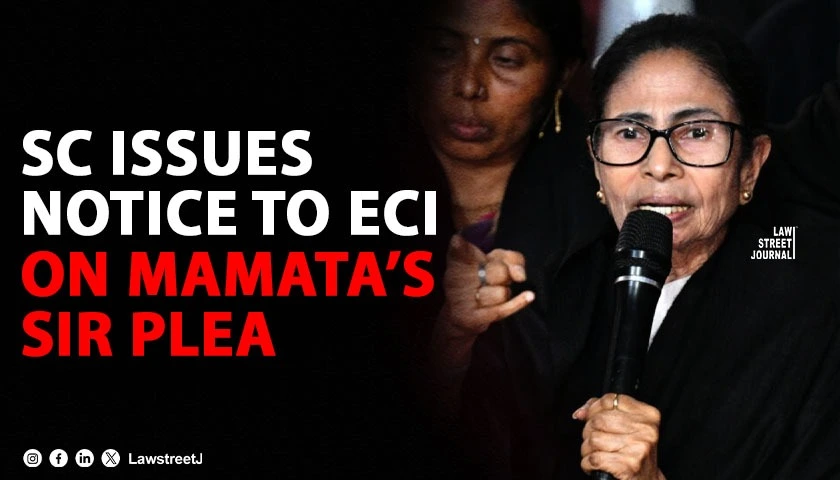
New Delhi: In an unprecedented constitutional moment, Mamata Banerjee, Chief Minister of West Bengal, appeared in person before the Supreme Court of India on Tuesday to challenge the Special Intensive Revision (SIR) of electoral rolls being conducted by the Election Commission of India in the State.
Appearing before a Bench led by Chief Justice of India Surya Kant, she sought a complete scrapping of the SIR process in West Bengal, alleging that it was arbitrary, discriminatory, and constitutionally infirm.
During her submissions, the Chief Minister repeatedly questioned the selective targeting of West Bengal, pointedly asking why similar intensive exercises were not being undertaken in Assam or other northeastern States ahead of elections. “Why only Bengal? Why not Assam?” she asked, calling the exercise politically motivated and unfair.
Banerjee contended that the SIR, which uses a 2002 electoral roll as its baseline, was “unplanned, ill-prepared, and ad hoc,” and geared more towards mass deletion of voters than genuine verification. She warned that the exercise posed a serious risk of mass disenfranchisement just months before the 2026 Assembly elections, striking at the very foundations of democratic participation.
She further alleged that West Bengal was being subjected to stricter standards than other States, despite earlier judicial observations that Aadhaar could be accepted as proof of identity. According to her, voters in Bengal were facing disproportionate procedural hurdles, while residents of other States were allowed to rely on documents such as domicile or caste certificates.
A major point of contention raised by the Chief Minister was the deployment of nearly 8,100 “micro-observers,” many of whom, she alleged, were drawn from BJP-ruled States. She claimed that these observers had effectively overridden the authority of statutory Electoral Registration Officers and were facilitating deletions without adequate verification. Referring to the Election Commission as a “WhatsApp Commission,” Banerjee alleged that informal instructions were being circulated through messaging platforms, bypassing established legal procedures.
She informed the Court that nearly 58 lakh voters had been marked as “declared dead” in the first phase of the revision. She also highlighted that a significant number of women were being removed from electoral rolls due to name changes following marriage, calling it a grave administrative failure.
Drawing attention to the human impact of the process, she submitted that the revision was carried out over a compressed timeline during peak agricultural and festive seasons, placing enormous strain on both voters and election officials. She alleged that the stress associated with the exercise had resulted in widespread public hardship and claimed that around 140 deaths, including those of Booth Level Officers, were linked to the intensity of the revision drive.
Senior Advocate Shyam Divan, appearing for the West Bengal government, argued that many voters had been flagged due to minor clerical issues such as spelling or transliteration differences, citing examples like “Datta” and “Dutta,” which were being treated as discrepancies warranting deletion.
After hearing the submissions, the Supreme Court issued notices to the Election Commission of India and the Chief Electoral Officer of West Bengal, directing them to file their responses by February 10.
The Bench also directed the West Bengal government to provide a list of Group B officers by Monday to assist with the verification exercise, a move that could reduce dependence on external micro-observers.
The matter has been listed for hearing on February 9, 2026.
Case Title: Mamata Banerjee v. Election Commission of India & Anr., W.P.(C) No. 129/2026