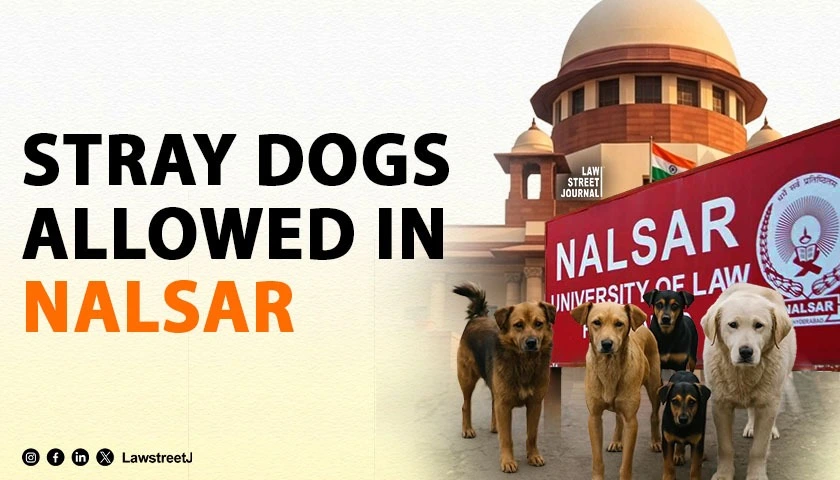
New Delhi: The Supreme Court has held that animal welfare groups and student-led bodies may maintain or feed stray dogs within educational institution campuses only on the condition that they formally undertake legal liability for any dog-bite incidents or related harm occurring on the premises. The ruling came in the judgment delivered in In Re: ‘City Hounded By Strays, Kids Pay Price’, SMW(C) No. 5/2025, by a Bench comprising Justices Vikram Nath, Sandeep Mehta, and N.V. Anjaria on May 19, 2026.
The Court held that the protection of stray dogs cannot be divorced from the responsibility to ensure human safety and made accountability a mandatory precondition for any campus-based animal welfare activity. Observing that rights claimed in favour of animals cannot operate in isolation from corresponding obligations, the Bench stated:
“The assertion of rights or interests in favour of such animals cannot operate in isolation, divorced from the corresponding responsibility to safeguard human life and safety. Insofar as the animal welfare groups or student-led bodies in educational institutions are concerned, it shall be mandatory for any such group or body operating within such campuses to expressly undertake such liability by filing an affidavit to this effect with the Head of the Institution concerned, failing which no such activity of maintaining or feeding stray dogs shall be permitted within the institutional premises.”
The Bench further warned that failure to enforce this direction would invite action against the head of the institution concerned.
The ruling arose in the context of submissions made on behalf of NALSAR University of Law, Hyderabad, which sought permission to continue its campus-based stray dog welfare initiative notwithstanding the Court’s broader directions prioritising the removal of stray dogs from educational campuses in the interest of public safety.
NALSAR submitted that it had institutionalised humane stray dog management through its Animal Law Centre, which undertakes sterilisation, vaccination, and sensitisation programmes involving students and staff under the Capture-Sterilise-Vaccinate-Release (CSVR) model. It argued that such an initiative could serve as a social experiment aligned with the Animal Birth Control Rules, 2023, while also promoting empathy towards animals.
The Court accepted the submission as a limited exception and permitted the CSVR model to continue on an experimental basis, subject to strict conditions. The Bench directed:
“In case the Animal Law Centre wishes to carry out the work in terms of the Capture-Sterilise-Vaccinate-Release (CSVR) model inside the campus of NALSAR University of Law, Hyderabad, such activity can be permitted on an experimental basis, subject to the pre-condition that the Animal Law Centre shall furnish an undertaking to the Vice Chancellor… that, in the event of any incident of stray dog bite occurring within the campus, the Animal Law Centre shall be liable to face tortious liability for the injury caused to the individual/s concerned.”
The judgment forms part of the Court’s broader ruling in the suo motu stray dog management case, in which the Bench dismissed all applications challenging its November 7, 2025 directions, upheld the Animal Welfare Board of India’s Standard Operating Procedure, directed the establishment of at least one fully functional Animal Birth Control Centre in every district, permitted euthanasia of rabid and dangerous dogs, and entrusted High Courts with continuing mandamus jurisdiction to monitor compliance.
Case Details: In Re: ‘City Hounded By Strays, Kids Pay Price’, Supreme Court of India, SMW(C) No. 5/2025. Before Justices Vikram Nath, Sandeep Mehta, and N.V. Anjaria. Judgment dated May 19, 2026.