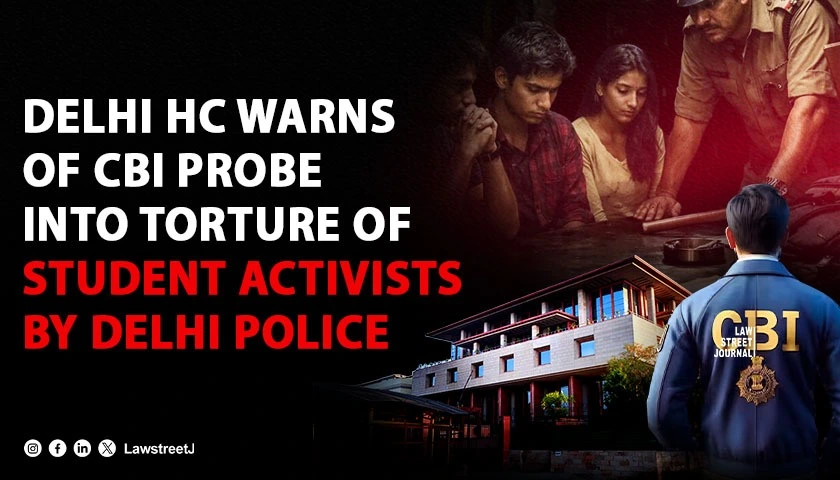
New Delhi: Expressing serious dissatisfaction with sealed cover reports, a division bench of Justices Navin Chawla and Ravinder Dudeja told the Delhi Police that it is “almost going there” on a CBI referral, and ordered the police to produce the entire case file in open court.
The Delhi High Court on Thursday warned the Delhi Police that it would refer the investigation into the alleged illegal detention and torture of student activists to the Central Bureau of Investigation, after examining sealed cover reports submitted by the police and finding them wholly unsatisfactory.
A division bench comprising Justice Navin Chawla and Justice Ravinder Dudeja, hearing habeas corpus petitions arising from the alleged detention of students and activists in March 2026, told police counsel in clear terms that their conduct so far had not inspired confidence and that the Court was not prepared to allow the matter to be brushed aside.
“We will not let it go. We might refer the investigation to the CBI now. We are almost going there. Either you tell us action has been taken or we will take action. You are forcing us to do that. We will have to say we can’t trust you with the investigation.”
— Division Bench, Delhi High Court (April 23, 2026)
The petitions relate to the alleged detention by the Delhi Police Special Cell of a group of students and activists in March 2026. The police contended that the individuals were taken in for questioning in connection with the alleged disappearance of a woman and suspicions of their support for Maoist or Naxalite ideologies. According to the police, the students were questioned and released on the same day, and the missing woman was recovered the following day, after which the students joined the investigation voluntarily.
The petitioners, however, alleged that the detention was illegal and that they were subjected to torture, sexual harassment, and wrongful confinement during their time in police custody. They further alleged that police officials subsequently threatened them over phone calls and pressured doctors not to conduct their medical examinations. The Delhi Police denied all such allegations, characterising them as “false, fabricated, and devoid of any material particulars.”
The bench made it clear that the gravity of the offence allegedly being investigated by the police—the disappearance of a woman and suspected Naxal links—could not justify non-compliance with procedural safeguards prescribed by law. The Court emphasised that the end does not justify the means, and that the Constitution’s guarantee of due process applies regardless of the seriousness of the allegations.
“When someone makes an allegation against another, will you just go and pick her up? If you had material to suspect them, there is a procedure prescribed in law that you must follow. We are not concerned with how grave the allegation was; the Constitution mandates procedure established by law.”
— Division Bench, Delhi High Court (April 23, 2026)
At an earlier stage, the Court had directed the preservation of CCTV footage from the locations from which the students were allegedly detained. It was subsequently informed that CCTV cameras at two of those locations were not functioning. On Thursday, the police submitted a sealed cover report regarding the status of CCTV cameras at the Delhi Police Special Cell office—the premises to which the students were allegedly taken. Senior Advocate Rebecca John, appearing for some of the students, argued that this footage was critical, as it could establish the duration of their detention.
After examining the sealed cover report, the bench recorded that it was not satisfied with the status report filed by the police and directed them to produce the entire case file for the Court’s examination. The matter has been listed for hearing on May 19, 2026, at 2:30 PM.
Additional Standing Counsel (Criminal) Sanjeev Bhandari, appearing for the Delhi Police, refuted the allegations of torture and denied that any threats had been made or that doctors had been pressured. He submitted that the FIR had not been shared with the accused pursuant to orders of a competent authority and assured the bench that any investigation would be conducted under the supervision of a senior officer. The bench’s response was pointed, indicating that it was not inclined to place reliance on an internal inquiry.
Case Details
- Court: Delhi High Court
- Case Type: Habeas Corpus Petitions
- Bench: Justice Navin Chawla & Justice Ravinder Dudeja
- Petitioners: Detained student activists (represented by Senior Advocate Rebecca John & others)
- Respondent: Delhi Police (represented by ASC Sanjeev Bhandari)
- Next Date of Hearing: May 19, 2026 at 2:30 PM

![Delhi High Court Sets Aside Arbitral Tribunal's Award Against NHAI in Highway Project Delay Case [Read Judgment]](/secure/uploads/2023/07/lj_9605_23374c2e-392c-4491-a2fe-f2f12fc5272f.jpg)
![Delhi Court Rejects Stay Request in Defamation Case Against Rajasthan CM Ashok Gehlot [Read Order]](/secure/uploads/2023/08/lj_5208_80de1ddc-d76a-4f7f-b180-408e3ae14fb4.jpg)