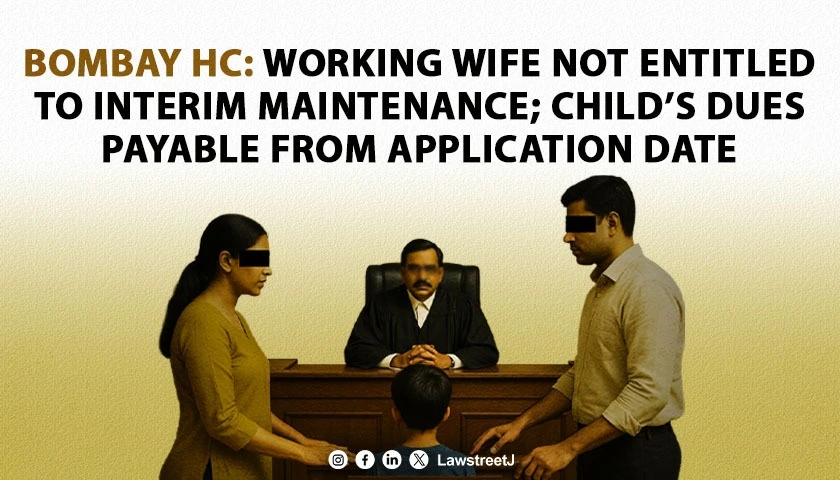
New Delhi: The Bombay High Court has held that a working wife with sufficient means to maintain herself is not entitled to interim maintenance under Section 24 of the Hindu Marriage Act, 1955. However, the Court clarified that maintenance awarded to a child must be paid from the date of application and not from the date of the order.
Justice Manjusha Deshpande delivered the decision on December 9, 2025, while partly allowing a writ petition filed by Deepti Mohan Das challenging a Family Court order that had refused maintenance to her but granted ₹15,000 per month as maintenance to her daughter from the date of the order.
The petitioner and the respondent were married on December 16, 2010, in Mumbai as per Hindu Vedic rites. A daughter, Ananya, was born on May 8, 2014. The petitioner alleged that she was subjected to extreme cruelty in the form of physical, verbal, and emotional harassment by the respondent and his family, compelling her to reside separately with her parents and minor daughter. She further alleged that the respondent once took away the minor daughter on the pretext of a summer vacation and failed to return her custody, resulting in the filing of a habeas corpus petition before the High Court, pursuant to which custody was restored to the petitioner.
The petitioner initiated divorce proceedings before the Family Court at Bandra, Mumbai, under Section 13(1)(ia) of the Hindu Marriage Act, 1955, along with an interim application under Section 24 seeking maintenance of ₹25,000 each for herself and her daughter, ₹20,000 per month towards rent, and ₹2 lakh as litigation expenses. Both parties filed affidavits of assets and liabilities along with their bank statements.
The Family Court partly allowed the application, granting relief only to the minor daughter by awarding maintenance of ₹15,000 per month from the date of the order, while refusing maintenance to the petitioner.
Challenging the order, the petitioner contended, inter alia, that maintenance should have been awarded from the date of application and not from the date of the order, relying on the Supreme Court’s judgment in Rajnesh v. Neha (2021) 2 SCC 324. She further alleged that the respondent had deliberately attempted to portray financial incapacity by taking a car loan, resigning from his job after learning about the divorce proceedings, and obtaining a top-up loan on his mortgaged property. She relied on bank statements showing regular salary credits of ₹1,28,239 from UBS Business Solutions between May 2019 and May 2021 to establish the respondent’s capacity to pay maintenance.
The petitioner also challenged the adverse inference drawn by the Family Court based on a single salary credit of ₹61,596 dated May 31, 2018, which was compared with her claimed salary of ₹43,157 in October 2010 and a salary slip of ₹32,156 for March 2022. The Family Court had observed that it was doubtful whether a salary could reduce to such an extent over a period of 12 years.
The respondent opposed the writ petition, submitting that the scope of interference under Article 227 of the Constitution is extremely limited and arises only in cases of perversity, arbitrariness, material irregularity, or patent illegality. He contended that under Section 24 of the Hindu Marriage Act, the applicant must establish lack of sufficient means for sustenance, while the non-applicant must have adequate income to maintain the applicant. He further pointed out that the petitioner had income from employment, trading, and mutual funds, demonstrating her financial independence.
The High Court held that the scope of the writ petition was confined to two issues: whether a case for interference under Article 227 was made out, and whether there was any material irregularity in the Family Court’s order.
On the issue of maintenance to the petitioner, the Court found no grounds for interference. It noted that the petitioner was employed as a Deputy Manager with Kotak Mahindra Bank, earning ₹28,032 per month, and was a well-qualified, independent woman working in a reputed organization. The Court upheld the Family Court’s conclusion that it was implausible for the petitioner’s salary of ₹43,157 in October 2010 to have reduced to ₹32,156 per month in March 2022.
The Court also rejected the petitioner’s explanation that her salary had reduced due to a change in employment, noting that a salary credit of ₹61,596 dated May 31, 2018, while working in the same organization, cast doubt on the accuracy of her other salary claims. Further, the Court observed that the petitioner’s bank statements disclosed income from mutual fund investments, dividends, and trading in shares, including an amount of approximately ₹7 lakh reflected in her ICICI Demat account, establishing that she had sufficient means to maintain herself.
With respect to the daughter’s maintenance, the Court observed that while the petitioner claimed monthly expenses of ₹43,250, no documentary evidence such as school fee receipts or stationery bills was produced. Relying on paragraph 92 of Rajnesh v. Neha, the Court held that where the wife is earning sufficiently, child-related expenses must be shared proportionately. Considering the tendency to inflate claims, the Court assessed the daughter’s actual monthly expenses at approximately ₹30,000 and held that the respondent was liable to bear half, thereby affirming the Family Court’s award of ₹15,000 per month.
The Court also declined to grant any amount towards alternate accommodation or litigation expenses, holding that the petitioner’s financial independence disentitled her from such relief.
However, on the issue of the effective date of maintenance, the Court held that the Family Court had erred in awarding maintenance from the date of the order instead of the date of application. Referring to Rajnesh v. Neha, the Court reiterated that maintenance must ordinarily be awarded from the date of application to prevent deprivation of sustenance due to prolonged litigation.
In the present case, the application was filed on July 15, 2019, while the order was passed on December 1, 2023—a gap of nearly four years. Accordingly, the High Court modified the impugned order and directed the respondent to pay interim maintenance of ₹15,000 per month to the daughter from the date of filing of the application.
Case Title: Deepti Mohan Das v. Avinash Krishnamurthy
Writ Petition No.: 3507 of 2024



![Husband Can Also Claim Alimony/Maintenance From Wife: Bombay High Court Orders Woman To Pay Alimony To Ex-Husband [Read Order]](/secure/uploads/2022/04/lj_2823_Divorce.jpg)