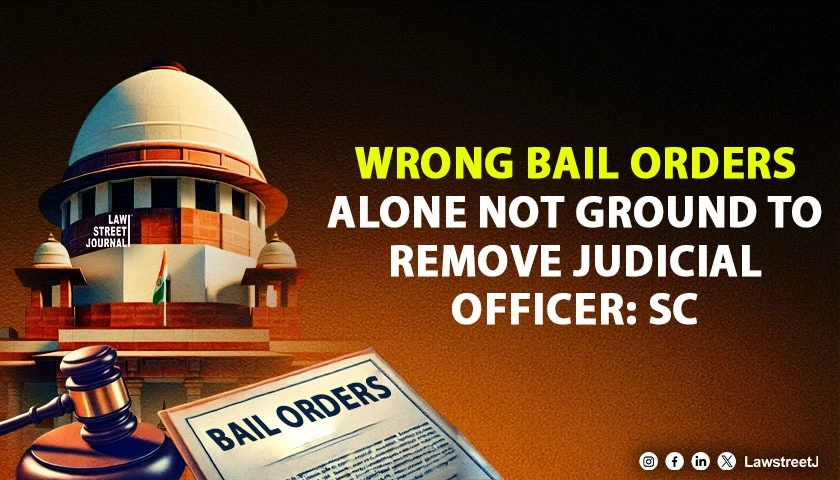
New Delhi: The Supreme Court has set aside the removal of a judicial officer with 27 years of unblemished service, holding that disciplinary action cannot be initiated merely because bail orders are wrong or fail to explicitly refer to statutory provisions, in the absence of evidence of corrupt motive, extraneous considerations, or misconduct.
A Bench comprising Justice J.B. Pardiwala and Justice K.V. Viswanathan allowed the appeal filed by Nirbhay Singh Suliya, a former Additional District & Sessions Judge from Madhya Pradesh, who was removed from service solely on the basis of four bail orders granted under the Madhya Pradesh Excise Act, 1915, without any material evidence of dishonesty or corruption.
The case arose from a complaint filed in 2011 by Jaipal Mehta alleging that Suliya was taking bribes through his stenographer, Anil Joshi, for granting bail in excise cases involving 50 bulk litres or more of liquor. However, the complaint was vague, did not cite specific bail orders, and primarily targeted the stenographer rather than the judicial officer.
Following a preliminary inquiry, departmental proceedings were initiated against Suliya on two charges. Charge-I alleged that he granted bail in four applications with “corrupt or oblique motive or for extraneous considerations,” contrary to Section 59-A of the Excise Act, which prescribes “twin conditions” for bail. These four orders were contrasted with 14 other orders where bail was rejected and Section 59-A was explicitly mentioned. Charge-II, relating to a rape case bail, was held not proved by the inquiry officer.
Critically, the Court noted several evidentiary deficiencies in the departmental proceedings. The complainant, Jaipal Mehta, was never examined as a witness. The departmental witness, Gendalal Chauhan, an executive clerk, actually testified in favour of Suliya, deposing that he never saw the stenographer Anil Joshi claiming to have connections with the judge or engaging in corrupt practices.
Most significantly, the public prosecutor K.P. Tripathi, who appeared in all 18 bail applications that were the subject matter of the charge, was examined by the defence and categorically deposed:
“I did not feel that a double standard had been adopted by the Court… In my opinion, I.e., in the capacity of Public Prosecutor, the orders granting bail were absolutely proper and on proper grounds.”
Despite this overwhelming evidence favouring Suliya, the inquiry officer held Charge-I proved, concluding that he had “deliberately violated” Section 59-A by applying “double standards in a mala fide and arbitrary manner.” Based on this, the Madhya Pradesh government removed him from service on September 2, 2014. His appeal was rejected in March 2016, and the Madhya Pradesh High Court dismissed his writ petition in July 2024.
Justice K.V. Viswanathan, authoring the lead judgment, undertook an exhaustive review of precedents establishing parameters for disciplinary action against judicial officers. The Court emphasized that while a fearless judiciary is the bedrock of the rule of law, disgruntled litigants and mischievous elements at the Bar sometimes engineer false complaints to intimidate members of the trial judiciary.
Referring to Sadhna Chaudhary v. State of U.P., the Court observed:
“There are innumerable instances of judicial officers who are liberal in granting bail… Such relief-oriented judicial approaches cannot by themselves be grounds to cast aspersions on the honesty and integrity of an officer.”
The Court noted that countless complainants are available to tarnish the judiciary’s image, “often for mere pennies or even cheap momentary popularity,” making it the duty of High Courts to extend a protective umbrella to upright judicial officers.
Citing extensively from R.R. Parekh v. High Court of Gujarat, Justice Viswanathan emphasized that inference of misconduct cannot be drawn “merely from a hypothesis that a decision is erroneous.” A wrong decision can be a bona fide error of judgment, and inadvertence is consistent with honest error. Crucially, “it is not the correctness of the verdict but the conduct of the officer which is in question.”
The Court also referred to Union of India v. K.K. Dhawan, outlining circumstances where disciplinary action may be warranted, including acting in a manner reflecting adversely on integrity, recklessness, misconduct, negligence, undue favour, or corrupt motive. However, the Court emphasized the caveat in K.K. Dhawan that for a mere technical violation, or merely because an order is wrong, disciplinary action is not warranted.
Applying these principles, the Court found the removal order fundamentally flawed on multiple grounds. The complaint lacked particulars and primarily targeted the stenographer; neither the complainant nor the stenographer was examined; witnesses supported the defence; and the four bail orders contained reasons, though Section 59-A(2) was not expressly cited.
The Court held:
“There is absolutely no material placed on record to show that there are circumstances from which inference could be drawn that extraneous considerations actuated the passing of those orders of bail.”
It further observed:
“It will be a dangerous proposition to hold that judgments and orders which do not refer expressly to statutory provisions are per se dishonest judgments.”
Rejecting the High Court’s reasoning, the Supreme Court held that while writ courts do not ordinarily act as appellate authorities over inquiry reports, they must interfere where findings are perverse or unsupported by evidence, as laid down in Yoginath D. Bagde v. State of Maharashtra.
Justice Viswanathan concluded:
“On the available material, no reasonable person would have reached the conclusion that the inquiry officer reached.”
Accordingly, the Court set aside all impugned orders, deemed Suliya to have continued in service until the age of superannuation, and awarded full back wages with consequential benefits, directing payment within eight weeks with 6% interest.
In an important administrative direction, the Court ordered that a copy of the judgment be transmitted to the Registrars General of all High Courts to bring the principles laid down to the attention of Chief Justices.
Justice J.B. Pardiwala, in a concurring judgment, highlighted the chilling effect of such proceedings on trial judges, observing that fear of administrative action is a primary reason for reluctance in granting bail, leading to an overflow of bail applications before High Courts.
Invoking the maxim Nemo Repente Fuit Turpissimus (no one becomes dishonest all of a sudden), Justice Pardiwala cautioned against branding officers of long standing as having “doubtful integrity” without cogent material.
Case Title: Nirbhay Singh Suliya v. State of Madhya Pradesh and Another