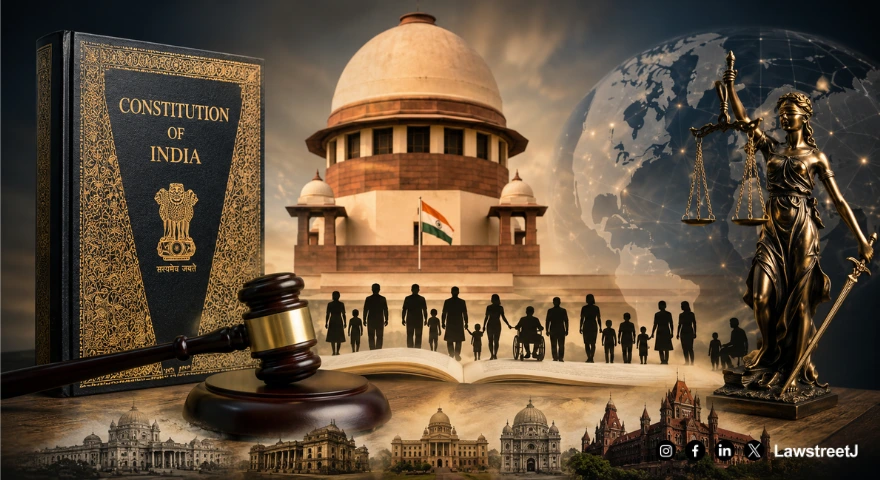
The distinction between having a constitution and practising constitutionalism lies at the heart of every modern democracy's claim to legitimacy. A constitution is merely a document; constitutionalism is the living commitment to limited government, the rule of law, separation of powers, and the protection of individual rights against the excesses of state power. India's constitutional journey, shaped substantially by the judiciary, offers a rich record of how this distinction has been tested, defended, and refined since 1950.
The Basic Structure Doctrine: India's Constitutional Anchor
No discussion of Indian constitutionalism is complete without Kesavananda Bharati v. State of Kerala (1973), decided by a thirteen-judge bench, the largest ever assembled by the Supreme Court of India. The case arose from a challenge to constitutional amendments that sought to curtail judicial review of land reform legislation. By a wafer-thin majority of seven to six, the Court held that while Parliament possesses wide powers under Article 368 to amend the Constitution, it cannot alter the document's "basic structure," a set of foundational features including democracy, federalism, secularism, judicial review, and separation of powers.
The basic structure doctrine represents perhaps the most significant judicial innovation in comparative constitutional law. It converted the Indian Constitution from a document that could theoretically be rewritten by a simple parliamentary majority into one with an entrenched core immune from amendment. This doctrine was tested and reaffirmed in Indira Nehru Gandhi v. Raj Narain (1975), where the Court struck down a constitutional amendment that sought to place the Prime Minister's election beyond judicial scrutiny, holding that free and fair elections form part of the basic structure. It was consolidated further in Minerva Mills v. Union of India (1980), which struck down amendments attempting to give Directive Principles primacy over Fundamental Rights without limit, and held that the harmony between Fundamental Rights and Directive Principles is itself part of the basic structure.
Judicial Review and the Rule of Law
The rule of law, a cornerstone of constitutionalism since Dicey, found early and forceful articulation in A.K. Gopalan v. State of Madras (1950) and its eventual course correction in Maneka Gandhi v. Union of India (1978). Gopalan had adopted a narrow, compartmentalised reading of fundamental rights, permitting deprivation of personal liberty so long as it followed "procedure established by law," regardless of the fairness of that procedure. Maneka Gandhi reversed this trajectory, holding that any procedure depriving a person of life or liberty under Article 21 must be fair, just, and reasonable, and must also satisfy Articles 14 and 19. This judgment effectively imported due process protections into the Indian Constitution through interpretation, without a formal amendment, expanding Article 21 into the wellspring for an entire jurisprudence of unenumerated rights, from privacy to dignity to a clean environment.
The doctrine of judicial review itself, though not explicitly termed as such in the constitutional text, has been read as an essential feature of the Constitution through cases including L. Chandra Kumar v. Union of India (1997), which held that the power of judicial review vested in the High Courts and Supreme Court under Articles 226 and 32 is part of the basic structure and cannot be excluded even by constitutional amendment.
Separation of Powers and Federalism
S.R. Bommai v. Union of India (1994) remains the definitive statement on the limits of executive power under Article 356, which permits the Union to impose President's Rule in states. The nine-judge bench held that the exercise of this power is subject to judicial review, and that secularism and federalism are part of the basic structure, curbing what had until then been a frequently misused tool for dismissing state governments on political grounds. The judgment strengthened the federal character of the Indian Union at a moment when the balance of power had tilted heavily toward the Centre.
Global Comparison: Constitutionalism Beyond India
India's basic structure doctrine has had notable international resonance, though its reception varies. In Bangladesh, the Supreme Court in Anwar Hossain Chowdhury v. Bangladesh (1989) explicitly adopted a version of the basic structure doctrine, drawing directly on Kesavananda Bharati, to invalidate a constitutional amendment. Pakistan's Supreme Court, in cases touching on the eighteenth and twenty-first constitutional amendments, has engaged with similar reasoning, though with less consistency. By contrast, jurisdictions such as the United Kingdom, operating under parliamentary sovereignty and an uncodified constitution, have historically resisted the notion that any judicial body can override the will of Parliament, though the UK Supreme Court's decision in R (Miller) v. The Prime Minister (2019), which held the prorogation of Parliament unlawful, signalled a growing judicial willingness to police the boundaries of executive power even without a codified basic structure to invoke.
The United States offers a different model of constitutionalism entirely, one built on Marbury v. Madison (1803), which established judicial review nearly a century and a half before Kesavananda Bharati, but without any equivalent doctrine limiting the constitutional amendment power itself under Article V. The German Constitutional Court's concept of "eternity clauses" under Article 79(3) of the Basic Law, which places human dignity, democracy, and the federal structure beyond the reach of amendment, is often cited as the closest conceptual cousin to India's basic structure doctrine, and indeed several scholars have noted that the German model may have influenced the Indian Court's reasoning in Kesavananda Bharati.
South Africa's Constitutional Court, operating under a transformative constitution adopted after apartheid, has developed a robust jurisprudence of constitutionalism centred on substantive equality and socio-economic rights, as seen in Government of the Republic of South Africa v. Grootboom (2000), which recognised a justiciable right to housing, an approach that resonates with India's own expansive reading of Article 21 to encompass socio-economic entitlements such as the right to food and shelter.
The Continuing Relevance of the Doctrine
More recent Indian jurisprudence continues to draw on this foundation. In K.S. Puttaswamy v. Union of India (2017), a nine-judge bench unanimously held that the right to privacy is a fundamental right intrinsic to life and liberty under Article 21, explicitly overruling the earlier restrictive positions taken in Gopalan and its progeny. The judgment situates itself squarely within the constitutionalist tradition of treating the Constitution as a living document whose protections evolve with societal understanding, rather than a static text frozen at the moment of its enactment.
Taken together, these cases illustrate that Indian constitutionalism has been built less through the constitutional text alone and more through sustained judicial interpretation that has repeatedly reaffirmed limits on majoritarian power, whether wielded by the executive, the legislature, or even a constitutional amending body. The comparative record suggests that while the specific doctrinal tools differ across jurisdictions, from entrenched eternity clauses in Germany to unwritten conventions in the United Kingdom, the underlying commitment to constraining state power within a framework of legality and rights remains a shared feature of mature constitutional democracies.

![Gujarat HC Sets Aside Order Forcing Minor and Mother to Attend Court Weekly for Grandfather’s Visitation [Read Judgment]](/secure/uploads/2026/03/lj_2941_Gujarat_HC_Sets_Aside.webp)
![“Unreserved PWD-LV Post Open to All Eligible Candidates Regardless of Social Category; Merit Sole Criterion: Supreme Court Sets Aside Calcutta HC Ruling [Read Judgment]](/secure/uploads/2026/04/lj_1389_Unreserved_PWD.webp)