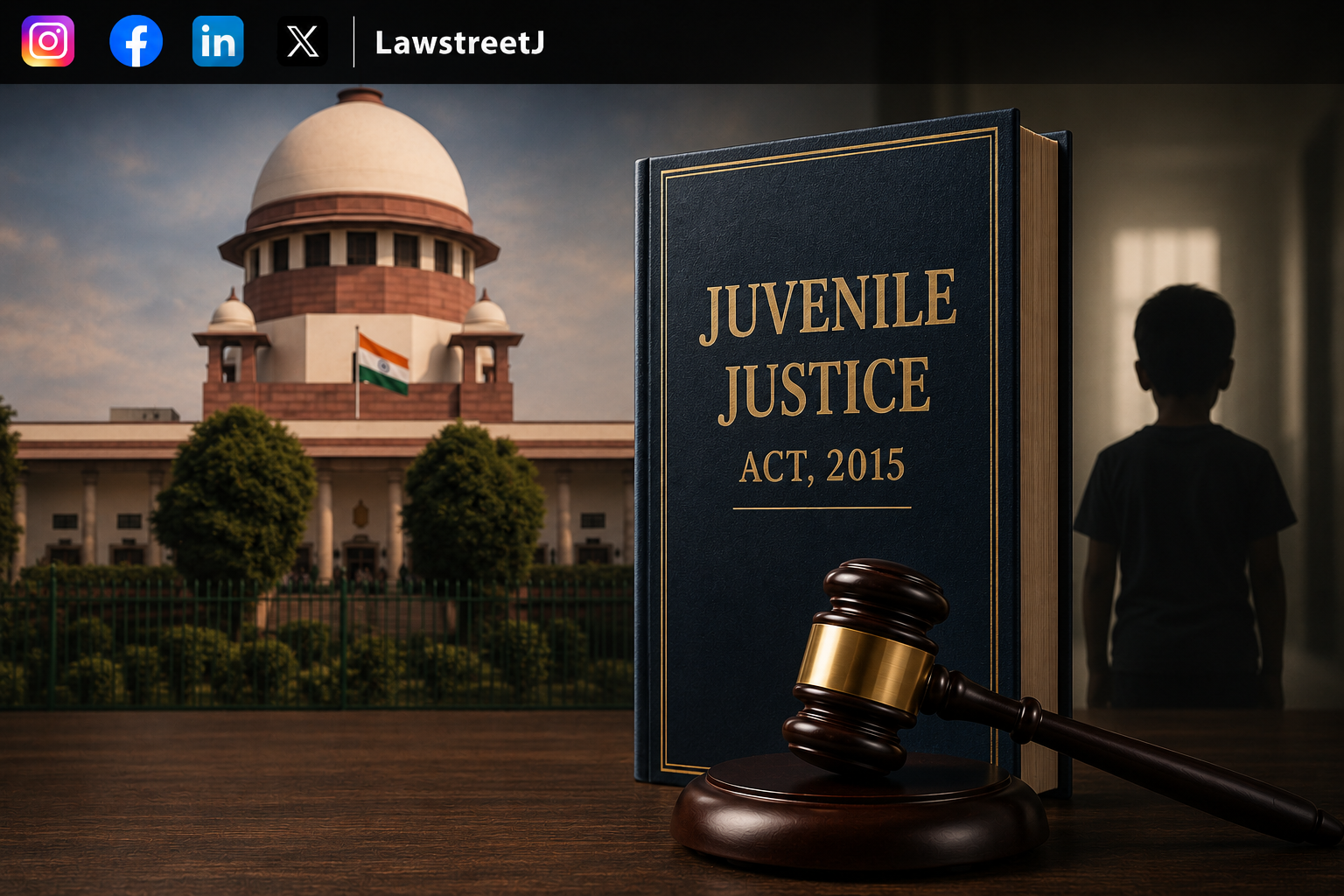
India's juvenile justice system rests on a simple but demanding premise: a child who breaks the law is still a child, and the State's first obligation is to reform and reintegrate, not to punish. Translating that premise into a working legal architecture has taken nearly four decades, three central statutes, sustained intervention by constitutional courts, and continuing oversight by human rights institutions. This article traces that architecture, its constitutional roots, its present statutory form under the Juvenile Justice (Care and Protection of Children) Act, 2015, its interface with the newly enacted Bharatiya Nyaya Sanhita, 2023, and the judicial precedents that have shaped it, before turning to the implementation gaps that continue to define the system's practical reality.
From the 1986 Act to the Rights-Based Turn of 2000
The Juvenile Justice Act, 1986 was India's first dedicated central legislation on the subject. It classified a child who committed an offence as a “delinquent juvenile” and provided for placement in special homes offering shelter, education, and vocational training, with institutionalisation intended as a last resort rather than a default response. In practice, however, the aftercare system it created struggled: chronic underfunding, a shortage of vocational and employment opportunities, poorly trained staff, weak family and community cooperation, and persistent social stigma against released juveniles all blunted the Act's rehabilitative intent.
These shortcomings, combined with growing international pressure following India's ratification of the UN Convention on the Rights of the Child in 1992, led to the Juvenile Justice (Care and Protection of Children) Act, 2000. The 2000 Act marked a deliberate shift in vocabulary and philosophy, replacing the label “juvenile delinquent” with “juvenile in conflict with law,” and widening the law's scope to also cover children in need of care and protection, including abandoned, orphaned, and runaway children. Questions of age determination arose repeatedly in litigation under this regime; courts have consistently held that no single method, whether medical examination or documentary evidence, is conclusive on its own, and that age must be assessed on the totality of available material, including school records and, where necessary, a social investigation report.
Constitutional Foundations
The legislative framework for children draws directly on the Constitution's Fundamental Rights and Directive Principles of State Policy. Article 15(3) empowers the State to make special provisions for women and children. Article 21-A makes free and compulsory education a fundamental right for children between six and fourteen. Article 23 prohibits trafficking in human beings and forced labour, and Article 24 bars the employment of children below fourteen in factories, mines, or other hazardous occupations. Among the Directive Principles, Article 39(e) and (f) direct the State to protect children from exploitation and abandonment, and to ensure that their development is not compromised by economic necessity, while Article 45 commits the State to early childhood care and education, and Article 47 to raising nutrition and public health standards. Together, these provisions supply the constitutional justification for a juvenile justice system organised around welfare and rehabilitation rather than retribution.
The Juvenile Justice (Care and Protection of Children) Act, 2015
The current governing statute, the Juvenile Justice (Care and Protection of Children) Act, 2015, was enacted to align India's law more closely with international child-rights standards and, controversially, to respond to public demand, intensified after the 2012 Delhi gang-rape case, for stricter treatment of older adolescents involved in heinous offences. Its central features include:
- A uniform threshold of eighteen years for juvenility, with a distinct pathway for 16-18 year-olds accused of heinous offences: the Juvenile Justice Board, assisted by psychologists and social workers, must assess the child's mental and physical capacity and understanding of the consequences of the act before it can decide whether the child should be tried as an adult before a Children's Court.
- Child Welfare Committees (CWCs) at the district level, which determine appropriate care and protection measures for children who are abandoned, orphaned, or otherwise vulnerable, and for whom institutionalisation is meant to be a measure of last resort.
- Special Juvenile Police Units (SJPUs) and designated child welfare police officers, trained to handle children in a manner that is non-threatening and age-appropriate from the very first point of contact with the justice system.
- Child Care Institutions (CCIs), registered and regularly inspected, tasked with education, vocational training, counselling, and psychosocial support, and legally required to keep juveniles separated from adult offenders at every stage.
- A statutory foster care and streamlined adoption framework, incorporating principles from the Hague Convention on Inter-Country Adoption, which had been absent from the 2000 Act.
The 2015 Act's “judicial waiver” provision for 16-18 year-olds in heinous cases remains its most debated feature. Child-rights advocates argued before Parliament's Standing Committee that trying any minor as an adult conflicts with both developmental science and India's obligations under the UNCRC; the government nonetheless proceeded with the provision as enacted.
The National Human Rights Commission's Oversight Role
The National Human Rights Commission (NHRC) has functioned as a standing monitor of the juvenile justice system since the 1990s, examining individual complaints and reviewing state-level implementation. In 2005, after the Patna High Court's Registrar General flagged the poor execution of the 2000 Act in Bihar, the NHRC directed a state-by-state review of juvenile justice administration and, together with a non-governmental partner, evaluated implementation across sixteen states. The exercise found implementation deficient across the board and led the NHRC to convene a National Conference on the Juvenile Justice System in New Delhi in 2007, which pressed states and union territories to eliminate case backlogs, adhere to statutory timelines, and give practical effect, not merely textual compliance, to the Act's protective provisions.
Where the Bharatiya Nyaya Sanhita, 2023 Fits In
The Bharatiya Nyaya Sanhita (BNS), 2023, which replaced the Indian Penal Code, 1860, is a general penal code, it defines offences and prescribes punishments for adults and juveniles alike, but it does not itself govern how children accused of those offences are tried. That remains the function of the Juvenile Justice Act, 2015, which operates as a special, overriding statute for anyone below eighteen years of age. In other words, the BNS may change the definition or sentencing structure of a substantive offence, such as provisions dealing with crimes against women and children, now consolidated under a dedicated chapter, but a child accused of that offence still goes before the Juvenile Justice Board, not a regular criminal court, and the 16-18 heinous-offence pathway continues to be governed by the JJ Act's own procedure and safeguards, not by the BNS.
A note on accuracy: some existing academic material in circulation describes the BNS as independently restructuring juvenile sentencing, victim compensation, and institutional accountability for children. At present, no enacted provision of the BNS specifically legislates on juvenile procedure in this way; these remain matters governed by the JJ Act, 2015 and its Model Rules, 2016, with the BNS relevant chiefly insofar as it redefines the underlying offences. Readers relying on this piece for exam or publication purposes should verify any BNS section numbers against the bare Act before citing them.
Landmark Judicial Pronouncements
Constitutional courts have done much of the work of translating juvenile justice legislation into enforceable standards, often stepping in precisely where legislative implementation faltered.
“On no account should children be kept in jail” - Supreme Court, Sheela Barse & Anr. v. Union of India (1986)
Sheela Barse & Anr. v. Union of India, (1986) 3 SCC 596, arose from a petition by journalist and social worker Sheela Barse seeking the release of children under sixteen who were detained in ordinary jails. The Supreme Court held that children accused of offences must never be lodged in jails, directed every state to establish or expand remand and observation homes, ordered district judges to inspect jails and identify illegally detained children, mandated legal aid for child detainees, and called for the establishment of dedicated Juvenile Courts staffed by specially trained magistrates in every district. The judgment remains the foundational precedent for the principle that juveniles must be institutionally and physically separated from the adult correctional system.
Vikram Deo Singh Tomar v. State of Bihar, 1988 Supp SCC 734, addressed the deplorable conditions in a protective home for women and girls in Bihar, where inmates lacked adequate food, clothing, and medical care. The Supreme Court held the State directly responsible for maintaining humane conditions in institutions housing vulnerable persons, linking the obligation to Article 21 and to India's commitments under international child-rights instruments, and directed the State to undertake immediate infrastructural and administrative improvements.
Sampurna Behrua v. Union of India, (2018) 4 SCC 433, examined the functioning of Juvenile Justice Boards and Child Welfare Committees across the country. The Supreme Court directed the Union and state governments to fill vacant CWC and JJB positions, improve infrastructure in Child Care Institutions, conduct regular and unannounced inspections, and provide sustained training to police officers, judicial members, and other juvenile justice functionaries, treating administrative capacity, rather than statutory drafting, as the binding constraint on the system's effectiveness.
Persistent Implementation Challenges
Notwithstanding this legislative and judicial architecture, the system's practical performance continues to be constrained by familiar structural problems:
- Overcrowded and under-resourced Child Care Institutions, many operating without adequate staff, counsellors, or vocational infrastructure.
- Delays before Juvenile Justice Boards, which can leave children in observation homes for extended periods awaiting adjudication, undermining the very rehabilitative purpose of the law.
- Social stigma after release, which limits education, employment, and family reintegration prospects for children who have gone through the system.
- Uneven training of police, JJB, and CWC personnel, resulting in inconsistent application of child-sensitive procedures across states.
- Weak inter-agency coordination between the JJ Act framework and related regimes such as the POCSO Act, and limited follow-up tracking of children after they exit institutional care.
These are, in large part, the same categories of failure the NHRC identified in 2007 and the Supreme Court addressed in Sampurna Behrua a decade later, evidence that the gap in India's juvenile justice system lies less in statutory design than in sustained administrative follow-through.
Conclusion
India's juvenile justice law has evolved considerably since 1986, from a narrowly framed welfare statute into a comprehensive, rights-based regime anchored in constitutional guarantees and shaped by decades of judicial intervention. Its foundational commitment, reaffirmed across the 2000 Act, the 2015 Act, and the BNS-era penal reforms, remains constant: children in conflict with law are to be reformed and reintegrated, not warehoused or punished as adults, save in the narrow and closely supervised exception carved out for heinous offences by older adolescents. The unfinished task, as courts and the NHRC have repeatedly observed, is not further legislative redesign but the consistent, adequately resourced implementation of the law that already exists, a task that will determine whether the promise of rehabilitation reaches the children the system is meant to serve.

![Juvenility plea valid even after final conviction: Supreme Court [Read Judgment]](/secure/uploads/2024/10/lj_7642_WhatsApp_Image_2024-10-14_at_5.37.07_PM.webp)
![Madras HC Validates Adoption By Grandparents With Mother’s Consent; Clarifies JJ Act Not Applicable To Hindu Adoptions [Read Order]](/secure/uploads/2025/10/lj_4741_Madras_HC_Validates_Adoption.webp)