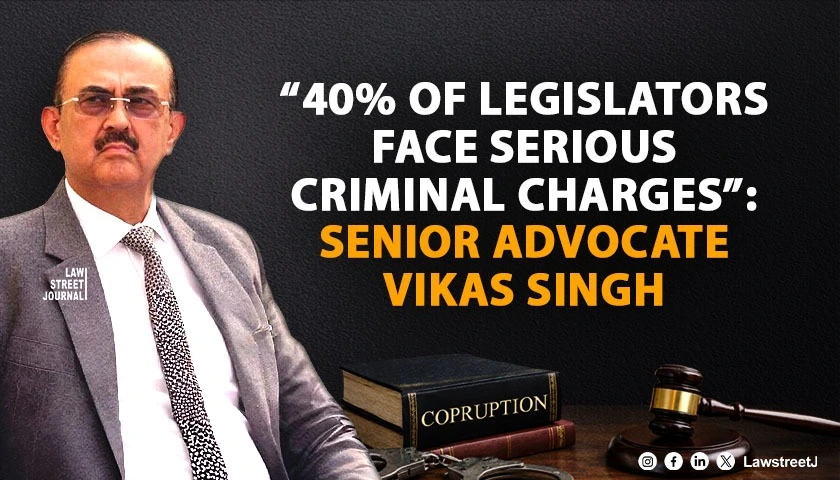
New Delhi: Senior Advocate and President of the Supreme Court Bar Association, Vikas Singh, raised fundamental concerns about the state of India’s electoral democracy while delivering a lecture on the importance of the Election Commission in the Constitution at the National Law University and Judicial Academy, Assam. He called attention to the criminalisation of politics, the unchecked role of black money in elections, and the need for structural reform in the country’s campaign finance system, arguing that the health of the Republic depends largely on the character and calibre of the legislators elected to govern the nation.
Singh opened by recalling observations made by Dr B.R. Ambedkar at the conclusion of the Constituent Assembly’s drafting process. Ambedkar had expressed two regrets. The first was that the Constitution could not be drafted in a vernacular language owing to India’s immense linguistic diversity. The second, and more relevant today, was that the Constitution did not prescribe specific qualifications or disqualifications for legislators.
Singh drew attention to a glaring asymmetry in India’s governance framework, noting that while civil servants are required to meet rigorous eligibility standards, no comparable qualifications have been mandated for lawmakers. Even being charge-sheeted in serious criminal cases disqualifies individuals from many public services, yet similar restrictions do not apply to those responsible for making the laws of the land.
Singh observed that the framers of the Constitution had hoped the electorate would naturally choose the most credible representatives. However, that optimism has not fully materialised. Today, he noted, nearly 40 per cent of legislators face serious criminal charges. When the issue of barring such candidates reached the Supreme Court, the Court indicated that eligibility criteria fall within Parliament’s legislative domain. Singh questioned, however, how Parliament could be expected to enact strict disqualification laws when a significant proportion of its own members might be directly affected by such legislation.
He also addressed the statutory framework that allows individuals convicted of serious offences to contest elections again after six years of completing their sentence, expressing hope that the Supreme Court may reconsider whether such re-entry into electoral politics aligns with constitutional morality. He pointed out that a bureaucrat convicted of corruption would be barred from public service for life, yet lawmakers enjoy comparatively lenient treatment under the existing legal framework.
Turning to the Election Commission of India, Singh examined the scope of its powers under Article 324 of the Constitution, which grants the Commission broad and sui generis authority to conduct free and fair elections. He traced the origins of the Model Code of Conduct to the 1960 Kerala elections and invoked the tenure of former Chief Election Commissioner T.N. Seshan, whose assertive enforcement of electoral norms in the 1990s transformed the Commission into a formidable constitutional institution.
He referred to the Supreme Court’s landmark judgment in Mohinder Singh Gill v. Chief Election Commissioner, which affirmed the Commission’s expansive powers while simultaneously embedding the principles of natural justice into its administrative decision-making.
Despite these constitutional safeguards, Singh lamented the Election Commission’s failure to effectively curb black money in elections. He narrated an incident from Bihar where an election aspirant candidly admitted to possessing sufficient funds, much of it unaccounted for, to secure a party ticket and contest elections. The electoral process, he observed, has become one in which black money allegedly influences both ticket allocation and campaign outcomes.
Contesting elections, even unsuccessfully, confers social recognition and political stature, incentivising wealthy individuals to enter politics for influence rather than public service. Singh argued that the Commission already possesses adequate authority to combat such practices, as all governmental machinery — including police, income tax authorities, and excise departments — comes under its supervision during elections. Yet enforcement, he suggested, has markedly weakened over time.
Singh also addressed the Supreme Court’s recent intervention striking down the electoral bonds scheme, which had permitted anonymous donations to political parties with tax exemptions. He questioned why political contributions should attract tax benefits at all, arguing that such donations are often made in anticipation of future favours. He advocated a fundamental shift towards state funding of elections, asserting that only a publicly financed system could eliminate the pervasive influence of black money from Indian politics.
He further critiqued certain voter list revision exercises, arguing that the Election Commission must not overstep into domains such as citizenship determination, which properly fall within the purview of the Home Ministry. Disenfranchising individuals who have long resided in a constituency raises profound constitutional concerns, he said, as residents who benefit from government schemes and contribute to the local economy are genuine stakeholders in governance and should not be arbitrarily excluded from the electoral process.
Concluding his remarks, Singh appealed directly to young citizens, emphasising their central role in safeguarding democratic values. Drawing parallels with youth-led movements in neighbouring countries, he urged students and young professionals to initiate a national debate on keeping corruption and criminality out of electoral politics. The sacrifices made during India’s freedom struggle, he said, demand that contemporary citizens remain vigilant in preserving the moral foundations of the Republic.
Singh’s address ultimately framed a pressing constitutional dilemma, questioning whether India’s democratic institutions can self-correct in the face of rising criminalisation and financial opacity in politics, or whether systemic reform through Parliament, the judiciary, or structural redesign of campaign finance has become an urgent necessity. The trajectory of electoral governance, he warned, will determine not only the quality of representation but the very character of India’s democracy in the decades to come.